




Writer: Jordan Sprogis


Editor: Lillian Castro


Reviewer: Cristian Lopez

Key Takeaways
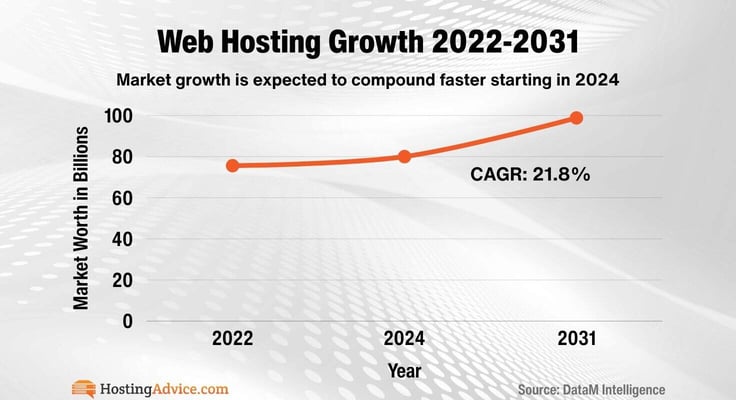
The global web hosting services market is projected to reach $98.8 billion by 2031. With a 21.8% CAGR rate between 2024 and 2031, it’s on track to nearly double in revenue every three to four years.
According to analysis from DataM Intelligence, much of the market’s growth is being driven by two forces:
- more businesses moving online or expanding their digital presence, and
- rising internet penetration on the consumer side, particularly among content creators, small businesses, and eCommerce sellers
“The market has effectively split into two major tracks: consumer hosting focused mostly on affordability and ease of use, and B2B hosting focused on performance, scalability, reliability, and ongoing operational support,” Hristo Rusev, CEO of ScalaHosting, told HostingAdvice.
Heck, maybe that’s why they call it a hosting stack: Everything gets added layer by layer. But corniness aside, Roger Williams of Kinsta points to three major phases in the web hosting industry that brought us to where we are today:
Hosting started with shared servers, which made it cheap enough for hobbyists and small sites. The VPS wave naturally came next because it gave growing users more control and better performance without the cost of dedicated hardware. And now we’re in a phase where a lot of that technical responsibility has been pushed off the user entirely.
But, Williams said, the lines are still not super clear, warning: “The ‘side hustle’ culture means a site can start on a $5 shared plan and scale into a massive enterprise application overnight.”
Are Two Lanes Better Than One?
The market is at a point where it’s forcing hosting providers to be clearer about which customers they want to serve.
This is obvious here in some areas: Take security, for example. In B2C hosting, security is typically offered as an add-on, while B2B hosting treats security like the major selling point with built-in tools and features. And there’s a simple reason for this: The consequences of security failure for B2C versus B2B are wildly different.

According to IBM’s annual Cost of a Data Breach research, the average cost of a data breach for a business runs into the millions of dollars. For enterprises, this regularly exceeds $4 million per incident. For the average Joe consumer? It’s frustrating, yes, but it’s survivable.
This seems to be where everything folds in on itself: One minute it’s “please don’t make me think about the technical details,” and the next it’s “if this doesn’t scale how I need it, I’m losing money.”
As luck would have it, the seemingly constant mergers, acquisitions, and consolidations only make that question harder to answer, says Trey Faison of InMotion Hosting.
“We are witnessing a steady deterioration of support services as web hosting becomes increasingly commodified,” he said. “As hosting firms are absorbed by larger conglomerates, the focus shifts toward lean infrastructure, pushing the burden of technical support back onto the customer, whether they are a consumer or a large business.”
If this market projection tells us anything, it’s that, while the market growth has given hosting providers more customers than ever, it’s also made it harder to say that those customers all belong in the same category.
