




Writer: Jordan Sprogis


Editor: Lillian Castro


Reviewer: Cristian Lopez

Key Takeaways
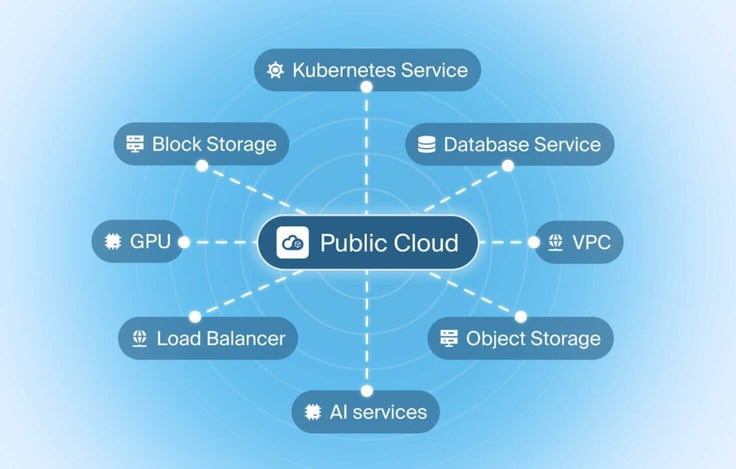
Infomaniak, the Swiss provider, just expanded its sovereign Public Cloud to include fully managed Kubernetes, managed databases, and LLM services from OpenAI.
The goal, Infomaniak said, is to offer a European alternative to U.S. hyperscalers for businesses that must comply with local GDPR/data sovereignty laws.
“This allows European companies not only to regain control over their cloud strategy, but also to drastically reduce their carbon footprint while maintaining high technical standards,” an Infomaniak spokesperson told us.
It’s apparently cheaper too, claiming to be up to 200% more cost-effective than comparable hyperscaler offerings. It also operates out of a renewable-powered data center in Geneva, Switzerland, which recovers waste heat and gives it back to more than 6,000 local homes.
An Atlantic Division
For years, Europeans have been staring down the barrel of nonstop, multiregional red tape dealing with U.S.-based megacompanies like Amazon or Microsoft.
Providers like OVHcloud and IONOS have long pitched themselves as sovereign European options. And now, Infomaniak is eagerly joining the ranks as a fully managed public cloud stack.
“Infomaniak now delivers a fully sovereign, on-demand infrastructure platform that covers the real needs of around 95% of organizations,” Infomaniak told us. “All services are designed, operated and supported exclusively from Switzerland, by a Swiss company, under Swiss law and in full compliance with European regulations.”

European businesses have eagerly been looking for alternatives to U.S. hyperscalers, especially in light of recent events. The 2018 Microsoft case raised many concerns after U.S. authorities sought access to customer data stored overseas, arguing that because Microsoft is a U.S. company, it could be required to share its personal information.
So in a period of technological dependence on non-European providers, Infomaniak said that “many organizations have realized that the continuity of their digital services now depends on infrastructures they can fully trust and control.”
The Hard Truth About Hyperscalers
Because its infrastructure is entirely based in Switzerland, Infomaniak’s Public Cloud is built around regional sovereignty.
It doesn’t offer AWS-style worldwide regions. So, for European businesses serving primarily European users, it doesn’t seem like a bad deal.
If only it were as simple as switching browsers and importing your passwords. Migrating is a months-long, expensive process.
Ask any developer who’s done it and they’ll say exactly what one Redditor said: “Moving off AWS is sooo hard.” It’s mostly because switching providers forces you to do major inventory.
“Moving off AWS essentially means starting from scratch. It seems unnecessary unless your company has an exceptional deal or is going to save millions, because otherwise this will burn a lot of $ and time,” another commenter said on r/aws.

Martial Fol, Infomaniak’s head of infrastructure, emphasized that the Public Cloud is easier to onboard and migrate to compared with hyperscalers.
“To lower the barrier to entry and accelerate migrations, we introduced fully managed services such as Kubernetes as a Service and Database as a Service,” the company told us.
Infomaniak takes care of things like luster life cycle management, security hardening, backups, updates, and scaling — instead of requiring customers to configure and maintain those components themselves.
AI Is Now Part of the Hosting Stack
As many hosting providers welcomed AI into their processes, security became a choke point.
Akamai, for example, has consistently found that organizations are building more APIs than they can securely keep track of. That means it’s harder to identify which ones are linked to it if any security incidents arise.
Forty percent of those surveyed in 2023 said they had a complete understanding of their API inventory and knew where the data was going. By 2024, that number had dropped to 27%.
It’s why Infomaniak is offering OpenAI-compatible APIs, which are run and hosted entirely in Switzerland.

The company also said that many SMEs default to easy, off-the-shelf AI tools because they’re simple to connect, but they are often hosted outside of Europe and based on scalable pricing models.
“Many companies understand that AI can improve internal efficiency or enhance the services they deliver… yet they often struggle to determine where it can generate real, measurable and sustainable benefits,” Infomaniak told us.
Basically, it can get insecure and expensive fast. And like migrating platforms, it’s yet another form of dependence that is hard to move away from.
Keeping its AI APIs in Switzerland lets Infomaniak avoid routing sensitive workloads through third-party platforms overseas, so companies can add AI directly into their own environments under the same jurisdiction as the rest of their infrastructure.
