




Writer: Jordan Sprogis


Editor: Lillian Castro


Reviewer: Cristian Lopez

Key Takeaways
For more than 20 years, making sure your website gets found meant you had to have amazing SEO: Owners knew they were writing for humans but also had to rank for Google. It was a strategic game of using the right keywords, building backlinks, and just hoping the algorithm liked you that day.
Today, things look a little different. Generative Engine Optimization (GEO) is actively changing how content and websites are discovered. It’s no longer Googling “dentists near me” because agentic AI crawls the web to deliver answers directly to the user.
That also means there’s a stark transition from traditional metrics like click-through rates, pay-per-clicks, and organic traffic. It’s forcing thousands of content creators, website owners, and marketers to readjust their strategies.

But for hosting providers, elements of their everyday lives are changing too: Many already bundle SEO tools and marketing dashboards into their platforms. As GEO enters the conversation alongside SEO, those same customers will soon start asking about AI visibility instead.
“We will need to retrain ourselves not to solely focus on the traffic with direct attribution that we’ve become addicted to in the digital marketing age,” Darcy Kurtz, Chief Marketing Officer at WP Engine, told us.
WP Engine understands it, having revamped its own metrics to track impressions and engagement from AI tools and is able to differentiate agentic versus human traffic.
Kurtz describes this as a hybrid era where SEO and GEO live side by side. But it won’t last forever: Eventually we’ll move fully into GEO only, and SEO will be a fond memory used to describe the foundation of the web.
“It’s unclear how long this hybrid world will last, but what we do know is that AI-powered engines like ChatGPT, Perplexity, and Gemini are reshaping how people search, how answers are delivered, and what ‘discoverability’ really means,” Kurtz said. “The traditional SEO playbook alone won’t carry us forward.”
Understanding the Website’s New Role
As AI takes on more of the web’s discovery process, the traditional rules of SEO start to blur. GEO may overlap with SEO in some ways, but it plays by an entirely different logic.
“GEO is about helping AI systems understand and surface content, not just humans,” Kurtz said.
That new logic changes what a website actually does. Users no longer visit sites to research from scratch — AI agents do that for them. When someone types a question into ChatGPT — “find me cheap flights to Florida” — the model scans thousands of pages and surfaces the best results directly in the chat.
“Users who start in AI tools aren’t clicking through links looking for information because all of their answers are served up in the tool,” Kurtz said. “By the time they land on a website, they are already informed.”
According to an Amsive study of 700,000 Google searches, click-through rates fell by 15.5% when AI Overviews entered the picture. And that’s why a website should serve two purposes.
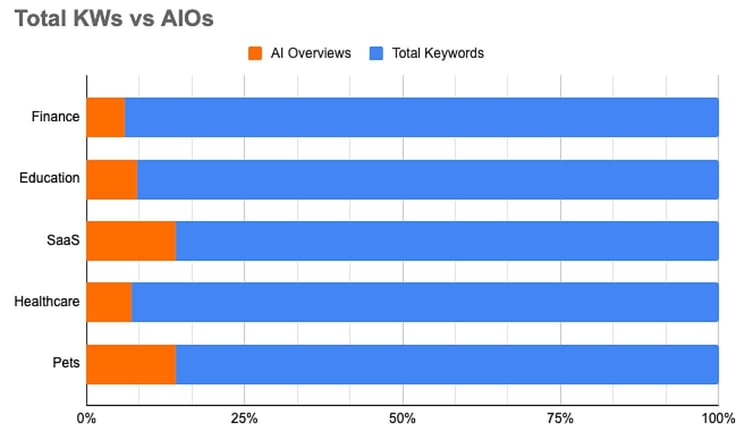
“For people starting in Google search, the traditional need to be an educational site still exists, but for those that start in AI tools, the website is no longer an educational tool,” she explained.
Still, there’s no need to sound the alarm. Though the way websites are built, optimized, and served is on the cusp of change, humans do and will continue to visit them.
It’s just that those visits now depend on how well a site feeds the data these agents rely on. In a way, the website is becoming both the endpoint and the source, acting more like a content database from which to pull information.
Hosts As Partners, Not Just Providers
For most of its history, hosting success was measured by uptime, speed, and security. Those keystones still matter, but users now expect their host to act like a partner, not just a provider. They want everything in one place — hosting, domains, SEO/GEO, and even social tools — without having to go between several vendors and dashboards.
It’s an evolution we’ve been watching for years. Helping customers succeed with their sites isn’t just about performance anymore; it’s about discoverability. And in the age of generative AI, sites that aren’t technically organized for AI discovery risk fading into invisibility, no matter how fast they load.
Kurtz said, in generative search, it’s about asking the new right questions:
- Is your content and brand showing up in AI responses?
- What’s the sentiment of your brand when AI references it?
- How often are you cited either directly or through third-party references?
- Is your direct traffic and referral traffic increasing?
- Are the visitors who arrive via direct and referral traffic converting at higher rates?
Generative engines don’t crawl the web the way humans browse it. They aren’t reading copy top to bottom; they’re parsing structure, semantics, and relationships between pieces of content to understand meaning. That’s why GEO is less about keywords and more about architecture.
“The impact is in how the content is organized,” Kurtz said. “One way forward is vectorizing website content so that it can be retrieved semantically, not just by keywords.”
Instead of short, keyword-heavy queries, people are now typing full, conversational questions. Semrush says the average Google search is just four words long, while ChatGPT prompts average around 23.
“The first step is to create an entity map that outlines what content you need,” she said. “Then you must create content related to the entity map that needs to be accurate, high-quality, and technically optimized using semantic structure, site schema, and clean markup for AI to interpret.”
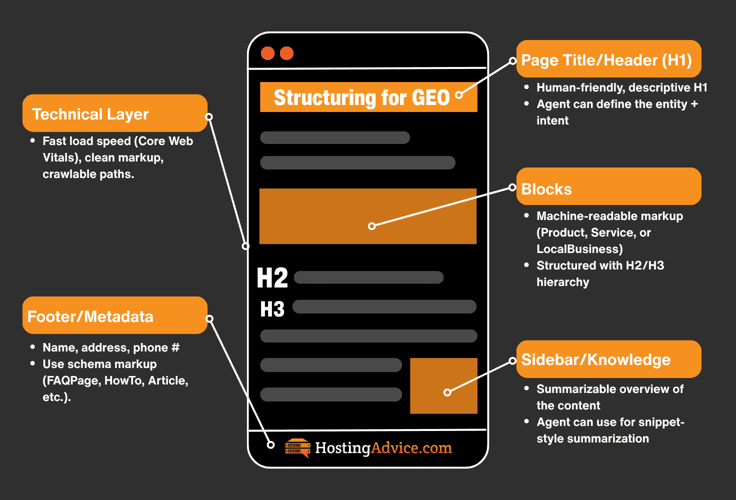
WP Engine has already started applying this strategy to its own site, using itself as a live test case to guide customers and agencies through the GEO visibility shift. The team has built out an entity map and begun updating content across the site to align with AI-friendly structure and semantics.
“The nuance here is that a website needs to still be visually clear and appealing for the humans that are still coming to the site, but also has structured data for agent visitors,” Kurtz explained.
It’s an interesting moment for hosts to play a bigger role in a space they already clearly influence. In a world where 99.9% uptime and SSL certificates were differentiators, they’re expected now.
The next differentiator will be GEO-readiness: platforms that support advanced schema, vector databases, clean APIs, and fast global delivery. These are the features hosts can standardize and simplify for their customers.
“At its core, the website is still the anchor. It’s the one place a company controls end-to-end,” Kurtz said. “The place where discovery turns into trust, and trust turns into action. In a generative world, future-proofing that foundation matters more than ever.”
