



Writer: Ryan Frankel


Editor: Lillian Castro


Reviewer: Cristian Lopez

Key Takeaways
- Thousands of existing colos can’t host 100kW AI racks without major retrofits, and water permits are blocking the obvious fixes.
- Karman Industries says its rocket-engine-derived compressors shrink cooling footprints by 80% using liquid CO2 instead of water.
- The company is opening a Long Beach factory this fall, with Riot Ventures backing, capable of producing 1 gigawatt of cooling capacity per year.
- Karman’s first commercial unit hasn’t shipped yet, and the 80% footprint reduction is an internal company figure not independently verified.
A 23-person startup in Signal Hill, California, has spent the past two years developing a cooling system for a data center based on a rotating compressor that spins at 30,000 RPM, about 10 times faster than a conventional industrial compressor.
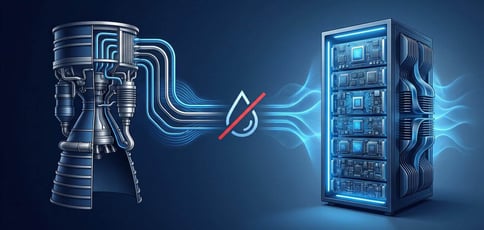
The result is essentially a very large heat pump in which one-third of the system is driven by rocket turbine technology to deliver liquid CO2 to the heat exchangers. The overall message is “rocket science,” and it isn’t incorrect.
Karman Industries was founded in 2024 by David Tearse and CJ Kalra. The risk the company is taking is more interesting than the SpaceX connection suggests. The experience with new, green-field applications for AI-based computing has been completely described.
Less appreciated is the need to find new ways to operate existing buildings designed for 8 kW to 12 kW equipment loads and now asked to accommodate power demands of 100 kW or more per cabinet for AI workloads.
The answer to that challenge is clearly "no" without major retrofit work. The pitch Karman is making is more interesting. Cooling currently accounts for about 40% of the power budget for a data center, and the percentage increases with rack densities.
Air cooling fails at about 30 kW per rack, leaving two essentially viable options for high-power loads. Either water can be delivered directly to the chips, or evaporative cooling can be applied to the building structure, resulting in much more efficient operation until local utility authorities impose further limits.
Why Air and Water Are Both Out
Those limits aren't hypothetical. Evaporative cooling for large hyperscale data centers consumes millions of gallons of water per year, and authorities are increasingly unwilling to approve construction at the pace operators want.
More than 15 states have recently introduced legislation requiring full disclosure of water use before approving new data center projects. The retrofit market now faces pressure from both infrastructure limits and rising computing demands.
How do you go from "this rack can hold a server" to "this rack can hold eight H200s" without adding new water supplies or tearing down half the building to install new chillers?
The Smaller, Zero-Water Pitch
Karman's answer is to provide an HPU, or heat processing unit. It's modular, delivers 10 MW per unit and uses liquid CO2 as the working fluid rather than synthetic refrigerants or evaporated water.
The result is a global warming potential of 1 (i.e., the baseline and not a prediction of apocalyptic conditions), and complete elimination of the "forever chemicals" for which the EU is developing regulatory requirements.
The company's favorite calculation: an 80% reduction in the physical requirements for cooling infrastructure, no requirement for water, and energy use about half that of an equivalent configuration.
"We applied an aerospace systems-engineering approach to data center thermodynamics," said Kalra of Karman. That's about as close as he gets to boasting. Tearse went further in the same announcement: "In the race to stand up AI capacity, time is the most expensive variable. We've moved beyond the era of legacy chillers to HPUs."
That second quote represents the major message. Karman isn't providing a minor improvement over the gas-piston compressors that have been available in mechanical yards since 2005. Instead, the company is providing a new category of equipment that's small enough to replace the space formerly occupied by conventional chillers and quiet enough with respect to water to eliminate the need for permit processing.
For a brownfield colo, this is the major selling point. No new site is necessary. No new water supply is required, and probably no new substation is needed, depending on the original configuration of the facility. Only a forklift, access to the roof, and a staff of Karman technicians with a torque wrench are required.
A 1 GW Factory in Long Beach, Then…
Karman has raised real money: a $20 million Series A led by Riot Ventures, bringing total funding to more than $30 million. The company will open its first manufacturing facility, branded GigaWerx, in Long Beach this fall with a capacity of one gigawatt of high-power-density systems per year. Construction of a second facility is planned for 2028.
That represents only a small fraction of the market that will develop. The global market for cooling data centers is expected to more than double from approximately $11 billion in 2025 to nearly $25 billion in 2032. Capture of even a low single-digit share of this market would produce an enormous business.
And if large hyperscalers proceed with large-scale retrofit programs, the limiting factor will be the rate at which GigaWerx can deploy these systems.
The company is also pursuing an important but largely unappreciated standards advantage. Its systems are compatible with the 800-V DC architecture NVIDIA is advocating for high-density AI racks, giving operators a path to upgrade existing facilities for next-generation workloads rather than merely meeting current requirements.
...What This Doesn't Solve
A few caveats are worth noting. None of the Karman units are running in a production hosting environment yet because the first unit hasn't shipped. The claim of an 80% reduction in facility footprint is based entirely on internal company calculations and hasn't been independently verified.
And the approach to recycling CO2 isn't new to the field of industrial refrigeration. Instead, it reflects a major improvement in the efficiency of the compressor, not the application of a new physical principle.
Retrofitting also doesn't solve the broader challenge of rising data center power consumption and the growing strain on the electrical grid. Karman just removes one major obstacle from the approval process for new facilities.
For operators managing hundreds of thousands of square feet of aging colocation space that once printed money on common WordPress installations and now function primarily as parking lots for legacy CRM workloads, this may be the first practical path to supporting modern AI hardware without rebuilding.
Whether Karman scales or gets bought by an HVAC giant within 18 months is another matter.
The retrofit market has been waiting for a cooling solution that is small, dry, modular, and easy to install. It took rocket engineers to deliver one.
