




Writer: Jordan Sprogis


Editor: Lillian Castro


Reviewer: Cristian Lopez

Key Takeaways
The internet has always been built for people, but in 2025, it looks a little different. More of its visitors aren’t human at all: Google, Meta, and ChatGPT crawlers hit up to 85% of websites every day, and nearly 29% of all internet traffic is attributed to bots.
It’s a new, strange reality where websites are now serving two very different audiences. The users care about design, usability, and speed; the crawlers only need structured data.
And hosting providers are in a bind: They’re paying for constant AI crawling while their clients may soon vanish from search visibility altogether.
Why Hosting Has to Adapt
The agentic web is reminiscent of the early mobile era, with emerging protocols like WAP, WML, and XHTML-MP. A similar phenomenon is happening in today’s age, where standards like MCP, Agent2Agent, and NLWeb are gaining popularity.

“Just as mobile-first design became essential when smartphones took over, AI-ready websites will soon be the new standard,” Tomas Rasymas, Hostinger’s Head of AI, said. “Traditional sites wait for visitors to come to them. AI-ready sites meet the visitors where they already are – inside AI tools – while still working seamlessly for people.”
But most hosts know that SMBs don’t care to learn about protocols. They want to know that their site works, and they’ll choose whoever can show them that it’s simple to deploy.
It’s as Christie Wright, Automattic’s CCO, recently told HostingAdvice: “Hosting migrations only make sense if they solve a real pain point like performance or technical support. Clients rarely switch hosts just because — it has to be worth the hassle.”
If AI visibility is what clients begin to look for, it’s easy to see why it may replace the bragging rights of advertising a 99.99% uptime guarantee — essentially becoming the “new” SLA.
One could argue that’s exactly where hosts have marketing power. Standards don’t just happen on their own, so it’s up to the providers to implement them into their stacks and introduce them to clients.
Hostinger’s Answer to Agentic Search
Hostinger recently released a brand-new Web2Agent service, which automatically converts websites into AI-readable formats. It essentially allows users to opt out of manually implementing MCP protocols, instead automatically tailoring the schema of their site to fit what AI agents are looking for.
“People shouldn’t have to worry about which standard wins,” said Rasymas. “With Web2Agent, we do the heavy lifting and ensure websites are always accessible to AI agents, no matter which protocol they use.”
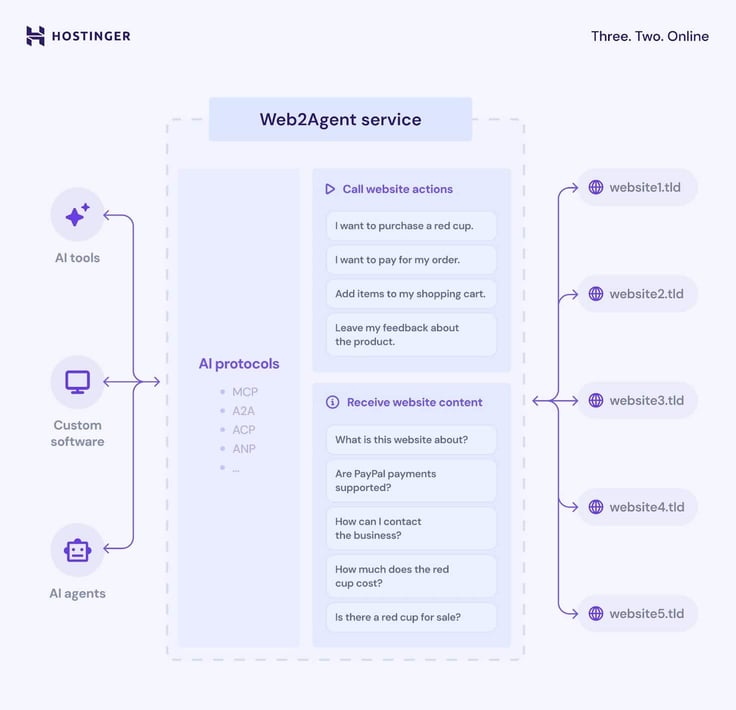
“The problem is that websites today are designed for people, but your next visitor might not be human – it could be an AI agent. These agents don’t care about your design or layout,” Rasymas said. “They need structured, machine-readable data they can navigate, understand, and act on. If your site can’t provide that, you’ll be left behind.”
More than 20,000 sites have already opted in since the soft launch.
Think about it this way: If a site suddenly isn’t getting any traffic, most SMB owners won’t say, “Oops, my backend structure wasn’t AI-readable.” They’ll say, “Why didn’t my host make sure I was set up for this?”
HostingAdvice.com is a free online resource that offers valuable content and comparison services to users. To keep this resource 100% free, we receive compensation from many of the offers listed on the site. Along with key review factors, this compensation may impact how and where products appear across the site (including, for example, the order in which they appear). HostingAdvice.com does not include the entire universe of available offers. Editorial opinions expressed on the site are strictly our own and are not provided, endorsed, or approved by advertisers.
Our site is committed to publishing independent, accurate content guided by strict editorial guidelines. Before articles and reviews are published on our site, they undergo a thorough review process performed by a team of independent editors and subject-matter experts to ensure the content’s accuracy, timeliness, and impartiality. Our editorial team is separate and independent of our site’s advertisers, and the opinions they express on our site are their own. To read more about our team members and their editorial backgrounds, please visit our site’s About page.
