




Writer: Jordan Sprogis


Editor: Lillian Castro


Reviewer: Cristian Lopez

Key Takeaways
- Newfold Digital, the company behind well-known brands like Bluehost and HostGator, has lost more than 1 million users since 2023.
- S&P says Newfold’s decline stems from weak brand recognition and lack of investment in R&D and marketing.
- Don’t be surprised if Newfold restructures again. It’s happened before.
A new S&P Global credit analysis shows that Newfold Digital, the parent company of hosting brands such as Bluehost and HostGator, has lost more than 1 million subscribers since 2023, which is about 17% of its customer base.
It’s a big number, one that’s obviously big enough to make headlines. And yet, it doesn’t seem to be anything personal — just a change in the market.
S&P analysts say Newfold’s decline reflects increasing competitive pressure in the space as the shared hosting segment continues to shrink.
“We believe Newfold’s underinvestment in sales and marketing and R&D, as well as its large portfolio of brands, has led to weaker brand recognition and reputation relative to its competitors, such as GoDaddy, Squarespace, and Wix, that have more-focused product offerings,” the analysis reads.
Shared Hosting Isn’t What It Used to Be
In the early to mid-2010s, shared hosting dominated the web hosting market. It was effortless to sell as the easiest and cheapest way to get a website online fast. So, for first-time site owners, bloggers, and small business owners, shared hosting was the best and often only option anybody talked about.
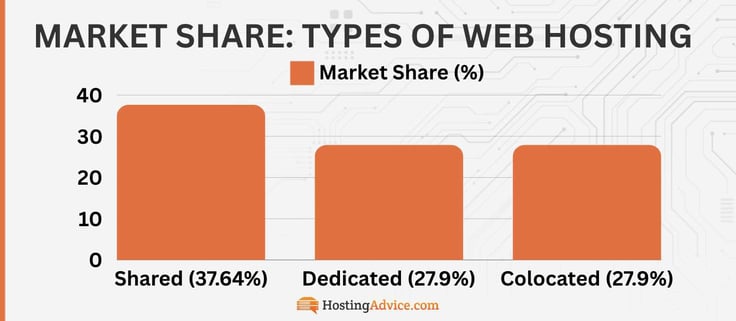
Fast-forward to today, and it now occupies about 37% of the global web hosting market as other options nudge in. Cloud hosting, VPS solutions, managed platforms, and SaaS-driven website builders like Wix and Shopify are taking up bigger pieces of the pie.
And in many cases, they’re also doing a better job at meeting modern expectations.
Actually — it really does just comes down to expectations. Today’s users want simplicity: fast load times, scalability, clear pricing, and easy-to-use tools that don’t require any specialized knowledge.
And yet, that same user is also more technically literate. When Hosted.com expanded its knowledge base and self-help tools, Wayne Diamond, CEO of Hosted.com said the host noticed a drop in beginner-level support tickets. “Clients are becoming more knowledgeable about what they are doing,” Diamond recently told HostingAdvice.
“They’re able to explain what’s happening more clearly and already understand where to go in their control panel or WordPress dashboard,” Diamond said. “They tend to have a better grasp of the technical terms and the reasons behind what’s going on.”
Just look at platforms like Vercel and Netlify that appeal to developers who don’t want to think about servers at all but need the versatility to build. Or website builders and SaaS platforms which are incredibly convenient and fast enough for non‑technical users.
That brings us right back to Newfold, whose struggles are largely caused by the rise of competitors who know exactly who they’re marketing to.
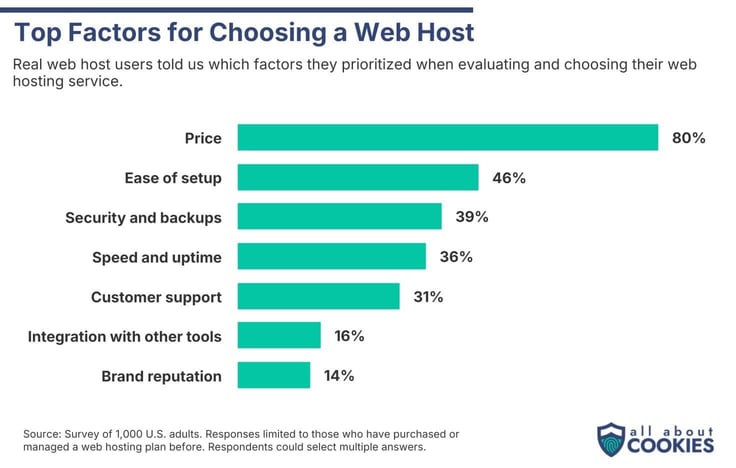
A recent survey supports these findings. Consumers in the study said they prioritize whether a product clearly fits what they’re trying to build, and not how large or recognizable the parent brand is.
Take WP Engine or Kinsta, for example, both of which found success in the very specific niche of WordPress managed hosting. Rather than trying to be everything to everyone, they focused on a specific audience with specific needs, and built loyal user bases as a result.
WP Engine now powers more than 1.5 million websites. Kinsta, a smaller but still a player that is taken seriously, powers 130,000 websites. That’s nothing to scoff at when we’re looking at something as niche as a managed WordPress hosting category.
Newfold, meanwhile, has dozens of brands and aging shared hosting platforms under its umbrella. And as the S&P report put it, catching up likely won’t be cheap: “We also believe Newfold will likely have to spend more on sales and marketing to increase its brand awareness and capture customers earlier in the buying decision process.”
Where Does Newfold Go From Here?
None of this means shared hosting is dead, of course.
Newfold still commands one of the largest shared hosting footprints in the world, and a 5.8 million-user base isn’t nothing. In fact, S&P notes that Newfold’s margins remain healthy (mid-30% range) and the business continues to generate “a significant amount of unlevered free cash flow.”
But if history’s any indication, Newfold Digital may be preparing for some restructuring. Endurance International Group rebranded as Newfold Digital in 2021, following years of acquisitions and restructuring. And in late-2025, it raised $100 million to try and jump-start growth again.
But with 1 million users gone, the road ahead won’t be quick or cheap. As S&P puts it: “It could take years, or require a significant increase in its investment, for Newfold to return to growth.”
