



Writer: Jordan Sprogis


Editor: Lillian Castro


Reviewer: Cristian Lopez

Key Takeaways
- Samsung C&T and CMC Corporation are jointly investing $1.3 billion in a new Ho Chi Minh City data center.
- Can Vietnam handle these loads? The northern half of the country already faces blackouts during dry seasons.
- Vietnam's Minister of Industry and Trade has warned that, unless new sources of power move in, northern Vietnam’s infrastructure will stay fragile.
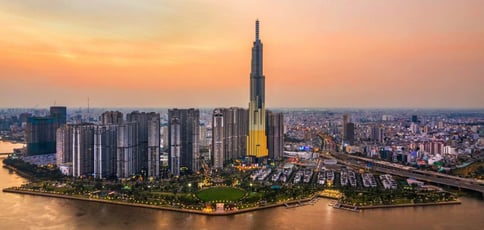
Samsung C&T and CMC Corporation, two of East Asia’s conglomerates, are teaming up to build a $1.3 billion facility in Ho Chi Minh City, Vietnam.
Why Vietnam is their new darling is easy to see: the country offers the kind of population, land, and pricing investors can’t resist: Across its 80 million internet users, the average age of people is around 33. The country also has low power tariffs ($0.085 per kWH) and tons of unoccupied land.
But beneath this land is an unstable power grid — a problem Vietnam has known about for years. As investors increasingly move into East Asia, is the country prepared to handle major data center builds right now?
A Tale of Two Cities
Look at a map of Vietnam and it’s easy to see how North and South Vietnam appear to be two different worlds. The country stretches down a narrow 1,025 miles from top to bottom. Comparing the two regions would be like having subtropical Florida and tropical-savanna Nigeria in the same country.
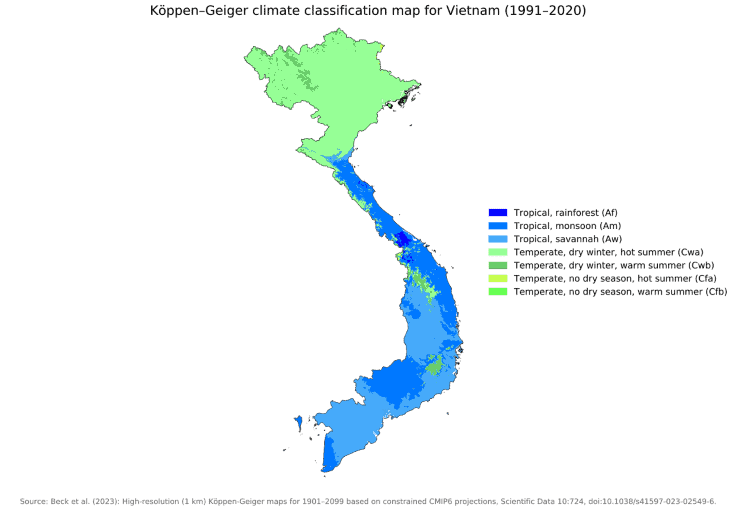
For all history buffs, Vietnam’s north-south divide follows the old 17th parallel, which is the line of latitude that split the country during the Cold War.
But to really evaluate whether Vietnam’s grid can “keep up,” you need a metric (or two):
- System Average Interruption Duration Index (SAIDI): The average total time (minutes or hours) that customers are without power over a year
- System Average Interruption Frequency Index (SAIFI): The average number of interruptions customers experience per year
While Hanoi — in the north, just below China — struggles with higher outage rates, Ho Chi Minh City’s (HCMC) power provider, EVNHCMC, reported a SAIDI of just about 15 minutes and a SAIFI of 0.18 interruptions per customer in 2023. That’s among the lowest in Vietnam.
| Location | SAIDI (min/customer/yr) | SAIFI (interruptions/yr) |
| Hanoi (North) | 59.95 | 1.475 |
| HCMC (South) | 15.2 | 0.18 |
| Vietnam (Overall) | 199.83 | 1.95 |
It’s why Samsung and CMC’s facility will be based in Ho Chi Minh City because clearly, it’s a great place to build — as long as investors are prepared to design for the inevitable heatwaves, of course.
Hydropower accounts for about 30% of Vietnam’s power. You can imagine that when the dry season hits, supplies run low and electricity rates run high because of air conditioning demands.
Northern Vietnam, for example, experiences a ton of blackouts because of heatwaves and droughts. In 2023, a blackout caused output to drop by more than 4 GW, which cost the country $1.4 billion.
Combine that with the fact electricity demand for 2025 has also jumped between 10-12% YoY, which pushed its peak national load to 54,500 MW. To put that in perspective, that’s equal to about half of California’s entire power demand during its hottest months.
Vietnam’s Answer to the Power Issue
In July, Vietnam’s Minister of Industry and Trade, Nguyễn Hồng Diên, told state media that the first half of the year brought record electricity loads to the northern region.

Yet, as he noted, “power supply was still maintained and guaranteed, especially for the North.” (We used Google Translate to translate Nguyễn’s Vietnamese into English, so translations are approximate.)
He also said that, to secure supply through 2027, Vietnam must add new generation capacity and prioritize overloaded zones, especially around Hanoi. Nguyễn urged EVN and EVNNPT (power providers) to “speed up the progress and early energize the power-supply projects for the North.”
In general, Vietnamese officials urged businesses to shift their workloads to off-peak hours until a more concrete solution is in action.
One idea could be to do what Singapore did. A few years ago, it invested in a 200 MW/285 MWh battery energy storage system (BESS). It acts like a giant backup battery that can stabilize the power grid during spikes or outages.
Something similar could be in the works: After years of rewriting with a final approval in 2023, its Power Development Plan VIII (PDP8) is a mapped-out goal that outlines the energy sources Vietnam will eventually rely on and where those plants will be built.
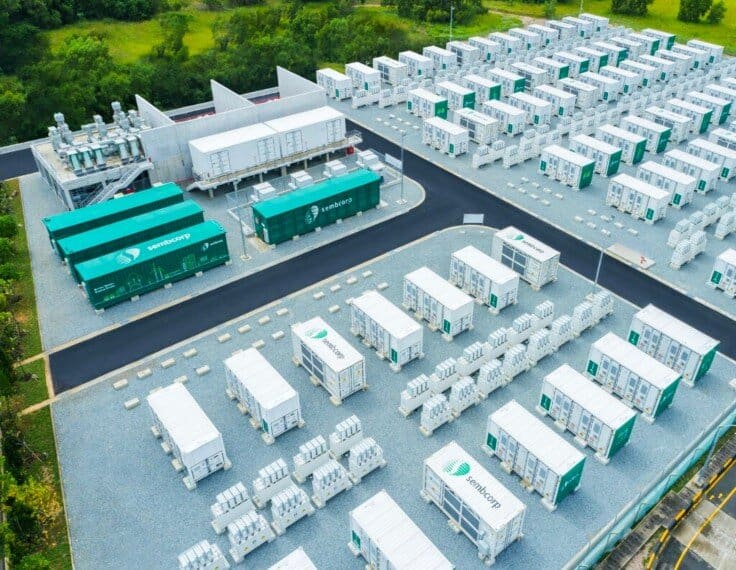
Its goal is to bring Vietnam’s total power capacity to 150 GW by 2030, nearly doubling it from today. Ideally, 30-40% of that will come from renewable resources. There are also plans to retire several aging coal plants and replace them with natural gas by 2050.
The plan indicates that with this, of course, comes grid modernization, which will likely include upgrades for transmission lines and smart-grid systems.
But it looks like many of the projects are behind schedule: Only 78% of planned 500 kV lines and 74% of 220 kV lines are finished.
So basically, until those upgrades actually happen, data center operators should probably assume seasonal interruptions are going to be par for the course.
