




Writer: Jordan Sprogis


Editor: Lillian Castro


Reviewer: Cristian Lopez

Key Takeaways
For most independent hosts, competing in a cloud market held by trillion-dollar giants feels impossible — which may be why HostPapa is the only hosting company to make it on this year’s “The Globe and Mail” 2025 list of Canada’s Top Growing Companies. It’s the fifth-consecutive time it’s appeared and jumped to No. 115 from No. 189 last year.
Hyperscalers make waves with activities like mergers, data center expansions, and AI-powered services at a scale that, frankly, no mid-tier player can match. But HostPapa’s streak directly challenges the notion that bigger is better.
As for what the “right” direction is, the list noted that the 400 firms managed to “grow strong despite bearing scars from the past three years” — a likely nod to Canada’s supply chain disruptions and the inflation spike that peaked in 2022 and 2023.
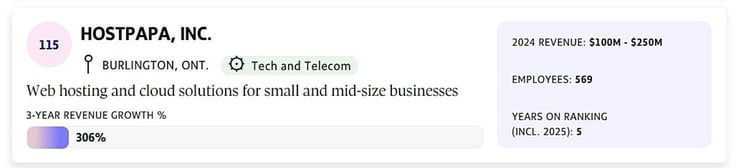
HostPapa’s revenue grew 306% in the three-year period the list is measuring. Most of that was driven by mergers and acquisitions, including Deluxe Hosting, Hostopia, Brandpa, and soon CloudBlue. Most recently, HostPapa secured an impressive $130 million in new financing.
“Our 306% growth reflects the strength of our platform and services, and, more importantly, the trust our customers place in us to power their online success,” said Jamie Opalchuk, Founder and Chief Executive Officer of HostPapa. “This motivates our team to keep innovating and expanding to support the AI-first digital transformation of businesses around the world.”
Filling in the Gap of Hyperscalers
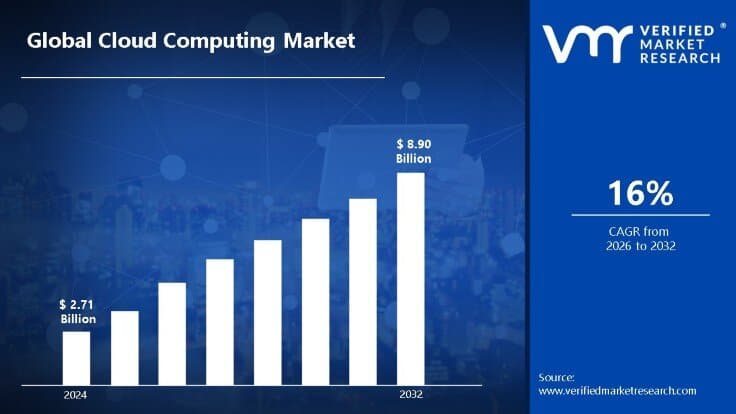
Hyperscalers like AWS and Google Cloud focus on the top end of the market, which these days includes enterprise contracts and AI infra projects that demand billions in investment. It’s why the cloud computing market is set to hit $9 billion in value by 2032.
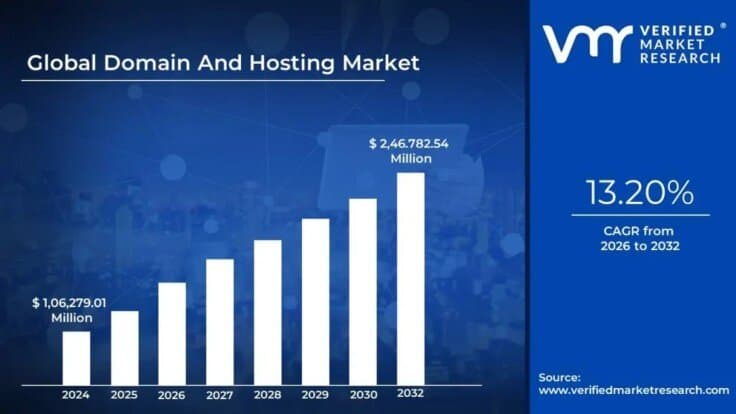
On the other hand, the domain and hosting market — which by nature is more mid-tier/commodity — is projected to hit $2.5 billion by 2032, which is a healthy pace for a high-growth tech sector.
More than anything, HostPapa’s success proves how well it’s been able to read both sides of the market.
On one side are privacy- and compliance-focused businesses looking for dedicated or bare-metal infrastructure — the kinds of things the Big Three are answering. But on the other hand are SMBs that want easy-to-use eCommerce tools and automation without the learning curve. Basically, something that should feel as simple as setting up a new iPhone.
That same mid-market consolidation trend is also happening across Europe and APAC, where local hosts are prioritizing niches instead of trying to out-scale the most popular brands in the world.
Take One.com, which purchased Hostnet from the Netherlands; or Leaseweb, a Dutch host/cloud provider that recently acquired German netdirekt and U.S. ServInt. Or look at Claranet, which over the past decade has combined M&As across France, the U.K., the Netherlands, and Portugal.
All of these hosts are doing something similar by focusing on local and regional ecosystems. That in itself gives them the power to balance realistic scale of ownership and customer service. So while it’s a quieter kind of growth, HostPapa — and many others — have already proven it’s more than sustainable for the mid-market layer.
It’s as Dawn Calleja, editor of “Report on Business” put it: The list, “Canada’s Top Growing Companies,” highlights the country’s leading innovators, adding: “We think it’s important to tell their stories, to help inspire the next generation of up-and-comers across the country.”
