




Writer: Jordan Sprogis


Editor: Lillian Castro


Reviewer: Cristian Lopez

Key Takeaways
Based on a global survey of 446 hosting providers, CloudLinux and WebPros just released this year’s Web Hosting Trends Report — and it answers exactly what so many providers are looking for: What do WordPress hosting customers actually care about?
Like, really care about. Not what kinds of gimmicks would work on them. In an era where not even WordPress is immune to AI and automation, security threats, SaaS competition, and revenue/margin questionability, you may expect the answer to be complex.
Surprisingly, it’s not. It looks like the decisions that end-users are making are…boringly consistent. According to providers, customers still choose their hosting company based on three core factors.
Providers Say Customers Choose WordPress Hosts for the Fundamentals
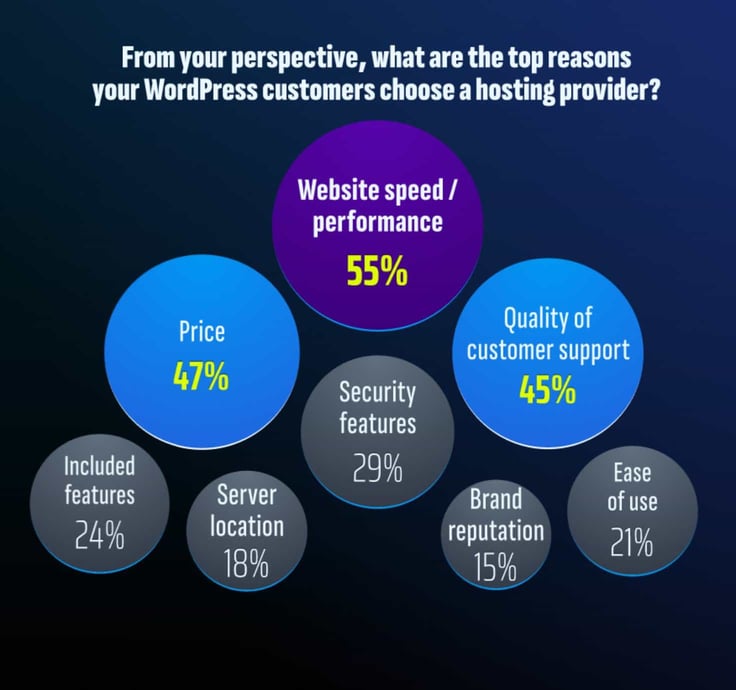
At a glance, here’s what CloudLinux and WebPros’ report found as the top reasons customers choose a WordPress hosting provider:
- Website speed and performance: 55%
- Price: 47%
- Support quality: 45%
But mere numbers aren’t enough, so let’s unpack what this all actually means.
Performance: 55%
More than half of hosting providers emphasized that performance is the primary reason customers sign up for WordPress.
As the world’s most popular CMS, it has the kind of reputation that pulls people in, but the problem is that WordPress isn’t your typical builder. It’s not static, but extremely dynamic — based on databases, plugins, themes, APIs, the whole shebang.
This obviously makes sense. Slow websites cost money. Whether it’s a small business running a website or an agency running several, performance is still No. 1, a priority plucked directly from the early 2000s internet. Some things never change.
They aren’t loyal to brands as much as they are price. McKinsey has repeatedly reported that value for money is one of the primary reasons customers switch brands.
WordPress hosting, of course, is no exception. It’s almost funny seeing how full-circle this all comes. From the era of snake oil salesmen to skeevy car salesmen, the pitch has been the same: yes, the product has to work, but price is what seals the deal.
Price: 47%
With only an eight-point gap separating performance (55%) and price (47%), cost is neck and neck with performance.
There’s some nuance here worth looking at. Performance and support are major factors, just like price, but the difference is that it looks like customers don’t shop for the cheapest hosting first. They look for what works best, and if it looks good, they’ll compare prices among one another.
For many users, hosting is still perceived as a commodity. And not in the sense that it’s rare, but that it’s expected. It’s a default that is just anticipated and they expect it to just work, without having to know everything that goes in behind it. That really blurs the lines around realistic pricing.
And WordPress is a different beast. It’s plugin-heavy, with the average site running more than 20.
We already know that customers want managed performance, which definitely includes plugin maintenance for many. The problem is that we also know that customers don’t want to pay managed-level prices. Combined with the fact that WordPress itself is free, there’s probably a psychological dissonance that hosting on it should feel inexpensive.
Support: 47%
We circle right back to the infrastructure without customers even realizing it.
Customers don’t think about support until they desperately need it. And in WordPress, this happens a lot: a plugin could be outdated, WooCommerce could go down.
Quality support has a stronghold on retention, with CloudLinux and WebPros’ report confirming that 18% cite poor support experiences as a reason customers churn.
Other reports, like Zendesk, have shown that 73% of customers will switch to a competitor if they feel the support was inadequate. Microsoft reported that 58% of consumers already switched companies because of poor customer service.
Meet the Tie Breakers
This wouldn’t be a classic HostingAdvice news story without the “but.”
In a classic turn of events, hosting providers have also found that there are a few secondary factors that tip the scales depending on what exactly end users are looking for as dealbreakers:
- Security features: 29%
- Included features and tools: 24%
- Ease of use/user-friendly control panel: 21%
Now, security is interesting here. It’s not usually the main reason that customers choose a provider, but it definitely becomes important later. On WordPress, that can happen sooner rather than later. Because WordPress powers such a massive share of the web, it’s a constant target.
That’s probably why security incidents (35%) and CMS/plugin issues (39%) rank so high in support time consumption.
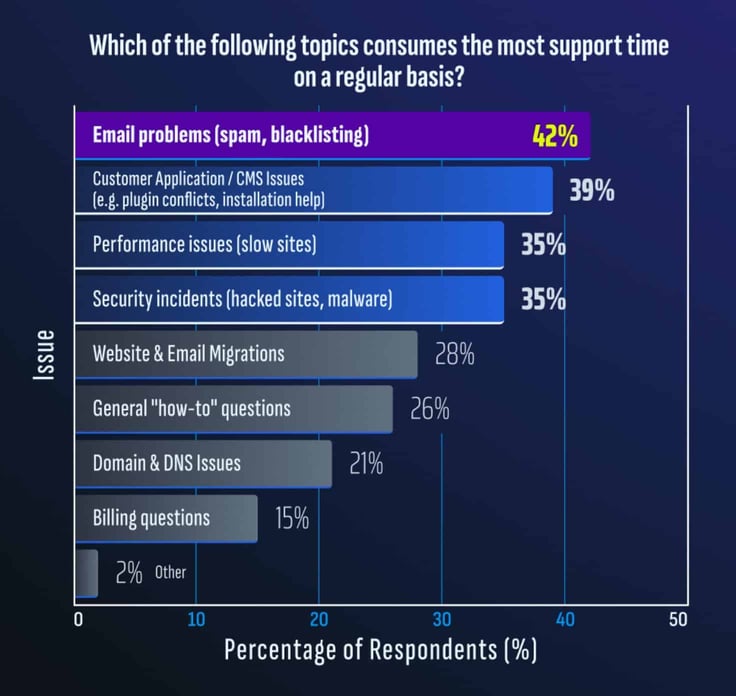
The best approach is to make sure customers know security features are available against attacks that will affect them. Humans respond to emotion and logic. Email, for example, is the most vulnerable add-on, with 42% of providers saying it’s the most time-consuming support team task.
The problem is that people don’t always have a natural sense of patience. Despite how much innovation is poured into an industry and its products, people still go after the same fundamentals they always have.
