


Key Takeaways
- Nearly 9 in 10 (88%) surveyed business owners say they are satisfied with their internet service, compared to just 60% of residents nationwide who agree.
- The South (92%) and the Midwest (88%) emerge as the regions with the highest business-internet satisfaction, while the West stands out for its dissatisfaction for both businesses (78.5%) and consumers (57%).
- Texas has one of the largest business-consumer gaps in the nation, with 98% of businesses showing satisfaction with their ISP versus 47% of consumers — a 51% difference.
The internet service industry has had its fair share of challenges over the years. Yet despite complaints of outages and lack of competition, internet service remains steady — at least for the businesses that can afford premium plans.
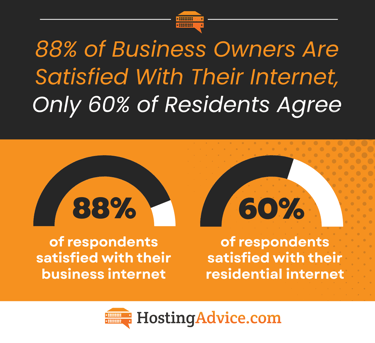
A recent HostingAdvice survey reveals that 88% of business owners are satisfied with their internet service, while just 60% of non-business owners agree — a 28-percentage-point gap.
This gap highlights a significant disconnect in how businesses and everyday Americans experience local internet service, exposing a clear two-tier internet system that may be driven in part by affordability rather than network availability.
88% of Business Owners Say They Are Satisfied With Their Internet, Only 60% of Residents Agree
Sudden outages, price hikes, and inconsistency. These three things have long plagued the local internet service industry, causing customers great frustration. But a local ISP’s reliability may have less to do with its infrastructure and more with how much a customer is willing to pay for its plans.
According to our study, one group consistently receives quality service: businesses. Business owners nationwide reported strong levels of internet service satisfaction, particularly those who can justify paying a higher premium for their plans.
In contrast, satisfaction drops roughly 30 percentage points in some regions, underscoring how pricing tiers and service prioritization create vastly different user experiences for those often operating within the same regional markets.
It’s clear that users are getting different levels of service and that tiered pricing models may be the common denominator. For local ISPs, the business model is straightforward and suggests that pricing tiers could play a role in service reliability.
Regional Success Stories Look Different for Businesses Than Residents
Our study also found key regional differences between how businesses and residents rate their internet service providers. As it happens, nationwide sentiment carried over to the regional opinions, showing clear gaps between consumer and business satisfaction.
The South and Midwest emerged as the top-performing regions for business internet satisfaction, yet those same regions did not deliver the same satisfaction for non-business users. The table below shares how satisfaction rates differ between businesses and residents across four major U.S. regions:
| Midwest | South | Northeast | West | |
|---|---|---|---|---|
| Businesses | 88.5% | 92.6% | 84.6% | 78.5% |
| Residents | 63.78% | 58.70% | 63.73% | 57.47% |
The divide is stark, especially in places like the South. While the South had the highest satisfaction rates for business internet, satisfaction among residents decreased by over 30 percentage points. This isn’t just a minor difference in service; it reflects a substantial difference in reported satisfaction.
The West, on the other hand, stood out for its shared frustrations with internet service among both business and consumer groups. It had the lowest satisfaction rate across the region for both groups, pointing to localized issues rather than nationwide ISP failures.
Our results suggest that in many regions, high levels of service are achievable, but not evenly distributed.
Texas Shows a 51-Point Divide Between Businesses and Residents
If there is one state that encompasses the disparity within the ISP customer base, it is Texas. While the Lone Star state leads the nation in business internet satisfaction, its residents report one of the lowest satisfaction rates in the country.

The gap is clear: 98% of Texas-based business owners say they are satisfied with their ISP, but only 47% of non-business owners in the state can say the same. That’s among the largest gaps observed in our survey.
By contrast, states like Illinois and Florida show more alignment between business and resident satisfaction. These results show that near-equal access to quality service is possible for all users and that the gap can be narrowed.
The Real Internet Problem Isn’t Reliability — It’s Affordability
While most people may chalk up inconsistent service to a network issue, our study suggests that internet problems aren’t always that cut-and-dry. In fact, the disconnect between user experience may have more to do with affordability gaps than anything else.
Our data suggests that high levels of service are achievable in many markets — though not evenly experienced. These results point to a possible relationship between cost and satisfaction, suggesting that higher-tier plans may contribute to more reliable service.
Consumers are opting for lower-tiered plans to ease the financial strain they’re facing, but it is also leaving them with more frustration and less reliable service.
“We can’t let internet access become like healthcare, where the quality of service is linked directly to how much you can pay. Yes, residential users deserve better internet access for a variety of reasons, but I see it mainly as an economic necessity,” says Joe Warnimont, Senior Analyst at HostingAdvice.
“Residential internet users are consumers; strong internet performance for the residential user means they’ll contribute more to online commerce. Many residential users are also part of the workforce, so we’re boxing out those who work from home full-time or on a hybrid schedule,” says Joe.
This growing divide raises concerns about digital equity. As households relying on low-cost plans struggle with slower speeds or limited customer support, businesses in the same regions are reporting excellent internet connectivity.
What This Means for Consumers, ISPs, and Policymakers
The widening gap between commercial and residential satisfaction highlights the need for greater transparency, competition, and affordable pricing models within the ISP industry. As the affordability crisis deepens and society becomes ever more digital, this discussion is more important than ever.
If the trend continues, we risk the divide expanding, leaving millions of Americans behind and disconnected in an increasingly digital world.
Methodology
This survey was conducted in January 2026 among 500 U.S.-based business owners and 500 non-business owners using a third-party research panel. Responses were screened using a proprietary machine-learning algorithm to remove fraudulent or inauthentic submissions. The margin of error is ±3.1 percentage points at the 95% confidence level, with higher margins for subgroups.
For media inquiries, please reach out to dennis@hostingadvice.com.