


Our lives revolve around the internet. If you live in the U.S., you probably use the internet for everything: work, education, healthcare, taxes, entertainment, keeping in touch with family… it’s easier to say what you don’t use it for. It’s become an essential part of our daily lives, and while we don’t think about it much while using it, we definitely feel its absence.
Broadband is the backbone of our modern, high-speed internet. It’s what allows for high-speed, always-on internet access that is capable of handling multiple connections at once. Yet despite its seemingly indispensable nature, there are a lot of places in the U.S. that just don’t have broadband access.
Blame it on the Last Mile Problem, which has been vexing telecommunication companies for as long as they’ve existed. The whole “information superhighway” metaphor is kind of tired now, but it helps to picture the internet as a system of roadways. It’s easy to get between major population centers since there are huge multi-lane highways connecting them. However, if you want to get to a tiny cabin in the mountains, you’re going to need to leave the highways and start taking narrow, unpaved roads.
It’s all about economy of scale: these less populated areas aren’t major destinations, so it’s just not viable to build eight-lane highways that lead to them. Since individual homes are also spread out, it’d be cost-prohibitive to pave every single road and driveway.
Broadband access works the same way: the fewer people who live in an area, and the more spread out those people are, the less cost-effective it is for internet companies to upgrade their infrastructure. But since the internet is becoming increasingly essential, many states are fighting to secure broadband access to their most underserved areas.
Looking at broadband accessibility over the past four years and using the latest data from County Health Rankings, we’ve carried out an in-depth analysis of which states and counties saw the biggest increase in their digital infrastructure between 2020 and 2024, and which are lagging behind.
- Navigate This Article:
State Comparison
Our study revealed significant regional disparities when it comes to broadband access. Alabama has made the greatest strides in broadband connectivity over the past four years, with residents enjoying a 9% increase.
Interestingly, other Southern states were identified among those with the most improvements. For example, Kentucky, Louisiana, Mississippi, and Tennessee all had 8% increases in broadband access.
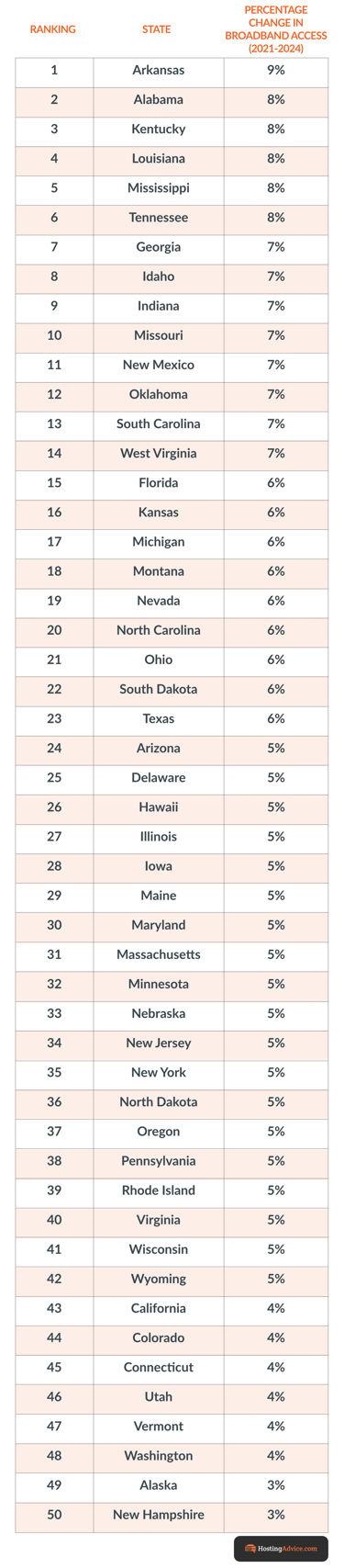
Notably, some northern states had the smallest increases, which makes sense given that they had greater connectivity rates in the first place — Alaska and New Hampshire were the worst performers, with increases of just 3% during the study time period.
Top 10 County Comparison
The study also identified significant differences with individual counties across the country. Guadalupe County (New Mexico) was the top performer nationwide when it came to broadband connectivity. Located in the central part of New Mexico, with an economy primarily based on ranching and farming, residents here have enjoyed a whopping 34% increase in connectivity over four years.

Telfair County in Georgia followed closely with a 32% increase, and Lake of the Woods County (Minnesota) and Wheeler (Georgia) both had 29% increases. Other states with counties in the top 10 included Nevada, Texas, Louisiana, Kentucky, Texas, and Arkansas.
Bottom 10 County Comparison
Interestingly, there were counties that have actually had a decrease in broadband connectivity during the four-year study period. The worst performer in the nation was sparsely populated Roberts County in Texas, whereby 9% fewer households now have access to broadband. Its economy is based on agriculture, particularly cattle ranching.

Roberts County was followed by Piute (Utah) and Steele (North Dakota) which also had decreases of 8% over four years. States with counties with the least improvements in broadband connectivity were Nevada, Texas, Louisiana, Kentucky, Texas, and Arkansas.
In total, there were 55 counties where access to broadband had actually decreased over the four years. Nebraska experienced the greatest decrease in broadband access.
Other Key Findings
Texas appeared to dominate the national rankings for rises in broadband connectivity. In fact, 1 in 5 Texas counties featured within the top 100. Twelve counties in Mississippi were in the top 100 as were eight counties from Georgia. Kentucky and Arkansas rounded out the top five with seven and six counties, respectively.
“Delivering high-speed internet access requires significant infrastructure investment, and it’s not surprising that there are still plenty of remote locations that don’t have it. Thankfully, however, that’s changing — not just through investment into fiber, but also through newer fixed wireless connections that rely on 5G, and even improved satellite connectivity provided by companies like SpaceX and Viasat,” said HostingAdvice technology expert Christian de Looper.
“Hopefully, this trend will continue, as more providers look to expand into more rural areas, and as cell companies continue to build out their 5G networks. Over time, that expansion will speed up, ensuring that even remote households have opportunities to get connected with higher speeds.”
Methodology
The percentage of households with broadband internet access was derived from County Health Rankings data spanning 2021 to 2024. By comparing the number of households with broadband access in 2021 to those in 2024 and relating it to the total population, we calculated the overall percentage of homes with broadband access.
This analysis provided insights into both the percentage change and the exact number of homes that either gained or lost internet access compared to four years ago. This assessment was conducted at both state and county levels to capture a comprehensive range of results.