


Reseller hosting serves as a way for users to resell their purchased hosting resources to third-party customers, acting as an intermediary to make a profit. Most large hosting companies sell reseller hosting plans for a discounted (wholesale) price. This way, the reseller can repackage and segment the hosting resources — like hard drive space, bandwidth, and server speed — to sell smaller packages to their own customers.
You wouldn’t sign up for reseller hosting if you only needed to host one website. It’s for organizations or individuals that want to run a business selling hosting packages to niche customers — often with specific needs, or in a particular industry or location. Web developers, designers, and agencies also tap into the power of reseller hosting, since they can get hosting for a discount, use it for clients, and increase profit margins.
In this article, you’ll learn all about reseller hosting, how it compares to other types of hosting, and the kinds of reseller hosting available. You’ll also find information about starting, managing, and improving upon a reseller hosting business.
Understanding Reseller Hosting
Reseller hosting plays an essential role in the web hosting industry thanks to its scalability and cost-effectiveness. Virtually all parties receive some sort of benefit.
Larger hosting companies get to sell more resources, often from under-utilized servers. Resellers receive hosting resources at steep discounts, allowing them to make a profit when selling to customers. Hosting users gain access to niche hosting providers that offer unique features for their purposes. For example, some reseller hosts focus on sustainability or providing user-friendly dashboards for specific industries.
Some reseller hosting companies, like Atak Domain, even sell discounted domain names to improve convenience for customers.
Reseller Hosting vs. Traditional Web Hosting
Although they offer similar server resources, reseller hosting and traditional hosting sell to completely different customers. Reseller hosting is for resellers who want to purchase the hosting resources from larger hosts, then repackage, add value, and resell the hosting to their own customers — often web design clients or niche industry users. On the other hand, larger web hosting companies sell traditional hosting directly to the consumer.
Traditional hosting works well for organizations or individuals interested in launching a website or app. Reseller hosting works best for web designers, developers, agencies, and any type of marketing or tech company interested in selling hosting as part of its products and services.
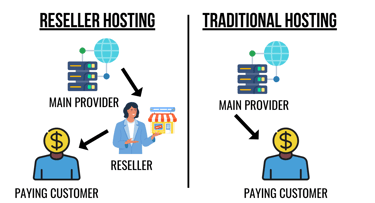
Reseller hosting, therefore, comes with white labeling, so the reseller can create a custom hosting environment with its own logo and brand elements. Reseller hosting also comes at a steeply discounted rate, and the resellers can set prices for customers. Whereas traditional hosts offer retail pricing with preset plans.
This flexibility in pricing also extends to features, making reseller hosting scalable and flexible. Reseller hosting gives its resellers the ability to adjust resources — like disk space and bandwidth — based on customer demands. This also helps resellers scale up their businesses as more customers come in, or as customers require additional resources.
On top of that, reseller hosting includes dedicated technical support to handle everything from custom dashboards to customer management. Traditional hosting, because it’s designed for standard website hosting and other projects like apps, comes with general customer support and preset scalability based on the type of hosting plan chosen.
How Reseller Hosting Works
Larger hosting companies sell virtually all the reseller hosting plans on the market. A business or individual signs up for a reseller hosting plan by paying the larger hosting company a fee, often a subscription for the amount of hosting resources required to serve a specific number of customers.
That business or individual then becomes a reseller of the hosting. The reseller usually adds value to its own packages by marketing to a unique group of customers, providing certain app integrations, or even offering superior customer service.
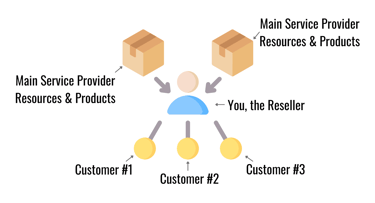
In this relationship, the parent host company manages maintenance of its servers and most backend server tasks. Parent hosts often provide useful tools for resellers to create pricing packages, onboard clients, and white-label their dashboards. The reseller must manage every aspect of customer relationships, from customer support to sales — the parent host has no hand in helping customers of a reseller.
A key part of managing reseller customers involves a control panel called cPanel. Many parent hosting companies provide cPanel to their resellers. This allows the resellers to customize the customer dashboard, opening up options for them to manage items like email accounts, software integrations, and databases.
Benefits of Reseller Hosting
Reseller hosting provides unique benefits for businesses and individuals to scale hosting operations. It’s especially beneficial for web professionals who need a value-added aspect of their services or products. Read about the main benefits of using reseller hosting below.
- Cost-effectiveness for entrepreneurs and small businesses: Reseller hosting requires minimal capital to get started. You don’t have to build the hosting infrastructure at all.
- Scalability and flexibility in resource allocation: Resellers have the ability to adjust payment plans and resources based on what customers need. If demand increases or customers want something extra like domain name registration, the reseller simply upgrades with its parent host.
- White-label opportunities for branding and customization: Parent hosts often offer white-labeling so the reseller keeps its dashboards and all hosting resources under its brand name. This helps build a brand image, increases professionalism, and eliminates any questions about serving as an intermediary.
- Streamlined management and customer support: Parent hosts handle server management, freeing up time and resources for the reseller to focus on essentials like customer support.
Once you understand the benefits of reseller hosting — particularly its potential for cost-effectiveness and scalability — you can move on to the types of reseller plans to choose the right one.
Types of Reseller Hosting Plans
From the most affordable, shared reseller hosting to more advanced reseller solutions like VPS and dedicated hosting, businesses have several options depending on customer needs.
Shared Reseller Hosting

Shared hosting is the most affordable and scalable type of reseller hosting, as long as the final customers only need shared hosting to begin with. The reseller purchases a large amount of shared hosting space from the parent host and then breaks it into smaller sections for its customers to use.
All of the users share the resources from one server. Features for shared reseller hosting include intuitive control panels (often cPanel), enough server resources for small to mid-sized websites, hosting integrations, and white-label branding.
Pros
- It’s an excellent, beginner-friendly way to get into reseller hosting.
- Plans are far less expensive than other hosting types.
- Since parent hosts maintain the servers, resellers can focus on other business tasks.
Cons
- Resellers have less control over the server and their hosting configurations.
- Performance may suffer if one site on the server takes up too many resources.
- Resources are less plentiful on shared servers than on other hosting options.
Shared reseller hosting makes sense for resellers new to the business or on a budget. It’s also ideal for businesses interested in offering web hosting services to clients. For instance, web developers may want to include hosting with design services as one package.
VPS (Virtual Private Server) Reseller Hosting

VPS hosting works where the reseller buys a VPS from a larger (parent) hosting company and then portions it out to its own paying customers. The customers get the benefits of a VPS — like stronger performance and security — while the reseller gains more control over its server.
VPS hosting is often compared to cloud hosting but with a little less elasticity and more predictable monthly pricing.
Pros
- Resellers gain control over elements like server resources, configurations, and security.
- Performance increases when compared to shared hosting.
- Security also improves when resellers upgrade from shared hosting.
- Customers get blocked off from other users, so an increase in one website’s traffic won’t affect other websites.
Cons
- It usually costs more than reseller hosting, meaning resellers’ profits are slashed, or they have to find creative ways to make more money. Sometimes, this means costs are passed on to the customer.
- VPS setups often require a little more technical knowledge from the reseller since the parent host passes over some server management tasks.
Resellers should consider VPS hosting when they’ve outgrown the resources provided by shared hosting. Resellers may also consider VPS hosting to gain greater control over the server. If you already know your users have high-traffic websites and apps, VPS hosting may make sense.
Dedicated Server Reseller Hosting

With dedicated server reseller hosting, the reseller pays a rental subscription for an entire dedicated server or multiple servers if needed. As with other types of reseller hosting, the reseller splits the dedicated server into segments to sell to customers.
A dedicated server provides the most control and security for the reseller since the server is not shared with other users from the parent host. Notable features of dedicated reseller hosting include maximum control, performance, and configurations compared to other hosting types. You may also receive more developer-friendly tools and advanced billing/business management features.
Pros
- It’s the highest possible performance a reseller can ask for when compared to VPS and shared hosting.
- Resellers can control everything about the server, from operating systems to integrations.
- Security increases since no users from the parent host use the server.
Cons
- Dedicated hosting costs more than VPS or shared reseller hosting.
- Resellers must manage most, if not all, aspects of the server. This means you need more technical knowledge and time to manage it.
- Scalable options, like cloud hosting, are becoming more popular and affordable.
Go with dedicated hosting if you’re an experienced, tech-savvy reseller with high-traffic customers. Other options besides shared, VPS, and dedicated reseller hosting include managed WordPress, cloud, Windows, and green (eco-friendly) reseller hosting, many of which focus on a niche.
Starting a Reseller Hosting Business
To start a reseller hosting business, businesses and individuals must follow the steps to choose the right hosting provider, choose the best hosting plan, and set up profit-producing pricing to sell to customers.
In addition, you should establish branding and customization options to fuel the business. Take a look below to learn the entire process.
Choosing the Right Reseller Hosting Provider
Before proceeding with anything in the reseller business, you must research parent hosting companies that provide reseller hosting. Your analysis will then help you pick the perfect reseller hosting provider to serve customers.
Here are some tips to guide your search:
- Seek reseller hosting with LiteSpeed servers. This leads to stronger performance and other features like the ability to fight DDoS attacks.
- Most resellers should opt for Linux hosting (thanks to its compatibility, stability, and security), but sometimes resellers cater to customers who integrate heavily with Windows programs.
- Examine the reputation of each provider by checking user reviews.
- Look for parent hosts with a demo or money-back guarantee. This way, you can test out the reseller hosting beforehand.
- Make sure the host has server locations near most of your potential customers.
- Ensure each host offers the resources and features required for serving your customers. For example, you may need to offer email accounts and domains.
- Test out the customer service from each parent host. Never rely on user reviews for this; you can test out customer support personally.
Along with these tips, resellers should always keep pricing in mind. After all, the entire point of running a hosting resale business is to make money.
Selecting the Appropriate Hosting Plan for Your Needs
After you’ve narrowed your search to one or two hosts, begin looking at which of their hosting plans might work best for your business and its clientele.
Use these guidelines to streamline the selection process:
- Understand the level of resources your reseller business requires. Who are your customers? Will they need more bandwidth, storage, or server power than the average user?
- Check which control panels come with each plan. This dictates your user experience, so make sure you’re not getting a less user-friendly dashboard just to save some money.
- Look for a hosting plan with server locations near your customers. This speeds up website speeds for customers.
- Analyze pricing between plans. Ideally, you find a plan that only requires you to pay for the resources used. Otherwise, opt for a plan within budget that still gives users the necessary performance.
- Overcompensate on the bandwidth and storage. Avoid cutting it close with server resources like storage and bandwidth. You’ll need room to handle seasonal spikes in traffic.
As you narrow down your search for the best plan, remember that scalability also matters. Ensure that you have access to other reasonable plans to upgrade when the time comes. This way, your business can scale and you never waste time switching from plan to plan.
Setting Up Your Hosting Packages and Pricing
To make a profit and attract customers, resellers need a strong pricing strategy. Here are the steps to make your pricing and packages both appealing and profitable:
- Know your target market: Research the businesses and individuals in your market to understand their budgets and resource requirements.
- Forecast your user count to establish desired margins: Reselling requires splitting up a server and selling off the sections to customers. That means you should predict how many users you plan to have. This helps you see how much you need to charge per user to recoup costs from the parent host and make a profit.
- Establish your hosting packages: Determine which features go well together. Offer the basics in one plan, then provide value-added upgrades in other plans to justify the pricing increases.
- Add pricing to each package: You have your desired margins, so now it’s time to put a price tag on each package. Be sure to establish a reasonable increase between packages so that going from one to the next doesn’t seem like a financial burden.
- Think about add-ons: These types of non-essential but helpful products and services function as valuable upsells. Think security packages, domain names, and domain name privacy.
Take your time with pricing out your hosting plans. It takes careful planning to get the right pricing for customers.
Establishing Branding and Customization Options
With any reputable reseller hosting plan, the reseller receives features for white-labeling and customization. These allow you to brand the user-facing dashboard. As a result, you build a brand image and make the interface as useful as possible. Below, you’ll find guidelines on how to configure branding and customization options for reseller hosting.
- Implement your logo and brand elements: Define your brand image before signing up for a reseller hosting account. Then use every branding setting available. That often includes uploading your logo, customizing dashboard colors, and even changing fonts.
- Customize customer support channels and invoices/receipts: Every interaction with customers should strengthen your brand image. If invoices or receipts go out, put a logo on them. If you have a chat box, put your logo on that as well.
- Customize the dashboard based on customer needs: Make it easy for customers to get what they want in the dashboard. That may mean immediate access to email management, or maybe a quick WordPress installation link. Look at your niche, establish what features are most important, and give users easy access to them.
With proper branding and dashboard customization, resellers set themselves apart from the competition while also making customers happy.
Managing a Reseller Hosting Business
From customer acquisition to scaling, the tips below ensure you keep improving and growing your reseller business well into the future.
Customer Acquisition and Retention Strategies
To bring in and keep customers, resellers need a strategy. Use these methods to improve your customer acquisition and retention rates.
- Offer top-notch customer support: The first rule of thumb for making customers happy is to provide excellent customer service. That means at every level — sales, technical support, and onboarding.
- Provide the best hosting possible to your target market: If your target customer wants something, give it to them. And never skimp on resources when you know it may cause performance issues. The best hosting companies have a user-friendly dashboard, close to 100% uptime, smooth performance, and all the niche features expected by their customers.
- Make your pricing competitive: Avoid becoming a cost leader, but monitor competitors’ pricing for similar hosting packages. Also, offer sign-up discounts to attract more customers.
- Consider acquisition strategies like SEO, referrals, marketing, and advertising: Options like SEO bring in organic traffic, while referral programs, marketing, and paid advertising reach out to customers who may not even know your company exists.
- Keep adding value: Think of how else your business can make money. This usually involves solving problems for customers. Would they enjoy the ability to purchase domain names? Might they want a website builder or SEO services?
By using these strategies, you’ll not only accumulate more customers but build a loyal following. In addition, you’ll establish a solid foundation for your business.
Handling Technical Support and Customer Inquiries
Tying into customer retention, a reseller’s customer support can turn a fledgling business into something special — something customers rave about and refer to others. To achieve that, however, you must follow some basic guidelines.
- Offer several support channels: Options like social media, chat boxes, email, and ticketing systems.
- Focus most of your support on a ticketing system: This helps keep track of all incoming messages, and it’s more affordable than a phone line.
- Offer a knowledge base without restricting access to human support: Fill the knowledge base with answers to every question your customers may ask. These tutorials cut down on your support costs and allow users to solve problems faster.
- Establish a well-trained support team: Build a small team and teach them everything about the hosting platform. They shouldn’t have to rely on a script, but rather solve issues and speak to customers like human beings.
- Respond as quickly as possible (ideally at any hour of the day): Offer 24/7 support with one or two support representatives on call at night. And make it part of your culture to respond to inquiries in a reasonable time frame.
Customer support could serve as your most valuable asset in the reseller business. Don’t forget about it because too many resellers do.
Monitoring Server Performance and Resource Usage
One indirect form of customer service involves making sure the servers run properly. You also must manage resource usage efficiently. See tips below for both.
- Use monitoring tools and run reports: Use automated server monitoring and create a dashboard that generates regular reports on your server’s status.
- Get notified of issues: Set up alerts, so you know when something goes wrong.
- Continually optimize server performance: This may mean tweaking settings. Other times it may require you to upgrade with your parent host.
Active monitoring ensures fewer issues with your hosting. And when an issue does arise, you can mitigate it as quickly as possible.
Challenges in Reseller Hosting
As with all businesses, reseller hosting comes with its challenges. Preparing for these challenges helps you build strategies to avoid issues. As a result, you can focus more on profits because you’ve already developed ways to mitigate problems. Below, you’ll find some common challenges in the hosting reseller space and how to approach them.
Competition Within the Reseller Hosting Market
Thousands of reseller hosting businesses battle over customers. It’s a tough market, but you can stand out by offering unique services. Many resellers think you can just rebrand regular hosting and make money. That’s not the case. Creating a unique selling proposition and making it known to your target customers is essential.
Technical Knowledge and Expertise Requirements
Resellers that use shared hosting may have less technical knowledge, but even those business owners need some sort of expertise in hosting. If you’re among those who lack hosting experience, hire someone who does, or spend time on training for yourself.
Ensuring Reliability and Uptime for Clients
Downtime means angry customers and a damaged reputation for your business. To avoid downtime or performance issues, start with a reliable parent hosting company. And don’t be afraid to spend money on server maintenance and monitoring.
Dealing With Potential Security and Compliance Issues
The hosting provider (you) carries a responsibility to protect customer websites. That entails using a parent host with robust security measures. You also may have to comply with industry and regional regulations to ensure the utmost security.
Keep reading to see how real-world resellers make their businesses work.
Reseller Case Studies and Success Stories
Starting a reseller hosting business may seem daunting without a little inspiration. So here are some real-world examples of successful resellers.
Tiiny.host

Tiiny.host makes five figures each year with only one person operating the business. Now boasting more than 40,000 customers, the founder only spent around $100 to start the business.
Lessons Learned and Strategies for Success
- Offer simpler and easier ways to do something, like how Tiiny.host provides one-click hosting for web development.
- Don’t let a low budget prevent you from exploring reseller hosting, which doesn’t require much upfront capital.
- You can make a one-person reseller business work. Expand when you’re ready. Or just keep it as a small business for extra income.
Tiiny.host also brought in many of its customers through SEO and search engine advertising, showing that finding a niche in this space (and targeting that niche) makes all the difference.
WebsitePlex

WebsitePlex offers web, alpha, and master hosting with options for cloud hosting, virtual servers, and dedicated servers. The business originally began with a website developer who hosted clients through a reseller account. Eventually, it expanded into a full-fledged hosting company growing to more than 310,000 clients.
Lessons Learned and Strategies for Success
- It’s far easier to break into the business by supplementing another business like web or app development. See if you can provide current clients with hosting to add value to your services.
- Start small then scale when ready. WebsitePlex quickly outgrew its VPS in two months.
- It’s a labor-intensive business but possible to turn it into something big if you focus on it full time.
Year after year, WebsitePlex adds even more resources such as dedicated servers and a larger support team. This shows the endless possibilities if you’re creative enough to grow your reseller business.
WebRevenue

With annual revenues of more than $365,000, WebRevenue serves as a top success story in the reseller market. WebRevenue still sells web hosting, but it has shifted into other portable areas like affiliate marketing and blogging for entrepreneurship and web hosting.
Lessons Learned and Strategies for Success
- Build upon your reseller business with other products and services. WebRevenue sells everything from consulting services to web marketing training.
- Consider adding a blog to bring in more customers. This SEO strategy has helped WebRevenue gain organic leads.
- Become an expert in your niche. Although online experts have saturated the web hosting space, there aren’t nearly as many voices discussing niches like eco-friendly hosting, game server hosting, or grid hosting.
With success stories like WebRevenue, WebsitePlex, and Tiiny.host, you can see how with the right strategies, and making your business unique in such a competitive space, can make your business profitable.
Harness Reseller Hosting to Create a Lucrative Business
You’ve learned how reseller hosting works, the benefits behind reseller hosting, and the various types like shared, VPS, and dedicated hosting. You even have a blueprint for building your reseller business.
We encourage you to explore uniqueness in your web hosting journey like the several successful reseller businesses outlined above did. With websites and apps popping up every day, reseller hosting is a necessity. But it’s a saturated market.
Attach your reseller hosting to another business like web development, and offer niche hosting with additional features that customers can’t find elsewhere. With all that and some hard work, you can create a successful reseller business that grows well into the future.