


Do you ever feel like projects are overwhelming, with all the tasks and subtasks that require completion? Product development projects are usually highly complex, and unexpected challenges are likely to pop up during the product development cycle.
Thankfully, there are ways to introduce structure by using project management frameworks that improve task prioritization and team coordination while staying more organized. One of the more popular of those ways? Agile methodology.
Agile methodology is an approach to project management and software development that focuses on incremental and iterative tasks.
The iterative process involved in Agile allows teams to quickly react to feedback and adjust their approach to developing the product — which ultimately leads to better products overall. Agile methodology emphasizes collaboration, flexibility, and continuous improvement throughout the development lifecycle.
Teams and organizations that need more flexibility in their workflow and that want to better incorporate customer feedback might want to consider Agile methodology. That said, it’s especially great for product development, from the early planning stages, to the final launch, to product support after its release.
Here’s everything you need to know about Agile methodology, especially as it relates to product development.
- Navigate This Article:
Agile: The Basics
The point of using Agile methodology in product development is to adapt, collaborate with customers, and iterate on your work.
Instead of following a rigid and predetermined plan, Agile methodology encourages teams to work in short cycles called sprints, continuously incorporating feedback and adapting to changing requirements.
In other words, work is turned into much smaller, bite-sized chunks. It reminds me of the saying, “The only way to eat an elephant is one bite at a time.”
Here are the key principles you should know:
- Customer collaboration: You should work closely with your customers throughout the development process to ensure the product meets their needs.
- Adaptability: Be flexible and responsive to changes in requirements or market conditions.
- Iterative progress: Develop and release your product in incremental steps, allowing for continuous improvement and feedback.
As you can probably see, aspects of Agile methodology have become pretty commonplace in all kinds of different workflows — and you and your team might already have some of those aspects in place without knowing that they’re part of Agile.
But, there are still some key differences between true Agile methodology and other common development methodologies. That’s not necessarily an issue — you don’t have to adopt all of the Agile methodology if it doesn’t work for your team. But doing so could help make your team’s workflow a little more flexible.
Agile vs. Traditional (Waterfall) Method
Agile and Waterfall development methodologies differ significantly in their approach to project management. Agile is designed around iteration and focuses more on shorter development cycles called sprints, which incorporate constant feedback. Teams work more closely with customers, and their focus is more on iterative updates than major changes.
Waterfall is a much more linear approach, where each phase is completed before teams move on to the next phase. It’s more rigid, and changes along the development cycle are more difficult to incorporate because of that rigidity.
Traditional development methodologies aren’t necessarily all bad — Waterfall development emphasizes detailed upfront planning and documentation, and that can work better for many teams.
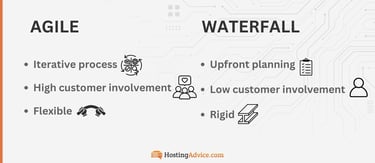
That said, Agile methodology is highly effective in fast-moving environments like software development and new product innovation. In these environments, customer needs can change quickly, and ongoing feedback directly influences the final product. Agile lets teams adapt quickly to these kinds of changes.
Of course, Agile might not be the best option for projects with super clear and unchanging requirements, strict regulatory compliance, or massive infrastructure projects where upfront planning and documentation are highly important.
In those cases, more traditional methodologies like Waterfall, with its linear approach, might be a better fit.
Benefits of Agile in Product Development
There are plenty of major benefits to implementing Agile methodology in product development. While fully adopting Agile methodology may take some time and effort, once your team is set up properly, you can expect to see some substantial improvements in a number of key areas. Here’s a quick outline of some of those areas.
- Faster time to market: Agile methodology accelerates time to market by breaking down projects into short sprints, helping allow teams to work incrementally and without having to wait for other steps of the product development cycle to be completed before they’re able to move on.
- Increased flexibility and adaptability to change: Agile methodology puts a much heavier emphasis on iterative development cycles and continuous feedback loops, which in turn allows teams to adjust quickly to changes in both the product itself and in market conditions.
- Improved team collaboration and communication: Agile methodology encourages frequent communication through daily stand-ups, sprint planning, and reviews. On top of emphasizing collaboration between team members, it also encourages collaboration between teams themselves.
- Higher product quality through continuous testing and feedback: With a constant feedback loop of data from both product testing and user feedback, teams are able to fix issues that arise during the product development cycle quickly, leading to a higher-quality product overall.
Breaking projects down into smaller chunks allows teams to adapt to changes and respond to feedback quicker, without expensive delays.
Agile encourages close collaboration through frequent communication and cross-functional teamwork, making sure everyone’s on the same page and that issues are resolved quickly. Continuous testing and regular feedback loops help catch problems early, which helps improve the product overall, and, of course, impacts customer satisfaction.
Core Agile Methodologies
There are actually a number of different ways to implement the core principles associated with Agile. Each methodology has unique characteristics, and each focuses on different aspects of project management. Here’s a brief overview of some core Agile methodologies and how they relate to the product development cycle.
Scrum
No, Scrum isn’t the layer of soap that builds up on your tub. Scrum is an Agile method that splits product development into short cycles called sprints. There are three key roles you should know about.
- Scrum Master: The first is the Scrum Master, who helps the team follow the process and clears roadblocks.
- Product Owner: Next is the Product Owner, who prioritizes tasks and represents user interests. You can think of this person as the guard rails to your project.
- Development Team: Finally, there is the Development Team, which builds and delivers the product in manageable chunks.
Scrum involves regular sprint planning, quick daily check-ins called stand-ups, sprint reviews for feedback, and retrospectives for improvement. By keeping things transparent and flexible, Scrum helps teams collaborate closely, adapt quickly, and consistently deliver better products.
Kanban
I’d never accuse Agile methodologies of having boring names. Next up is Kanban. It’s an Agile method that focuses heavily on a more visual approach to workflow management.
It uses a board with columns, which often represent stages of completion. For example, columns could be labeled “To Do,” “In Progress,” and “Done,” with tasks moved to different columns as their status changes. The idea is to continuously pull tasks through stages based on capacity, limiting “work in progress” to maintain a steady flow of updates.
This visual approach allows you to adjust as needed while still being able to see what needs to be completed and when.
Lean
Lean methodology is all about cutting out inefficiencies and helping you prioritize what’s actually important in the development cycle. The Lean approach came from manufacturing but was integrated into the Agile methodology and is still widely used in product development.
Lean emphasizes these key areas:
- Quickly testing ideas
- Identifying inefficiencies
- Improving efficiency based on feedback
Simplicity is the name of the game here — removing unnecessary steps, shortening cycle times, and prioritizing tasks that directly improve the end product. This helps you adapt quickly and ensures products better match customer needs without wasted effort or resources.
Extreme Programming (XP)
Extreme Programming (XP) is an Agile method designed specifically for software development.
It works through intense collaboration between members of a team and includes frequent testing. XP makes use of a number of different kinds of workflows, too, including pair programming (where two developers work on code together), test-driven development (writing tests first), and continuous integration (regularly merging code to catch issues early).
By combining these things, XP helps teams create reliable, customer-focused software with fewer bugs and faster delivery times.
Key Components of Agile Product Development
Agile product development relies on short, iterative cycles that allow teams to quickly deliver value, adapt to feedback, and prioritize customer needs.
It emphasizes clear communication, collaboration, and flexibility through essential practices such as user stories, sprints, daily stand-ups, and retrospectives, ensuring products continually align with user expectations.
User Stories & Backlogs
User stories are designed to inform a product’s development by emphasizing the user’s perspective, better outlining what the user needs and how features can address those needs. These so-called user stories are often organized into a list called a backlog, which is prioritized by the product owner.
Sprints & Iterations
Agile methodology breaks the development process down into shorter timeframes, called sprints. Typically, these sprints last one to four weeks each. Sprints themselves are made up of a series of manageable tasks from the backlog and are designed to deliver incremental improvements quickly.
Stand-up Meetings
Stand-up meetings are basically just daily team check-ins and are usually very short – around 15 minutes or so. The goal of stand-up meetings is for team members to communicate what they’ve accomplished and what they plan to work on next and to discuss any roadblocks they’re facing.
The process helps promote communication in teams and create a more collaborative environment that helps maintain momentum in the product development cycle.
Retrospectives
Retrospectives are structured sessions held after each sprint is completed. In a retrospective, teams look back at the sprint and their performance, identifying things that are working in their workflow and things that could be worked on.
The idea is that a team’s workflow will continuously improve over time, helping ensure a high level of productivity.
Tools for Agile Project Management
Agile teams typically use dedicated tools to stay organized, track progress, and boost collaboration.
The good news is that there are plenty of these tools available, and while they all have their own strengths and weaknesses, it shouldn’t be difficult to find one that fits your team’s needs.
- Jira: Jira is a go-to choice for many development teams, offering features tailored specifically to Agile, like managing sprints, handling user stories, and detailed bug tracking.
- Trello: For a simpler, visual approach, Trello uses easy-to-manage Kanban boards that let teams quickly see task statuses and easily move items between statuses over the product development cycle.
- Asana: Asana blends task management with useful extras like timelines, dependencies, and easy integrations. It’s great for teams mixing Agile with other working styles.
- ClickUp: ClickUp is similarly flexible to Asana. It pairs task management, customizable dashboards, and automation to help you adapt Agile practices exactly how you want.
All of these tools have expanded beyond the basics, too. For example, while Trello was originally known for its Kanban-style boards, it now offers plenty of other features to help teams stay on track, too.
The tool that’s right for your team depends on a number of different factors, and it’s difficult to label one as the best overall. That said, it’s worth looking at your team’s current workflow and how you want to change it when looking into these tools.
Wrapping Up: Agile in Action
Agile methodology is a flexible, team-driven approach to product development — and one that could help make your team more adaptable to changes, and deliver incremental updates at a fast pace.
With the small updates approach to product development, and the idea of incorporating user feedback, many teams will improve efficiency, while working together better.
Agile’s key practices — like user stories, sprints, daily check-ins, and retrospectives — help everyone stay on the same page, keep things transparent, and focus on delivering real value, even as projects evolve.