


When you think of a URL, the first thing that probably comes to mind is the top-level domain (TLD) — those familiar suffixes such as .com, .net, and .org that sit on the tail end of web addresses.
TLDs are the last segment of a domain name and are a small yet crucial key in identifying the type or purpose of a website. For example, .com (short for commercial) is typically meant for businesses, .org (organization) for nonprofits and organizations, and .net (network) for network infrastructure-related sites.
Despite its age and familiarity, .org isn’t as widely recognized as the ever-dominant .com or .net, so I would bet you’re not familiar with most of these statistics about the .org TLD. If your interest is piqued, let’s dive in.
1. There Are More Than 11 Million .Org Websites
The number of registered .org TLDs stands at a whopping 11,192,565.1 While .org domains are primarily used in the U.S., they still face intense competition from other globally used TLDs.
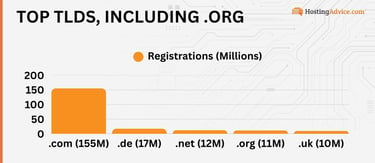
The concept of TLDs dates back to the early days of the internet. Initially, TLDs were created to categorize websites based on their intended use or geographical location. Over time, the list of TLDs has expanded to include country-code TLDs (ccTLDs) such as .uk for the United Kingdom and generic TLDs (gTLDs) such as .info, .biz, and newer ones such as .xyz, .io, and .shop.
2. There Were Fewer Than 1 Million .Org TLDs in the 1990s
The .org TLD has experienced significant growth over the past few decades. But within just a few years after its introduction in 1985, there were fewer than 1 million registered .org domains.2 Compared to today, that’s an incredible growth of 1,000% over roughly 30 years!
3. The .Org TLD Holds 4.2% of the Global gTLD Market Share
I know what you’re probably thinking: “Only 4.2%? What’s the big deal with that?” Well, although it may seem small, this tiny share makes .org the second-most popular generic TLD after .com, which dominates with a 44.4% market share.3 Plus, this “measly” 4.2% is about 11 million domains, so there’s that, too.
4. The First .Org Site Was Established In 1985
Time flies because the first .org domain has turned 40! In 1985, a nonprofit organization registered the very first .org TLD under mitre.org.4

Considering .org was originally released for nonprofits and organizations, this isn’t too surprising. But what’s actually remarkable is that mitre.org remains active today, serving the same mission under the same ownership!
5. Wikipedia.org Is the #1 Most Popular .Org Site
Wikipedia.org is the most popular .org website, drawing in nearly 6.7 billion monthly visitors, which isn’t surprising to me.5 After all, I’m one of those 6.7 billion people who use it every month. Last month, I went down a wormhole reading about the Oregon Trail. Anyway, I won’t get started on that.
Wikipedia.org is operated by the nonprofit organization Wikimedia Foundation and aims to promote open knowledge sharing through various projects, including Wikipedia.org.6
6. The 3 Most Common Types of .Org Sites Are Nonprofits, Organizations, and Charities
When the .org TLD was initially introduced in 1985, it served as a miscellaneous TLD for organizations and other entities that didn’t fit into other domain categories, like social causes or community-driven websites.7,8
In 2019, however, the restriction that limited .org domains to nonprofits was removed.9 This allowed .org to evolve beyond its original purpose. It is now widely used by other organizations, such as educational institutions, community projects, and personal websites promoting social impact and community engagement, among other issues.
7. The Cost of a .Org TLD Ranges from $5 to $20 Per Year
While .org TLDs range in cost between $5 and $20, their average cost is $12/year.10
This pricing is similar to that of .com and .net domains, which is interesting because .org is less popular. However, .org domains often have similar price ranges due to their strong reputation among organizations and historical significance as one of the original TLDs.

It also just makes sense: Keeping the .org price affordable is closely tied to many organizations’ missions, especially those in the nonprofit, educational, and community-focused sectors.
8. The .Org TLD Is 1 of 5 Original TLDs
The .org TLD is part of the original group of gTLDs — that included .com, .net, .biz, and .info — determined by the Internet Assigned Numbers Authority (IANA) in the 1980s.11
These gTLDs were called generic primarily to distinguish them from country-code TLDs (ccTLDs). Interestingly, the domains .name and .pro are also considered gTLDs, but they have restrictions that require proof of eligibility according to specific guidelines.
9. Google Index Yields Nearly 6.5 Billion .Org Search Results
An indexed website is a website or webpage discovered, processed, and stored in Google’s database, otherwise known as Google Index. Not every search result shown in Google search results is considered an indexed website.
According to the popularity of different TLDs based on the number of indexed websites, there are approximately 6.5 billion in Google search results. As a comparison, .com has 25 billion indexed results, and .net has 6 billion.12
10. Domains Under .Org Made Up Almost 6% of the Top 1,000 Global Domains
Domains under the .org TLD accounted for approximately 6% of the Top 1000 Global Domains. But generally speaking, .org accounts for 4.63% of all domains.13
| Rank | TLD | Amount (% of Domains) |
|---|---|---|
| 1 | .com | 3,070,958 (49.80%) |
| 2 | .net | 342,294 (5.60%) |
| 3 | .ru | 291,622 (4.73%) |
| 4 | .org | 285,630 (4.63%) |
| 5 | .info | 172,434 (2.80%) |
The Tranco ranking is a response to potentially flawed or unreliable ranking data in popular website ranking lists, such as Alexa, Umbrella, and Majestic. Under the carefully curated Tranco list, manipulating rankings requires significantly more effort than the lists mentioned above.
11. The Trust Rating for .Org TLDs Are 3.3 out of 5.0
The trust rating for .org TLDs is 3.3 out of 5.0.14 Since .org domains are traditionally associated with nonprofit organizations, charities, and community initiatives, this TLD can enhance an organization’s credibility and trustworthiness.
In comparison, .com domains have the highest trust rating with 3.5, making them the most trusted TLD. Following .com, .co domains are rated second with a trust rating of 3.4.
The higher trust rating of .co compared to .org — despite being a less popular TLD — is likely due to the similarity in spelling between .com and .co. One can also guess that users may also perceive .co as closely related to .com, which could prove legitimacy.
12. Ethos Capital Attempted to Purchase .Org Domain Holder for $1.135 Billion in 2019
In November 2019, private equity firm Ethos Capital announced it would acquire the Public Interest Registry (PIR) from the Internet Society (ISOC) for $1.135 billion.14 ISOC established the PIR in 2002 to manage and operate the .org domain.
The proposed acquisition raised concerns among the public. Critics worried that the deal could result in higher operating costs for .org registrants and potentially impact the integrity and availability of domain registrants.
In response to these concerns, the Internet Corporation for Assigned Names and Numbers (ICANN) rejected the sale in May 2020.
13. .Org TLDs Have a Memorability Rate of 32%
According to a survey, users can recall .org domain names correctly 32% of the time. In comparison, .com domains have the highest memorability rate at 44%, with .co following behind at 33%.15
In this context, a higher memorability rate means the TLD is more memorable and easier for users to remember without relying on bookmarks or search engines, which can lead to increased direct traffic and brand recognition.

Since .com is the default to most people, sometimes .org websites buy out the corresponding .com domain name and automatically redirect traffic to the correct site.
The memorability rate is influenced by several factors, including the length and simplicity of the domain name, the clarity of its meaning or association with the site’s purpose, and the familiarity of the domain extension, including .org.
14. In 2015, .Org’s Related Domains, .Ngo and .Ong, Were Introduced
Nongovernmental organizations (NGOs) with social, environmental, and humanitarian initiatives opt for the .org TLD. But in 2015, two new TLDs related to the cause surfaced: .ngo and .ong. Unlike .org, these TLDs require legal verification.
The .ngo TLD acts as the acronym for nongovernmental organizations and serves as the primary term in Africa (53%), Asia (52%), and Europe (31%). The .ong (Organización No Gubernamental) TLD is the same, except in romantic languages, and is most predominant in South America (35%).16 By 2017, more than 1,400 .ngo and .ong domains were sold.17
15. Craigslist.org Has More Than 127 Million Monthly Visits
While it’s a far cry from the number of visits Wikipedia gets, Craigslist.org has more than 127 million monthly visitors.18
No, you’re not experiencing a Mandela effect — there is also Craigslist.com. Craigslist.com focuses on specific localities. For example, if you visit craigslist.com/hartford, you’ll find listings around Hartford, Connecticut. On the other hand, Craigslist.org serves as a starting point for users to see their local Craigslist site based on their country’s location.
Thinking of Joining the .Org Train?
If you’re considering a new TLD, .org can be the stepping stone to showcasing your organization’s mission and purpose. From nonprofits and educational institutions to social groups, spiritual communities, and open-source initiatives, a .org domain serves best to amplify your reach and legitimacy.
Since its establishment in 1985, .org has remained a trusted platform for mission-driven organizations and remains a key part of the internet landscape.
Resources and Further Reading
- https://research.domaintools.com/statistics/tld-counts/
- https://en.wikipedia.org/wiki/.org
- https://www.statista.com/statistics/265677/number-of-internet-top-level-domains-worldwide/
- https://venturebeat.com/offbeat/the-first-org-domain-was-registered-30-years-ago-today/
- https://en.wikipedia.org/wiki/List_of_most-visited_websites
- https://techjury.net/blog/how-many-websites-are-there/
- https://www.semrush.com/blog/top-level-domains/
- https://datatracker.ietf.org/doc/html/rfc1591
- https://www.searchenginejournal.com/dot-org-registry-sold/336763/
- https://tld-list.com/tld/org
- https://en.wikipedia.org/wiki/Generic_top-level_domain
- https://www.hayksaakian.com/most-popular-tlds/
- https://www.dnsinstitute.com/research/popular-tld-rank/
- https://www.internetsociety.org/news/press-releases/2019/ethos-capital-to-acquire-public-interest-registry-from-the-internet-society/
- https://growthbadger.com/top-level-domains/
- https://www.nptechforgood.com/2017/11/03/how-to-choose-the-right-domain-name-for-your-nonprofit-charity-or-ngo/
- https://nonprofitquarterly.org/what-you-should-know-about-the-new-ong-and-ngo-domains/
- https://www.semrush.com/website/craigslist.org/overview/