




PostgreSQL may seem like a strange collection of letters to the uninitiated, but free PostgreSQL hosting can be an important tool for developers and businesses to leverage data effectively.
The relational database is similar in many respects to popular MySQL databases, but it doesn’t enjoy nearly the same support in the database hosting industry. Instead of blogs and other simple websites, PostgreSQL (pronounced post-gres-Q-L by most) is typically used for larger, more complex datasets.
With the added security, performance, and scalability requirements to successfully run PostgreSQL, the specialized services can get complicated and expensive. We’ve scoured the internet for the most trusted and affordable solutions that can lend some expertise in helping optimize your data workflows.
- Navigate This Article:
Best Overall Free PostgreSQL Host — IONOS
Free web hosting can be a treacherous landscape, fraught with scams and subpar services. But when a unicorn emerges from the mist to give developers a fast, secure, and trustworthy platform on which to build, database administrators should be quick to take advantage.
Such is the case with IONOS, which gives new customers a free $500 starting credit to use specifically for PostgreSQL hosting. The company’s scalable cloud environments enable you to customize your CPU, RAM, and storage capacity to meet your project’s specific needs.
1. IONOS.com
 | ★★★★★ /5.0 |

- PostgreSQL hosting in ISO 27001 data centers
- Fully customizable CPU, RAM, and storage
- PITR backups, vertical scaling, cluster cloning
- API, SDK, and DCD integration
- $500 in free credits to use in trial period
- Get started on IONOS now »
| Starting Price/Mo. | $0.00 |
As Europe’s largest hosting company and one of the world’s most trusted web hosting brands, IONOS represents a shining beacon in the free hosting space by offering enterprise-grade specialized services for zero cost or obligation.
In addition to giving you the freedom to build the PostgreSQL infrastructure you want, IONOS further sweetens the pot by taking care of all security, maintenance, and monitoring needs to make your job even easier.
3 Best Almost-Free PostgreSQL Hosting Services
The mythical free hosting service represents the Holy Grail to many web and application developers. Whether you’re experimenting with a new database system or don’t have the big funding to match your big idea, we understand the interest in no-cost hosting. Who wouldn’t pick a free PostgreSQL hosting option instead of a costly hosting package?
The problem is, however, that free hosting almost never delivers on any of its other promises. Sure, you can keep your bank account intact, but your personal data is much less secure. You likely need to display ads or links to your hosting provider. Your hosting environment’s resources will be extremely limited, unsupported, and unreliable.
To us, investing less than $5 per month is an extraordinarily worthwhile investment. The modest fee unlocks an incredible wealth of features and upgrades from established, cutting-edge technology businesses that are highly respected in the U.S. and around the world.
Take a look at the top-rated, ultra-popular shared hosting providers that go beyond simply supporting PostgreSQL by optimizing their systems for database stability, security, and performance:
2. Bluehost.com


- WordPress.org recommended; officially endorsed since 2005
- NVMe SSD storage, free CDN, and global data centers
- AI website builder — go live in minutes, no coding needed
- AI malware detection, WAF, DDoS protection, and free SSL
- 99.99% uptime SLA and 24/7 human support via chat/phone
- Get started on Bluehost now.


Sead Fadilpasic


Bluehost pricing is about as competitive as the industry offers.Sign up for a shared hosting plan for as little as $1.99 per month, and WordPress hosting packages are consistently priced; a VPS plan starts at…
Go to full review »| Money Back Guarantee | Disk Space | Domain Name | Setup Time |
| 30 days | 10 GB NVMe SSD | FREE (1 year) | 5 minutes |

- Best overall value: The most complete shared hosting plan at this price point
- AI builds your site in minutes — no technical skills needed
- Free domain, free SSL, and weekly backups on all plans
- Managed WordPress with AI agent and free email marketing
- 30-day money-back guarantee with 24/7 expert support
- Get started on Hostinger now.
Sead Fadilpasic
As the shared hosting market has become more saturated, things like unlimited storage, bandwidth, and email accounts have become the norm.Hostinger, however, goes above and beyond the norm by also giving users an unrestricted number of websites, databases,…
Go to full review »| Money Back Guarantee | Disk Space | Domain Name | Setup Time |
| 30 days | 20 GB SSD | FREE (1 year) | 3 minutes |

- Free domain, free SSL, and Cloudflare CDN with Argo Routing
- AI-powered malware scanning, WAF, and DDoS protection
- Unmetered bandwidth, cPanel, and 1-click WordPress installs
- Managed WordPress updates and staging on all plans
- 30-day money-back guarantee and 24/7 phone & chat support
- Get started on HostGator now.


Lynn Cadet


HostGator is a solid compromise between performance and price. Its shared hosting includes unmetered bandwidth, cPanel, one-click WordPress installs, and support for domain-based email through tiered cPanel email plans, including an unlimited-mailbox…
Go to full review »| Money Back Guarantee | Disk Space | Domain Name | Setup Time |
| 30 days | 10 GB SSD – 100 GB SSD | FREE (1 year) | 4 minutes |
See other top shared hosting options »
5 Free PostgreSQL Database Hosting Options
For those developers dead-set on trying a free option, we’ve scoured the internet for the most promising options. Free PostgreSQL database hosting ranges from permanent no-cost tiers suitable for side projects and lightweight apps, to time-limited trials designed for testing and experimentation. Know which type you’re signing up for before you build on it.
The hosts above are general-purpose providers that support PostgreSQL alongside other databases. The options below are purpose-built or specialized for PostgreSQL specifically, a meaningful difference if database performance and flexibility are your top priority.
If you need a paid managed option beyond what’s listed here, ScaleGrid is worth exploring.
5. Aiven
Aiven is a fully managed database platform that offers a permanently free PostgreSQL tier with no credit card required and no time limit. The free plan is intentionally limited in size but runs indefinitely, making it a reliable option for side projects, learning, and lightweight applications that need a managed Postgres environment without the risk of a trial expiring mid-project.

The platform itself is enterprise-grade: deploy to your choice of AWS, Google Cloud, Azure, or DigitalOcean, with automated backups, point-in-time recovery, connection pooling, and over 70 PostgreSQL extensions, including TimescaleDB. Setup takes under 10 minutes via the web console, the API, the CLI, Terraform, or a Kubernetes operator.
When you’re ready to scale, Aiven’s $300/30-day trial credit lets you test larger paid configurations before committing. Paid plans offer full high availability, longer backup retention, and multicloud replication. For a free managed PostgreSQL service with a credible upgrade path, Aiven is one of the strongest options in this article.
6. Supabase
Supabase has quickly become one of the most popular PostgreSQL platforms for developers, positioning itself as an open-source alternative to Firebase with a genuinely useful free tier. The free plan includes 500MB of database storage, 1GB of file storage, 5GB of bandwidth, and up to 50,000 monthly active users across two projects — no credit card required.

What makes Supabase stand out beyond raw PostgreSQL is its full-stack approach: authentication, file storage, edge functions, real-time subscriptions, and auto-generated REST and GraphQL APIs are all included and wired together out of the box. For developers building modern web or mobile applications, it dramatically reduces the backend setup time.
The main caveat worth flagging: free projects are automatically paused after 7 days of inactivity. They wake up when accessed, but this makes the free tier unsuitable for production apps that might go quiet for a week. There are also no automated backups on the free plan. For experimentation, MVPs, and side projects, however, Supabase’s free tier is one of the most generous in the PostgreSQL space. Paid plans start at $25/month.
7. Neon
Neon takes a different architectural approach to PostgreSQL hosting — serverless and usage-based, with compute that scales to zero when idle, so you only pay for what you actually use. The free tier includes 100 compute hours per month per project and 0.5GB of storage, with no credit card required and commercial use allowed.

Acquired by Databricks in May 2025, Neon has since reduced prices significantly — compute costs dropped 15-25% and storage pricing fell dramatically post-acquisition. The free plan doubled its compute allowance as part of those changes, making it one of the most improved free PostgreSQL options heading into 2026.
Neon’s standout feature is database branching — the ability to instantly create isolated copies of your database for development, testing, or CI/CD pipelines without duplicating storage costs. For developers working in teams or shipping frequently, this is a genuine productivity advantage over traditional managed Postgres.
The free tier is best suited for prototyping and development; the 0.5GB storage limit will constrain anything approaching production scale. Paid plans start at $5/month.
8. HelioHost
A veteran of the free web hosting industry, HelioHost has offered no-cost server space for more than 12 years. Instead of charging customers a monthly or annual fee, the 501(c)(3) nonprofit organization relies on donations and volunteer support. HelioHost users contribute to the platform’s surprisingly good technical support, found in forums, Discord chat, and even via telephone.

HelioHost owns its own hardware, featuring seven servers colocated in Silicon Valley (the organization is crowdfunding the purchase of an eighth server). The full-stack access from knowledgeable admins enables HelioHost to offer surprisingly well-rounded free hosting plans. In addition to Postgres, the company supports ASP.NET, Java and Java Server Pages, Ruby on Rails, Django, Python, and Perl.
HelioHost most closely matches the almost-free web hosting providers listed at the top of the article with its inclusion of free cPanel, unlimited bandwidth, custom email addresses, and the Softaculous auto-installer to go with 1GB of storage (you can get more by contributing to fundraisers).
9. Amazon RDS
A go-to cloud computing service trusted by the likes of Netflix, Facebook, and Major League Baseball, Amazon Web Services is one of the largest hosting companies in the world. The platform boasts tons of innovative products for machine learning, analytics, gaming, enterprise applications, and many others — including managed hosting services with Postgres.

Amazon RDS for PostgreSQL emphasizes cost-effective and efficient scalability while managing complex and time-consuming administrative tasks. The included AWS Management Console makes it extremely easy to deploy automatically configured Postgres databases geared for optimal performance.
Given the stature and clout AWS enjoys in the industry, developers might be surprised to learn that the company has a free tier geared toward helping developers test and tinker with new ideas or giving new customers a chance to get familiar with the platform. The free tier lasts one year and includes 750 hours of service with 20GB of SSD storage and 20GB of additional SSD storage for backups.
What is PostgreSQL?
Billed as the world’s most advanced open-source relational database, PostgreSQL is a relational database management system that boasts more than 30 years of active development. The platform, built for storing large amounts of complex data, extends SQL with a focus on scalability and security for mission-critical data processing workloads.
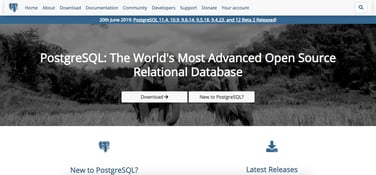
As is the case with other relational databases, PostgreSQL is used to store, filter, edit, and deliver table-based information to websites, apps, and other online systems. The flexible system runs on all major operating systems and carries a strong reputation for reliability, performance, data integrity, and extensibility.
PostgreSQL traces its roots back to a 1986 project at the University of California at Berkeley that sought to efficiently and completely support data types and relationships. SQL support was added in 1994, boosting its popularity and adoption rates. To date, more than 400 contributors have made more than 45,000 commits.
What is the Best Free Managed PostgreSQL Hosting?
It depends on your use case, but here’s how the top free options compare at a glance:
| Host | Free Storage | Time Limit | Credit Card Required | Managed | Best For |
|---|---|---|---|---|---|
| IONOS | $500 credit | 30 days | Yes | Yes | Enterprise-grade trial |
| Aiven | Limited | None | No | Yes | Permanent free managed Postgres |
| Supabase | 500MB | None* | No | Yes | Full-stack app development |
| Neon | 0.5GB | None | No | Yes | Serverless, branching, CI/CD |
| Amazon RDS | 20GB SSD | 12 months | Yes | Yes | AWS ecosystem integration |
| HelioHost | 1GB | None | No | No | Nonprofit, general free hosting |
For a truly permanent free tier with no credit card required, Aiven and Neon are the strongest options. If you need more features out of the box for app development, Supabase is hard to beat despite the inactivity pause.
Is PostgreSQL Free to Use?
Yes — PostgreSQL itself is completely free and open-source under the PostgreSQL License, which is similar to the MIT License. There are no licensing fees to download, install, or use PostgreSQL, even for commercial applications.
What you may pay for is hosting. Running PostgreSQL on a server requires compute, storage, and bandwidth, which cost money unless you use one of the free tiers covered in this article. Many developers start on a free tier and upgrade to a paid plan as their project grows.
How Do I Choose a Web Host?
When you embark on your journey to choose a PostgreSQL host, there are a few things you should know to guide your decision. Consider these tips as your map to find a treasured host.
- Understand your hosting requirements: This should be your first step in choosing a host. You need to evaluate how much control you need over your server environment. You’ll need a VPS or dedicated server if you want full root access.
- Evaluate available resources and limitations: Each web host has different storage, RAM, capacity, and database limits. Select one that provides enough room for you to host your database.
- Ensure data security and backup solutions: Server security is critical. Only choose a web host that offers a robust suite of security tools, including automatic backups, server monitoring, a WAF, and DDoS protection.
- Plan for scalability and growth: You’ll need more resources if your project grows. Look for a web host that offers several tiers of plans that you can upgrade to if you outgrow your current package. Ideally, your host should offer at least VPS or cloud hosting.
Once you make a shortlist, compare plan pricing and select the provider that best meets your needs.
What is the Difference Between PostgreSQL and MySQL?
PostgreSQL is an object-relational database management system (ORDBMS), while MySQL is a relational database management system (RDBMS). PostgreSQL is ACID-compliant while MySQL is not.
PostgreSQL uses data types that are more advanced, and MySQL uses primitive data types. PostgreSQL is better for large and complex datasets, while MySQL is better for small to medium-sized datasets.
How Much Does PostgreSQL Cost?
It’s free to create a Postgres database. There are no licensing fees to download, install, or use PostgreSQL, even for commercial applications. What you pay for is hosting.
Here’s a realistic breakdown of what PostgreSQL hosting costs:
- Free tiers: Aiven, Neon, and Supabase all offer permanently free PostgreSQL plans with storage limits ranging from 0.5GB to 500MB. Good for prototyping and side projects.
- Shared hosting with PostgreSQL support: $2 to $4/month for entry-level plans from providers like Bluehost, Hostinger, and HostGator. Best for small websites and simple applications.
- Managed cloud PostgreSQL: $5 to $25/month for entry-level managed plans from providers like Neon ($5/month) and Supabase ($25/month). Designed for production applications.
- Enterprise managed PostgreSQL: $50 to several hundred dollars per month for high-availability configurations with dedicated resources, multi-region replication, and SLA guarantees — typical of Amazon RDS Standard plans and Aiven’s Business and Premium tiers.
The right tier depends entirely on your database size, traffic, and uptime requirements. Most developers start on a free tier and upgrade once their project outgrows the storage or connection limits.
Is PostgreSQL Better Than MySQL?
Whether you’re capturing analytics on your application performance or writing a blog, a secure, reliable, and highly available database is essential to everyone, from individual website owners and application developers to global enterprises.
The majority of website owners are probably more familiar with the industry-standard MySQL and MS SQL database systems, which have much broader usage in affordable web hosting plans. MySQL, a core component of the ubiquitous LAMP stack, drives the databases for popular content management systems like WordPress, Drupal, and Joomla.
For those with larger and more complex datasets, though, an alternative solution like PostgreSQL might be more appropriate — even though it’s not supported nearly as widely among hosting providers. Uber, Netflix, Instagram, and Spotify are all companies that use PostgreSQL, which is also important for organizations that need to track medical records, oversee customer service operations, and collect sensor data from IoT devices.
Generally speaking, small websites on a shared hosting plan are probably best suited to use MySQL, which will consume fewer resources and run faster. PostgreSQL is typically best for business-oriented applications or scenarios that require extensive development work or stringent data integrity standards.
How Do I Install PostgreSQL?
You can download PostgreSQL from the official website. The installation process is different for each operating system. For Windows, you can use the graphical installer. For Linux, you can use the apt package manager. For macOS, you can use the Homebrew package manager.
Next Steps: Finding the Best PostgreSQL Server Hosting
Because PostgreSQL is typically reserved for complex data systems and enterprise-grade organizations, it’s not commonly found on affordable shared hosting plans. Once you get familiar with Postgres through one of the hosts we’ve listed above, you’ll probably want to upgrade to a VPS or dedicated server relatively quickly to provide your database with a more permanent home.
The extra computing power will make your database apps much more scalable, performant, and reliable — all the hallmarks of the professional and innovative brand you’re looking to establish.
Fortunately, the added control and customizations associated with the upgraded hardware open up the hosting options for database administrators to install PostgreSQL. Pay attention to the level of support or expertise you can expect from these hosts, however; some merely tolerate PostgreSQL, while others can actively support you if something goes wrong.
Here are some of the hosts we recommend for VPS-based PostgreSQL:
If you’re planning to develop applications or need to manage a large amount of data, know that PostgreSQL is free and available for public download. Your host should provide the tutorials or knowledge base articles to help you get started, or be sure to head over to the PostgreSQL community discussion area for more help.
HostingAdvice.com is a free online resource that offers valuable content and comparison services to users. To keep this resource 100% free, we receive compensation from many of the offers listed on the site. Along with key review factors, this compensation may impact how and where products appear across the site (including, for example, the order in which they appear). HostingAdvice.com does not include the entire universe of available offers. Editorial opinions expressed on the site are strictly our own and are not provided, endorsed, or approved by advertisers.
Our site is committed to publishing independent, accurate content guided by strict editorial guidelines. Before articles and reviews are published on our site, they undergo a thorough review process performed by a team of independent editors and subject-matter experts to ensure the content’s accuracy, timeliness, and impartiality. Our editorial team is separate and independent of our site’s advertisers, and the opinions they express on our site are their own. To read more about our team members and their editorial backgrounds, please visit our site’s About page.