

Key Takeaways
The Lone Star State is known for a lot of things — barbeque, football, and vast skylines with some of the most beautiful sunsets in the country. It’s also known for its low taxes, cheap land, and forgiving regulation. And if you were a provider looking to plant their company’s flag in the U.S., you’d start with going south to start signing paperwork.
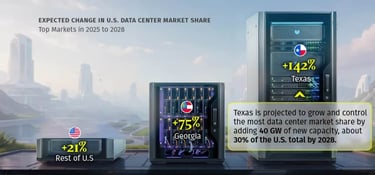
Texas is one of the most incentive-friendly states for data centers, offering generous tax breaks, including sales tax exemptions on equipment. The state is now home to around 400 data centers and is expected to see the largest growth in market share, projected to increase by 142% by 2028.
Some argue that this is great for the local economy, bringing in more jobs. But recently, Texas lawmakers have been admitting the special treatment data centers get is a long-term problem.
“These new numbers are extremely concerning and I will say they’re unsustainable,” said state Senator Joan Huffman. “I plan to look at filing legislation to either repeal the exemption or take a very close look at it and see.”
Since Texas data centers are exempt from paying sales tax on equipment, Texas projected those exemptions would cost around $130 million per year in lost tax revenue for the state. By 2026, it surpassed $1 billion.
Is There a Plan B?
It’s still too early to know exactly what the tax picture will look like (assuming lawmakers do take action). But if you’re planning to keep servers in Texas long term, you may want to look over the numbers and make sure the state still actually makes sense.
And if you’re looking to leave, there are a few alternatives, though none of them are quite like Texas.
Data Center Alley in Virginia is one of the most established hubs in the U.S. But it’s already slowing down, running into its own set of problems, from power constraints to growing local pushback over zoning, cost, and environmental impact.

It’s likely going to happen in El Paso: Meta’s data center requires a $473 million gas power plant to meet its predicted energy demand. While Meta is expected to cover costs upfront, officials worry utilities could later pass those costs on through higher electricity rates.
Concerns like these are everywhere. By 2025 alone, more than $900 million in projects had been blocked and $46 billion delayed in Virginia, according to Data Center Watch. That’s a lot of space that wants to be built with surrounding residents vehemently opposing each one.
Even in the states that are welcoming these big buildouts, the welcome mat only goes so far.
In some places, it’s lawmakers starting to question whether the incentives still make sense; in others, its residents pushing back on land use, power demands, and rising costs. Sometimes, it’s just down to physical infrastructure — there’s simply not enough power, space, or materials at the ready to keep scaling the way providers want.
So if you’re shopping for a new home for your servers, it’s probably not just about how cheap it is anymore, but which states will give you the least number of problems.