


Key Takeaways
When was the last time you heard a client ask for self-hosted infrastructure? You may not think it’s up-and-coming, but the numbers say otherwise.
According to a new report by Market.us, the global self-hosting market is expected to skyrocket from $15.6 billion in 2024 to $85.2 billion by 2034 at a 18.5% CAGR.
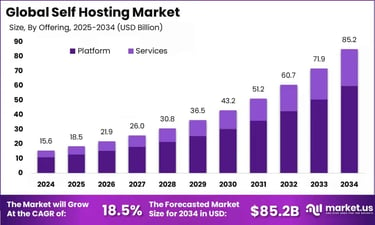
That’s not bad for a relatively small corner of the web that’s long been seen as the region for sysadmins, hobbyists, and privacy enthusiasts.
For a long time, self-hosting appealed mostly to those who needed utmost control. But as of late, it’s more about practicality: Some customers are deciding they’d rather manage their own stack than keep paying for uncertainty.
Why Self-Hosting Is Picking Up
According to the Market.us analysts, there are a few trends that are all converging at once:
- Businesses are becoming more technically literate, meaning the need for self-hosting is becoming more practical and attainable. It’s especially driven by highly sensitive industries — like health care, finance, and legal services — where third-party SaaS platforms could compromise compliance or data security.
- Open-source is becoming more standardized, which, alongside low/no-code platforms, is lowering the barrier to entry for novice developers and small businesses experimenting with their own tools.
- The cost of the cloud is getting sky-high. Many companies that migrated to the cloud years ago are still dealing with unpredictable costs and are overprovisioning their resources (and paying for it).
- Data privacy and compliance laws are locking in even more, so there’s really no room for error, especially in those aforementioned highly sensitive industries. AI is also changing everything privacy-related, but keeping AI systems on-prem can better guarantee the protection of sensitive data and compliance.
Who’s Actually Driving Demand
As of 2024, platform-based self-hosting accounts for more than 70% of the total market. Unlike SaaS, these platforms give organizations the flexibility to run everything themselves — from deployment to security to compliance — and it’s particularly attractive to those sensitive industries we keep mentioning.

Enterprise customers make up a whopping 82.7% of the end-user market for self-hosting, which is as predicted. Thanks to their highly sensitive and industry-specific demands, off-the-shelf SaaS tools don’t always work. Many companies have recently stated they’re moving off public clouds and back into private data centers or on-prem infrastructure.
As for which companies are helping drive the self-hosted demand, Market.us lists Nextcloud, Supabase, Verpex, GoDaddy, and InMotion Hosting among the top five.
Regionally speaking, North America dominated the self-hosting market, accounting for 34.9% of global revenue (around $5.44 billion). The U.S. in particular is moving fast with a CAGR of 16.2% (compared with the 18.5% globally). Of course, that really comes as no surprise — the U.S. has pocket-to-the-floor-deep enterprise roots, strict compliance laws, and is widely known for its tech startups and innovations.

But that’s not to say other countries aren’t following closely. Germany, France, and the U.K. in Europe are moving fast, as are China and Japan across much of APAC. And there’s plenty of growing activity in Brazil, Mexico, South Africa, Saudi Arabia, and the UAE.
Where This Leaves Hosts
Self-hosting isn’t bad news for hosting providers. Over the next few years, hosts can expect new waves of clients:
- Expect more interest in simpler infrastructure — things like bare metal, VPS, and containers
- Hybrid setups will likely become more common since customers can run parts of their stack themselves but still rely on hosting infrastructure
- Providers that already support open-source tools, automation, or hands-on deployment help may be the first to see this
- Managed providers that offer hybrid DIY-supported hosting models could also see major interest
If there’s anything hosts should take away from this, it’s that large organizations want to decide how their systems are set up and managed. It’ll be important for providers to offer a level of control and flexibility over the next decade.