
Surprisingly, Netflix Didn’t Go Down During the “Conformity Gate” Traffic Surge. Here's Why

Writer: Jordan Sprogis

Jordan Sprogis, Contributing Expert

Jordan Sprogis is a creative writer and tech researcher who has been working on online content for the better part of a decade. She holds a bachelor's degree in professional writing from Western Connecticut State University and has devoted much of her career to crafting content for various web verticals, including CyberSpyder and The Echo. Since joining HostingAdvice, Jordan has combined her storytelling ability with her fascination for advancements in technology to pen over 500 articles geared toward industry pros and newcomers alike.

Editor: Lillian Castro

Lillian Castro, Senior Editor

Lillian Castro brings more than 30 years of editing and journalism experience to our team. She has written and edited for major news organizations, including The Atlanta Journal-Constitution and the New York Times, and she previously served as an adjunct instructor at the University of Florida. Today, she edits HostingAdvice content for clarity, accuracy, and reader engagement.

Reviewer: Cristian Lopez

Cristian Lopez, News Manager

Cristian Lopez uses his Business Marketing background from the University of Illinois at Chicago to create comfortable environments for customers, clients, and colleagues to share their thoughts and ideas openly. From interviewing tech leaders to conducting UX market research projects, Cristian knows the importance of storytelling — a key variable for innovation and inspiration. His goal at HostingAdvice is to wow readers on the ever-evolving nature of the tech industry and bring his audience the most reliable and exciting content on all things hosting.

Follow the HostingAdvice team for a daily dose of tech news, trending IT discussions, and interviews with the web's most innovative technologists.
Follow Us:
2.7k
1k

The fast-spreading fan theory dubbed “Conformity Gate” had thousands of Netflix users logging on around 8 p.m. Eastern time on Jan. 7. They all expected a surprise “Stranger Things” finale, but nothing new ended up coming out. Still, the rush to the platform was ever-present.

And yet, Netflix didn’t fold under the traffic pressure. It’s impossible to know exactly how much Netflix actually saw that night, but most users appeared to experience little more than brief slow-loading.

While Downdetector received about 1,400 reports, they were scattered between 7:55 p.m. and 8:10 p.m. Eastern time, and there were no spikes that were actually sustained and nothing official from Netflix’s status page.
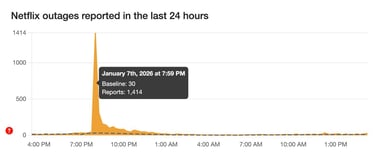
Netflix outages reported in the last 24 hours - Downdetector
Source: Downdetector

The expectation that Netflix would have crashed isn’t totally irrational. “Stranger Things” pulled in 59.6 million views within five days of the premiere of its final season. When that much traffic shows up at the same time, crashes tend to feel…inevitable.

We reached out to Netflix for comment, but did not receive a response by the time of publication. Still, the company has been fairly open over the years about how its infrastructure is built.

So, Why Didn’t Anything Happen?

Netflix’s preplanning and infrastructure purposely helped avoid something more catastrophic.

To start, Netflix operates its own proprietary global CDN, Open Connect, which uses edge caching, predictive capacity planning, and cloud autoscaling.

Netflix gives guaranteed priority to playback requests, while background pre-fetching is allowed only if the system has spare capacity. Source: Netflix Tech Blog

Netflix’s architecture also splits control-plane services in the cloud (like account and metadata requests) from the data plane that streams video via edge caches, so it isolates and scales different workloads separately.

Its engineers also use Chaos Monkey, which intentionally injects issues into production so systems learn how to react to specific issues or behaviors.

Also, you have to consider that not every traffic request hits Netflix the same way.

During busy spikes, Netflix uses a method called “prioritized load shedding.” If the system sees an unusual amount of activity, it protects the information actually needed to start playback, and gets rid of the less important background work first, like browsing-related preloading and previews.

While Conformity Gate likely caused a surge in activity, most of that extra load would have landed on the background work mentioned.

And that’s why thousands of users barely noticed a hitch. For the most part, at least.

About the Author

Contributing Expert

Jordan Sprogis is a creative writer and tech researcher who has been working on online content for the better part of a decade. She holds a bachelor's degree in professional writing from Western Connecticut State University and has devoted much of her career to crafting content for various web verticals, including CyberSpyder and The Echo. Since joining HostingAdvice, Jordan has combined her storytelling ability with her fascination for advancements in technology to pen over 500 articles geared toward industry pros and newcomers alike.

« BACK TO: BLOG

Meet the Experts

Our team of experts with a combined 50+ years of experience in web hosting serve insight and advice to more than 20 million users!

We Know Hosting

$

4

8

,

2

8

3

spent annually on web hosting!