


Key Takeaways
- DuckDuckGo says traffic to its AI-free search experience has gone up 3x since Google announced more agentic answers and search capabilities.
- DuckDuckGo became famous for what it didn't collect, and now it's gaining attention for something else it isn't forcing on users.
- Is this no-AI lane something hosting providers should consider?
DuckDuckGo, the privacy-first search engine, just reported that its AI-free search engine jumped nearly 28%. It also reported that U.S. app installs increased by around 20% week over week.
This growth comes just a week after Google made its latest AI upgrades — including more AI Mode capabilities and AI-generated answers, as well as new agentic search features designed to complete tasks directly within Search.
“We’ve been getting feedback internally and from trusted testers, and they’ve found AI Mode incredibly helpful — they particularly appreciate the speed, quality and freshness of responses,” the official Google Search blog reads.
And yet, a triple-digit rise in DuckDuckGo usership says there’s a smaller group who are not as convinced.
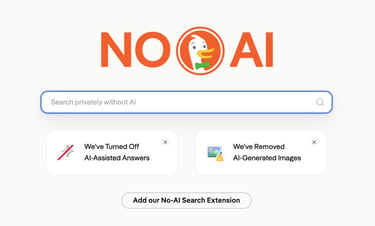
DuckDuckGo has traditionally pitched itself as the privacy-led alternative to search engines like Google and Bing. Recently, the company launched and has been promoting its No AI search experience at noai.duckduckgo.com, where AI features are disabled by default.
This isn’t quite a flip-the-table moment for search. Google controls 85% of U.S. search traffic, while Bing holds nearly 10% and DuckDuckGo sits below 2%. The company’s recent surge is impressive, absolutely, but it’s far from threatening anyone’s dominance.
DuckDuckGo Is Trending, but Google Still Owns Search
DuckDuckGo's recent surge has sparked conversation around AI-first search, but it still accounts for less than 2% of the U.S. search market.
This Is About More Than Privacy
So what exactly is DuckDuckGo offering that Google isn’t?
- No search history
- No user profiles
- No personalized ads
- No third-party tracking
- No selling user data
- Automatic HTTPS encryption
- Email (AKA spam) protection with a @duck.com address that forwards to a user’s real inbox
- Mobile app tracking protection
Google and Bing, by comparison, rely heavily on user data to personalize search results, advertisements, and recommendations. While the desire has evolved — just look across Reddit and social media and it’s easy to see that users aren’t only talking about data collection, but actually complaining about AI SERPs.

In a r/technology discussion about DuckDuckGo’s growth, one user wrote, “Google just sends me to Reddit all the time anyway. Switched a while back.”
Now, none of this is to say that DuckDuckGo is rejecting AI entirely. Quite the opposite, in fact: The company offers duck.ai, AI-assisted answers, and AI chat features. But users can toggle them off as they like — which really gets to the core issue: People want to choose whether or not they’ll use AI.
Or, in the words of Gabriel Weinberg, founder and CEO of DuckDuckGo: “Google is force-feeding AI with no way to opt out. As result, their results are getting worse, not better.”
Traditional KPIs in an AI Era?
Hosting providers have spent the last year preparing clients for a future that is run by AI agents, AI summaries, and … well, fewer clicks. But DuckDuckGo’s sudden popularity is basically positing: What if some users don’t actually want that future?
Google’s updates are designed to answer in the search results, meaning users don’t click through to the actual external websites. Convenient for some, but we already know how much it’s hurting publishers, bloggers, eCommerce businesses, and other organizations that depend on organic traffic.
Agentic AI ultimately means fewer opportunities to attract visitors, which is not good for orgs that depend on that KPI. For those in hosting, this concern is not exactly new.
Over the past year, we’ve covered how AI is steadily changing the relationship between users and websites. From Google’s AI Overviews reducing click-through rates to Shopify’s push toward agentic commerce inside ChatGPT, the industry has been pushing toward a future where users get answers (and even complete purchases!) without ever visiting the website that runs them.
We’ve also heard concerns from hosting providers themselves. Kinsta’s Roger Williams has described the trend as the “cannibalization of web traffic,” warning that AI is essentially absorbing the traditional search journey.
DuckDuckGo is still a tiny player in a market dominated by Google, but it’s clearly benefiting just by offering a simpler alternative. Not bad for a search engine with a duck mascot.