
Why a Small Site’s Sudden Global Traffic Spike Wasn’t What It Looked Like

Writer: Jordan Sprogis

Jordan Sprogis, Contributing Expert

Jordan Sprogis is a creative writer and tech researcher who has been working on online content for the better part of a decade. She holds a bachelor's degree in professional writing from Western Connecticut State University and has devoted much of her career to crafting content for various web verticals, including CyberSpyder and The Echo. Since joining HostingAdvice, Jordan has combined her storytelling ability with her fascination for advancements in technology to pen over 500 articles geared toward industry pros and newcomers alike.

Editor: Lillian Castro

Lillian Castro, Senior Editor

Lillian Castro brings more than 30 years of editing and journalism experience to our team. She has written and edited for major news organizations, including The Atlanta Journal-Constitution and the New York Times, and she previously served as an adjunct instructor at the University of Florida. Today, she edits HostingAdvice content for clarity, accuracy, and reader engagement.

Reviewer: Cristian Lopez

Cristian Lopez, News Manager

Cristian Lopez uses his Business Marketing background from the University of Illinois at Chicago to create comfortable environments for customers, clients, and colleagues to share their thoughts and ideas openly. From interviewing tech leaders to conducting UX market research projects, Cristian knows the importance of storytelling — a key variable for innovation and inspiration. His goal at HostingAdvice is to wow readers on the ever-evolving nature of the tech industry and bring his audience the most reliable and exciting content on all things hosting.

Follow the HostingAdvice team for a daily dose of tech news, trending IT discussions, and interviews with the web's most innovative technologists.
Follow Us:
2.7k
1k

After leaving GoDaddy for a private host, a small U.K.-based publication, Anglican Mainstream (AM), saw a sudden spike in international visitors. Close to 80% of its traffic now comes from outside the U.K., including 65 daily website visits originating from China.

The website was frozen by GoDaddy in February due to copyright infringement, though AM rejects this claim, saying the removal was due to its orthodox Anglican commentary.

Source: GoDaddy

After weeks without a site, a U.K. businessman offered to privately host AM. Since the transition, its co-founder, Canon Dr. Chris Sugden, said the spike was the positive outcome of leaving GoDaddy.

“What initially felt like a disaster — even a spiritual attack — has proved to be God’s means of placing us on a firmer technological footing and extending our reach far beyond what we imagined,” he said.

It’s a dangerous assumption. Why would non-U.K. readers be regularly accessing a Church of England site? And why would Chinese readers be interested in a Christian site written in English?

Why Traffic Spiked After Leaving GoDaddy

These days, sudden traffic spikes aren’t always new visitors, so what AM saw after its migration is not much of a surprise anymore.

For the first time, automated traffic has officially surpassed human activity: Imperva’s 2025 Bad Bot Report found that bots now account for more than half of all web traffic.
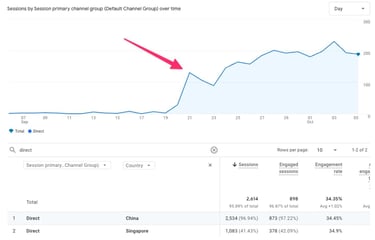
Screenshot of GA4  graph traffic
This GA4 user noticed a spike from China and Singapore. Source: mnc_pic

And recently, site owners using Google Analytics (GA4) say they’ve seen sudden traffic spikes attributed to places like China and Singapore.

Google’s analytics platform records any site action as “events,” such as page_view and session_start, or as simple as scrolling and clicking.

While those events are logged by GA4, they don’t require a full page load, which tells you what the browsing visitor is actually doing. And that just makes it so much easier for bots to fly under the radar.

It’s not uncommon for modern day automated tools to route through IP ranges in these regions.
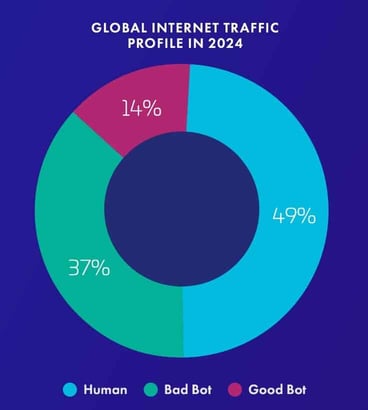
Source: Imperva

SEO sites like DefiniteSEO, for example, found that sudden GA4 traffic spikes in these regions are almost always “inauthentic sessions from automated systems,” which show typical bot patterns (low engagement, high bounce rates).

Since China and Singapore are major hosting hubs, they’re commonly used by VPN services, hosting providers, and bulk automated tools.

And hosting migrations make these kinds of analytics even more skewed because when a site moves, its DNS and IP records also change. Those kinds of changes will attract crawlers, scanners, and bots.

It’s easy to misread “good” news like this, so hosts need to make sure they’ve turned on bot filtering and rate limiting — and yes, they’re protections many managed hosts already apply, but they can be especially easy to miss during migrations.

About the Author

Contributing Expert

Jordan Sprogis is a creative writer and tech researcher who has been working on online content for the better part of a decade. She holds a bachelor's degree in professional writing from Western Connecticut State University and has devoted much of her career to crafting content for various web verticals, including CyberSpyder and The Echo. Since joining HostingAdvice, Jordan has combined her storytelling ability with her fascination for advancements in technology to pen over 500 articles geared toward industry pros and newcomers alike.

« BACK TO: BLOG

Meet the Experts

Our team of experts with a combined 50+ years of experience in web hosting serve insight and advice to more than 20 million users!

We Know Hosting

$

4

8

,

2

8

3

spent annually on web hosting!