


Key Takeaways
- Blocking, allowing, rate-limiting — some hosting proviers have tried it all for their client sites.
- Semrush’s new report is the most expansive of its kind to date, and it suggests the effort may have been worth it.
- There are things hosts can do to help their clients stay seen without becoming an SEO shop themselves.
Hosting providers finally have some evidence about what AI search engines are actually doing: A Semrush report analyzing 126 million U.S. AI search prompts found that ChatGPT and Gemini don’t just crawl the web differently, but they cite it differently, too.
ChatGPT cites an average of 15 sources per response, while Gemini cites just three. This means the same website could be crawled by multiple AI platforms and see totally different types of visibility and potential referral traffic. ChatGPT leans heavily on community and reference sites like Reddit and Wikipedia, and Gemini primarily cites Wikipedia, Reddit, and YouTube.
Now, these preferences explain where AI gets its information, but it doesn’t really explain whether a client’s own website is the source being credited. And that’s what could drive direct traffic.
Why AI Mentions Don’t Equal Citations
First thing’s first: A mention isn’t the same as a citation. A citation is the source that an AI model references, while a mention puts the brand’s name directly in the answer.
Take Patagonia: Semrush says it held an AI visibility score of around 80 — almost completely supported by other sources like Reddit and REI instead of Patagonia’s own site.
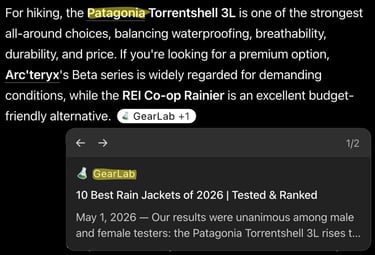
And if you were to ask ChatGPT to tell you about Patagonia’s Torrentshell 3L, you’ll see that even though it mentioned Patagonia’s brand name, its citations were both GearLab.
On Gemini, only about 30% of the brands it mentions are also the websites it ites as sources. This means a brand can show up in AI search answers even if the AI got its information from a different website.
Improving Your AI Readability Score
If an AI is able to read, understand, and pull information from a webpage, Adobe (Semrush’s parent company) says that page has a higher “Citation Readability Score.” It’s basically a measurement of how easy a page is for AI to parse and cite.
Adobe’s findings are fascinating because they provide much more context to the questions we were kind of guessing on before.
For example, homepages matter a lot more than some may think: Retailers with the highest AI visit share had homepage readability scores of 52% higher than the lowest performers. Search results pages were 32% higher, blog/news content 30% higher, and buying guides 23% higher. Adobe calls these “entry and discovery” pages.
Top AI-Traffic Sites Have More Complete Content
Source: Adobe Digital Insights, February 2026
The content on these pages is just as important. Companies that brought in the most AI traffic had:
- 53% fewer missing words on the homepage
- 38% fewer missing words on brand landing pages
- 28% fewer missing words on content pages
Adobe says this suggests that AI struggles when relevant information is in things like images, JavaScript heavy layouts, or otherwise aren’t very machine-readable friendly.
If you want a look at who’s doing it right, only 36 brands maintained top-100 visibility across all four platforms, which included YouTube, Google, Reddit, Amazon, Facebook, Apple, Walmart, Disney, and Nintendo.
The industry matters the most: In News and Media, the top three brands account for 82.9% of total category visibility. Consumer Electronics isn’t far behind at 76.9%. The Finance and Industrial markets are not nearly as crowded, coming in 41.4% and 42.2%, respectively.
Semrush says these categories could actually be opportunistic for “brands to gain visibility over time,” which suggests that what determines a client’s odds is more about their industry. And that’s exactly where hosting providers can step in.
The Host’s Role in AI Visibility
We used to be able to see exactly where our traffic was coming from, and thanks to AI search, an entire category feels shielded. Until someone figures that one out, hosts can do what they’ve always done: take care of the boring part of infrastructure work.
That could mean adding schema markup validation into the hosting dashboard; sitemap checks that flag pages that need a refresh; monitoring TTFB, and helping clients understand what robots.txt and llms.txt do.
Adobe’s research specifically shows that clear page structure, complete textual content, descriptive product and support pages, and organized informational content are all things that are proven to make sites easier for AI to interpret and potentially cite.
Hosts were sort of put into this partnership position, but it also looks like they’re embracing it. A WebPros/CloudLinux industry survey of 446 hosting providers found 50% see themselves expanding services, such as site builds and security remediation, as new sources of revenue.
As AI search is changing how consumers discover websites, helping clients earn citations could become one more way for hosts to prove their value.