


Key Takeaways
- Community tensions, budgetary constraints, and travel challenges guaranteed some struggles for WordCamp Europe 2025. Yet, the event proved that WordPress is still moving forward with force.
- HostingAdvice spoke with WordCamp Europe attendees from Kinsta, Hostinger, and WP Rocket about the major trends shaping WordPress this year, including AI’s growing role in the ecosystem.
Nestled along the Rhine River, more than 1,700 people traveled to Basel, Switzerland, for this year’s WordCamp Europe (WCEU) event, which took place June 5-7.
AI and user experience were the main focuses this year — but many attendees said the event also emphasized its true strength: its community.
See, a boost of morale was important this year because this year’s event looked slightly different from last year’s in Torino, Italy, which drew nearly 3,000 attendees. And it appears that spirits did remain high.
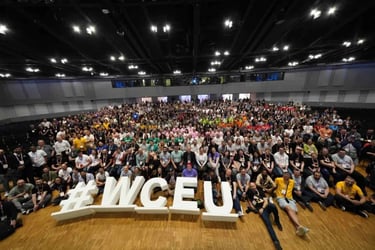
Marcel Bootsman at Kinsta credited the contagious energy and ongoing commitment to its attendees throughout the two-day event.
“This WordCamp powerfully reminded me that the human element of WordPress remains its greatest asset,” he said. “It felt like a true celebration of the people who make WordPress what it is.”
So, while AI was the central topic of conversation this year, the community behind the WordPress ecosystem was just as loud.
Why This Year Looked Different from the Last
Steve Mosby, one of the event coordinators, said organizers anticipated a smaller turnout.
Basel was chosen for its central European location and commitment to sustainability. But Switzerland’s high costs were a known barrier.
“It’s seen as expensive, and we know that can scare people off. And with everything else going on in the community, there was a bit of hesitation,” said Mosby.
Visa complications were also a pain point, said Uros Tasic, another WordCamp organizer: “Some people needed to prove they had a certain amount of money per day in their bank account — and that’s not easy.”
Organizers issued more than 200 visa invitation letters, but not everyone was approved.
“Still, seeing so many people making the effort means a lot. It’s a good reminder of how much WordCamp Europe means to this community,” added coordinator Laura Sacco.

And, of course, the Automattic and WP Engine feud also cast a large shadow.
Matt Mullenweg publicly called WP Engine “a cancer to WordPress,” accusing it of exploiting the platform while misusing the “WP” branding.
So Automattic demanded 8% of gross revenue. In turn, WP Engine fired back with legal threats. By October, 159 employees left Automattic, and a 16% cut in its workforce followed in April.
“One of the hardest things early on was keeping morale high. There was so much noise on social media, and a lot of organizers were confused,” said Sacco.
“We had to remind everyone: We’re not here to pick sides. We’re here to organize a community event,” said Tasic.
Agathe Medvedieff at WP Rocket said she knew there would be an aura of uncertainty, but was ultimately encouraged by the turnout.
“I was struck by how powerful this community truly is,” she said. “Even in a year of challenges, the energy, warmth, and resilience of the people here reminded me why WordPress is so special.”
“The hallways were alive with conversations, problem-solving sessions, and laughter. You could feel the collective relief and joy of being together as a community, sharing ideas, and forging new relationships,” added Bootsman.
Next year’s European event location hasn’t been disclosed, but Tasic confirmed it will be more affordable and easier to access.
The Biggest Conversations
When HostingAdvice received feedback from this year’s WCEU, there was a common theme that came as no surprise to anybody.
From product announcements to hallway conversations, AI dominated discussions across the board.
Just last month, WordPress announced its first official AI team, which is focused on coordinating AI projects across the WordPress ecosystem.
“It’s exciting to see a dedicated group driving how AI can enhance content creation, development workflows, and user experiences within WordPress in a standardized, community-driven way,” said Bootsman.

Domantas Gudeliauskas at Hostinger said AI was one of the most exciting shifts this year, especially centered around performance, with SaaS builders dominating the scene.
“We witness this every day as we see thousands of clients using AI tools to build WordPress websites, create content, and troubleshoot issues,” he said.
Google’s Core Web Vitals helped by making developers prioritize speed, as it forced developers to push it “to the forefront of the WordPress development conversation,” noted Bootsman.
“This trend is about creating a fundamentally faster, more responsive web, which benefits end users with better experiences and site owners with improved SEO and conversions,” he said.
Gudeliauskas added, “Together, these changes are empowering more people to build secure, high-quality websites with less effort and greater confidence.”
This goes beyond core WordPress — other managed WP hosting providers and third-party services are also embedding AI into their services:
- Bluehost recently debuted an AI-powered eCommerce platform
- Shopify also launched an AI Store Builder that integrates with WordPress
- Hostinger’s new LLMs.txt file creation for WP helps AI tools to understand and recommend client websites
“With new teams and tools emerging, there’s huge potential to simplify workflows and unlock new creative possibilities for everyone. I can’t wait to see what comes next,” said Medvedieff.
Bootsman pointed to another notable trend: Gutenberg’s transformation from a content editor into a full site builder — which is very SaaS-esque.
In April, WordPress released version 6.8 — “Cecil” — which introduced new styles, improved editor controls, faster page loads, and more than 100 accessibility enhancements.
About 900 contributors helped shape the release, proving yet again that the community remains at the center of WordPress’s core.

“This isn’t just about blocks for posts anymore,” Bootsman said. “It’s about global styles, templating, and managing every aspect of a site’s design directly within the WordPress interface … [W]ithout needing to delve into complex code or rely as heavily on third-party page builders.”
This is a good time since WordPress has been on a growth plateau for the past few years.
Between 2019 and 2021, the platform surged by more than 6%. But from 2022 to 2025, its market share grew just 0.4%.
While WordPress still dominates the CMS landscape, the rise of SaaS-based, low-code web builders is clearly reshaping the space.
Balancing easy access for novices and full flexibility for developers is a tricky line. But this year’s WCEU proved that WordPress is willing to walk it.
It’s as Gudeliauskas said: “These changes are empowering more people to build secure, high-quality websites with less effort and greater confidence.”
Interested in attending a WordCamp? Find a list of all the events on the official website.