
WordPress 7.0 Dropping RTC Is Actually Saving Hosts a Server-Load of Headaches

Writer: Jordan Sprogis

Jordan Sprogis, Contributing Expert

Jordan Sprogis is a creative writer and tech researcher who has been working on online content for the better part of a decade. She holds a bachelor's degree in professional writing from Western Connecticut State University and has devoted much of her career to crafting content for various web verticals, including CyberSpyder and The Echo. Since joining HostingAdvice, Jordan has combined her storytelling ability with her fascination for advancements in technology to pen over 500 articles geared toward industry pros and newcomers alike.

Editor: Lillian Castro

Lillian Castro, Senior Editor

Lillian Castro brings more than 30 years of editing and journalism experience to our team. She has written and edited for major news organizations, including The Atlanta Journal-Constitution and the New York Times, and she previously served as an adjunct instructor at the University of Florida. Today, she edits HostingAdvice content for clarity, accuracy, and reader engagement.

Reviewer: Cristian Lopez

Cristian Lopez, News Manager

Cristian Lopez uses his Business Marketing background from the University of Illinois at Chicago to create comfortable environments for customers, clients, and colleagues to share their thoughts and ideas openly. From interviewing tech leaders to conducting UX market research projects, Cristian knows the importance of storytelling — a key variable for innovation and inspiration. His goal at HostingAdvice is to wow readers on the ever-evolving nature of the tech industry and bring his audience the most reliable and exciting content on all things hosting.

Follow the HostingAdvice team for a daily dose of tech news, trending IT discussions, and interviews with the web's most innovative technologists.
Follow Us:
1k
1k

WordPress 7.0 is heading into release week without the one feature that helped delay it in the first place.

The final release is still scheduled for May 20, but real-time collaboration (RTC) — the Google Docs-style editing feature that has been headlining the release — is no longer part of the package.

The dev team said it decided to remove RTC over concerns about surface area, race conditions, server load, memory efficiency, and bugs in fuzz testing. RTC is still coming though, with developer blogs confirming that it’s set to be included in a future release.

Did Hosts Dodge a Bullet?

Even before it was announced that RTC was no longer rolling out with 7.0, developers were vocal about their displeasure with the feature. Much of the concern simply comes down to architecture capabilities.

WordPress planned to use HTTP polling so it could work across regular WordPress installs. This means the editor would have to repeatedly check the server for updates at intervals of every four seconds when editing alone and every second with collaborators.

WordPress admitted that while the approach does work, using WebSockets could offer lower latency and reduced server load for sites doing heavier collaborative editing. Which unfortunately also requires separate server resources and a new authorization layer.

To support this just for hosts would have meant a pretty significant investment. Imagine a forced update that makes you pay to use it.
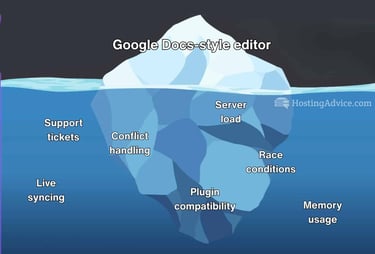
An iceberg graphic illustrates that real-time collaboration in WordPress looks simple to users as a Google Docs-style editor, but creates hidden hosting and developer challenges such as server load, live syncing, race conditions, plugin compatibility, memory usage, and support tickets.

This is why some developers questioned whether RTC belonged in Core at all. One Reddit user described it as “not something that will be used by most,” while another argued that the feature would be difficult to build well with HTTP polling anyway.

Hosts should make sure to explain to their customers that not only is RTC not shipping with 7.0, but include why (because some may already plan to ask).

What they may not understand is that Google can optimize its own single environment, while WordPress has to survive on everyone’s own individual environments. So a feature that works beautifully on one managed platform could look like a hot mess on a crowded shared server or a plugin-heavy WooCommerce site.

So, yes: It’s a bullet dodged for hosts — until it’s actually ready to ship, of course. Then we’ll really see what happens.

About the Author

Contributing Expert

Jordan Sprogis is a creative writer and tech researcher who has been working on online content for the better part of a decade. She holds a bachelor's degree in professional writing from Western Connecticut State University and has devoted much of her career to crafting content for various web verticals, including CyberSpyder and The Echo. Since joining HostingAdvice, Jordan has combined her storytelling ability with her fascination for advancements in technology to pen over 500 articles geared toward industry pros and newcomers alike.

« BACK TO: BLOG

Meet the Experts

Our team of experts with a combined 50+ years of experience in web hosting serve insight and advice to more than 20 million users!

We Know Hosting

$

4

8

,

2

8

3

spent annually on web hosting!