


Key Takeaways
Just as cities were built around cars, the modern internet was built around existing infrastructure and not exactly where it was needed. It’s much like how we prioritized building highways instead of widening sidewalks or improving public transit (and most of us are still dealing with it today).
Like rideshares and buses before them, many internet-era solutions have tried to address this gap. Edge computing improved uptime for millions, but these solutions only really work where there’s existing infrastructure to build on.
In many regions of the world, that foundation simply doesn’t exist. So now, some providers are starting to take a different approach, one that doesn’t rely on existing infrastructure at all.
StorMagic, HiveRadar, and Mako Networks just announced a partnership with a pretty admirable goal: to deliver a fully mobile edge computing solution designed for rural, hard-to-reach regions.

If “mobile edge” sounds like another buzzword, it’s understandable. But the idea is pretty simple and not so different from its predecessor.
The edge relies on fixed infrastructure, like cell towers and satellites, to bounce off and bring latency to millions of people. But instead of that, a mobile edge means you can just take the infrastructure with you. Check out the video above to get a closer look.
While this may sound like a departure from the traditional method, it’s not exactly a replacement, said StorMagic’s CEO, Susan Odle: “Mobile edge infrastructure builds on the same principles that underpin traditional hosting, but it is designed for environments where those models do not easily extend.”
Why Edge (Also) Wasn’t Enough
Let’s zoom out for a second, just for the sake of refamiliarizing ourselves. The first phase of modern infrastructure came from hyperscalers, but if users weren’t close enough to a major metropolitan area, latency was spotty at best.
It’s why edge infrastructure became popular, but again, it wasn’t enough for everyone. Edge assumes proximity to infrastructure, right? But in many regions, that infrastructure doesn’t exist.
Just look at the facts. Southeast Asia deals with typhoons and earthquakes across thousands of remote islands, while oil and gas sites across the Middle East operate in isolated, high-risk environments (especially during ongoing geopolitical tension).
At the same time, large parts of Central and South America remain rural and hard to reach. Even North America — the Great Plains and northern Canada — still has gaps. In many parts of central or east Africa, this is regular news.
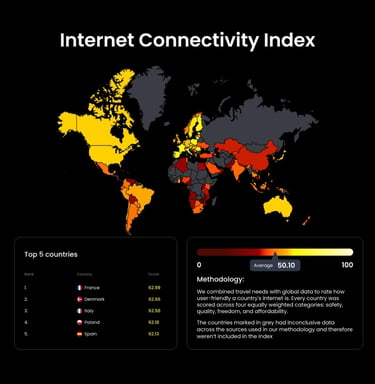
“Workloads that must operate in environments with limited connectivity benefit greatly from having compute and storage deployed locally,” Odle said.
No kidding. Rural broadband speeds are about 24% lower on average. In some countries, rural users see more than 40% slower speeds. Even in parts of the U.K., almost a quarter of rural areas lack basic broadband altogether.
That’s exactly the gap StorMagic, HiveRadar, and Mako Networks are trying to close by essentially combining their proprietary sophisticated software and hardware that creates a portable, prebuilt mini data center.
“Mobile edge infrastructure is well-suited to mission-critical workloads… including disaster recovery efforts, defense and emergency response, remote and industrial sites, media production and distributed retail,” Odle said.
It sounds a lot like mobile command centers, right? It’s not far off, and it’s also why Odle describes this opportunity as a meaningful change for the hosting industry. In reality, that opens the door to bringing mobile edge to a range of setups, like:
- Remote industries, such as oil fields, mining sites, and offshore rigs
- Mobile deployments, like disaster recovery or medical units
- Temporary setups, like film sets, live events, or construction sites
- Remote operations, such as in energy, mining, and agriculture
But the point remains the same: The internet should be reachable everywhere. As Odle said: “Customers no longer have to choose between mobility and performance — they get both.”