


Key Takeaways
- Cloud costs are hitting a breaking point, pushing hosting providers to reconsider whether renting still makes financial sense.
- AWS, Azure, and Google have a level of dominance that dictates pricing, discounts, and the rules everyone else has to follow.
- Supermicro’s latest MicroBlade systems and Vultr’s VX1 line suggest that there’s a growing push to give hosts affordable alternatives to hyperscaler dependence.
- Providers are hybrid-curious — the answer may just be owning infra for high-utilization workloads while renting only what requires on-demand capacity.
The perception of cloud computing is changing to the point where many hosting providers are beginning to wonder whether renting infrastructure still pays off in the long run.
For the last decade, the industry has lived in a cloud-first mindset. Everyone bought into it: Renting compute is cheaper, easier, and lets you scale without bottlenecks. And in many cases, this is an absolute truth: Raising capital to invest in your own racks is painful.
That part hasn’t really changed, but the cost structure around cloud setups looks a lot different than what most of us were pitched. AI workloads are causing a major spike in demand for computing, with Gartner expecting global cloud spend to reach $723.4 billion this year.
As those costs rise, many providers are forced to test the limits of the OpEx model — or go back to a familiar model that many providers ditched years ago: CapEx.
When we talk about OpEx versus CapEx in cloud computing, we’re talking about two different religions in the industry. OpEx is where providers outsource their infrastructure — rent the servers, the storage, the network — and write it off as an operational expense. CapEx is the opposite. It’s where providers put the money directly back into the business and actually own the hardware.
Is the faith in the OpEx model finally cracking? Maybe.
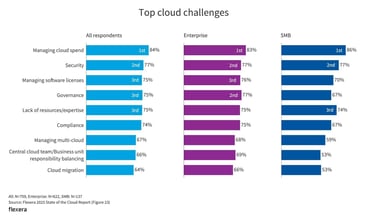
Flexera’s 2025 State of the Cloud Report says 84% of organizations say cloud spend management is their No. 1 challenge. There’s no equivalent study on hosting providers (yet), but similar findings suggest the same thing: Lenovo’s 2025 TCO analysis found that local infrastructure performs better for AI workloads, and infrastructure operators like DataBank say we’re amid a “bare-metal renaissance.”
Staring Down the Monopolistic Barrell
Karl Marx’s ghost would be the first to tell you that there’s a glaring issue that plays a role in today’s cloud economic setup.
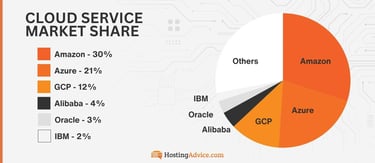
AWS holds about 30% of the market, Azure around 20%, and Google Cloud 12%. That’s 63% of the global cloud market held by three conglomerates. And if you add in fast-rising competitors Oracle, IBM, and Alibaba Cloud, that number looks a lot closer to 70%. It just doesn’t leave a lot of wiggle room for other promising options.
When only a few companies control all the infrastructure that most of the world relies on, the control is in their hands instead of spread out among a variety of other players. Why offer better deals when your customers have nowhere else to go anyway?
If three companies hold 63% of global cloud infrastructure, all the pricing, incentives, and rules tend to look the same across the board. For example, when AWS raises egress fees or changes its discount structures, competitors are forced to follow, otherwise they may be seen as “too cheap” or “unsustainable” (read: lower quality).
And of course, providers that rely on the Big Three’s networks see hyperscaler pricing trickling down to their structures, too. If Google changes its monthly costs, then anyone using GCP has to adjust their pricing for their customers, too.
It’s something we’re watching unfold every year in the cPanel/Plesk world: Some hosts are forced to increase their plans because those annual price hikes keep trickling down to their customers.
Even if one does want to migrate, switching is a battle in itself. Moving your compute, network, APIs, and backups is costly, and that alone forces many providers to accept defeat and stay.
This all may be why we’ve been seeing an uptick in providers offering solutions that help hosts move away from hyperscaler-cloud dependency and own their own hardware without it meaning they have to sell their souls.
The Case for Ownership
Supermicro just announced a new 6U 20-node MicroBlade server line, promising 70% space savings, 95% less cabling, and 30% higher energy efficiency compared to traditional racks. Inside the enclosure, each blade has a single AMD EPYC 4005 CPU (up to 16 cores), up to 192 GB of DDR5 RAM, and a full-size GPU.
The quiet heroes are the manufacturers, of course. AMD’s corporate vice president, Derek Dicker, said: “We designed the AMD EPYC 4005 Series CPUs with our system partners in mind, creating a processor that enables them to develop differentiated, cost-effective enterprise solutions.”

Vultr also recently released a new server line, VX1. It claims up to 77% better performance-per-dollar and 33% lower cost per vCPU than the Big Three typically offer. VX1 uses AMD EPYC processors, local NVMe storage, and up to 50 Gbps throughput. Starting at $175/month, it’s a pretty feasible cost.
Vulr itself has, more or less, said that its new VX1 server line is a response to the high computing costs for cloud service providers. Its CEO, J.J. Kardwell, said: “Cloud infrastructure budgets are under strain as workload volumes grow, and new AI initiatives compete for resources. VX1 was purpose-built to change the economics of cloud computing and set a new performance-per-dollar standard.”
Buying hardware outright is still an investment. But what Supermicro and Vultr are doing — from opposite ends of the market, no less — is carving out a middle lane for hosts who don’t want to abandon the cloud, yet can’t afford to let hyperscaler pricing dictate their entire business model.
Deloitte expects that lane to widen. In a recent study, the firm noted that AI’s hardware and energy demands will “make enterprise infrastructure a strategic differentiator once again.”
But Bruce Kornfeld, the CMPO at StorMagic, has told us before: The future isn’t “cloud only” or “cloud first.” Instead, it should be about selective cloud dependence.
“Instead of ‘cloud only’ or ‘cloud first,’ they can start educating on the benefits of a more balanced approach between an on-prem edge computing approach that is ‘cloud enabled’ but not too dependent on cloud,” he said. In other words, nobody has to leave the cloud completely, but owning some of your hardware can C.Y.A. (That is, cover your assets.)
A Shift Toward Cost-Driven Infrastructure
Maybe it’s not about cloud-first or on-prem-first anymore. Maybe it’s simply cost-first because Bernard Golden at CIO.com says one thing often gets lost in the buy-vs-rent debate: clarity.
He argues that cloud economics fall apart not because cloud is inherently overpriced, but because most providers don’t know what they’re actually paying for. Reports found that nearly 60% of surveyed companies say cloud costs are too high, and 78% of companies estimate that 21-50% of their cloud spending is wasted annually.

You can already see this split in how different workloads get handled. Managed WordPress hosts, for example, often run their high-utilization compute — i.e., dedicated hosting — on owned or colocated hardware. If a server is running 24/7 at that level, it’s cheaper to own it.
But the opposite is true for unpredictable or short-lived workloads. Traffic spikes caused by holiday spikes or marketing campaigns just don’t justify buying racks of hardware that sit underused 11 months of the year. Those workloads scale better (and cheaper) in the cloud.
Nobody’s predicting a mass exodus from AWS, Azure, or GCP; the cloud isn’t going anywhere. It’s just that hosts are starting to pick their allies a bit more carefully. Supermicro, for example, offers denser, more efficient hardware. Vultr wants to make the cloud more sustainable.
And analysts are, of course, warning that AI’s demands will punish anyone who treats those workloads as if they were par for the course.
Basically: Own the parts of your stack that run constantly, and rent the things that spike, shrink, or need global reach.