


Key Takeaways
- Nearly 1 in 4 small business owners are losing two full workdays a week to administrative tasks.
- For many platforms, AI has been the answer. But one expert reminds us that AI is only as smart as the data it can actually see.
- Are hosts running out of time to close the gap between infrastructure and actual business operations?
Did you know that nearly 1 in 4 small business owners (SBOs) are spending 16 or more hours a week on administrative tasks? That’s two entire workdays gone every week.
The findings — thanks to a survey by Squarespace — show that more than half of respondents say that administrative tasks are actively stopping their growth. And you know who shares the responsibility? Their web hosts.
After all, the website has become the expectation for modern small businesses. More than 70% of small businesses globally have a website, and that number grows every year. By now it’s impossible for hosts to pretend the website is the only thing they’re responsible for.
Web hosting providers are, of course, trying to address this. We’ve been watching it happen for almost two years. The challenge is simple, right? SMB owners want fewer problems. So what’s holding them back?
A Decade of Duct-Taping Everything
Let’s take a short walk down Memory Lane.
For most of the past decade, starting a website is synonymous with launching a website. That’s where the hosting provider came in — everything after that was largely the SBO’s problem: finding software, payment processors, CRMs, inventory tools, analytics dashboards, and whatever else they needed to keep things running.
“Initially, that gave businesses flexibility,” said Nikki Kuritsky, Squarespace's head of commerce. “But as those systems multiplied, so did the operational complexity to manage them and the bills to pay them.”
The result is a world where the average organization now relies on more than 100 SaaS applications. The irony is that Squarespace found that 79% of businesses believe running their client experience in one place would give them more time to focus on work instead of managing tools.
Why Hosts Are Suddenly Becoming Platforms
For years, hosting providers could focus on the one thing they mainly offered: infrastructure. Those tools were left to third-party software.
But nowadays, SMBs don't care which company owns which tool. They really just care about getting the work done. Whether the scheduling tool or the email platform or the blog writer comes from the same company is less important as long as it works together.
It also explains why so many providers are investing heavily in AI.
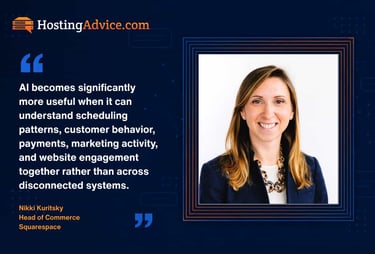
“AI becomes significantly more useful when it can understand scheduling patterns, customer behavior, payments, marketing activity, and website engagement together rather than across disconnected systems,” Kuritsky said.
Maybe it's obvious, but the more connected a platform becomes, the more context AI has to automate the annoying and frustrating administrative work that business owners have spent years handling themselves. That's the win right there.
The Integration Tax Is Real
Of course, becoming an all-in-one platform is easier said than done — just look at Wix.
The company has spent the past year pouring resources and money into AI, including its $80 million acquisition of vibe-coding platform Base44 last June. It's paying off: As of this May, Base44 hit $150 million in annual recurring revenue.
But there are tradeoffs. Wix also just cut 20% of its workforce (about 1,000 people) thanks to rising costs, AI competition, and a fast-changing market.
The difference? Wix has spent more than a decade building toward an all-in-one platform. Many traditional hosts haven't, which means they're trying to evolve while customer expectations, AI capabilities, and competitive pressure are all changing at once.
Hosting executives even have a name for one of the biggest obstacles standing in their way.
"The biggest advantage is what I'd call eliminating the integration tax," Aviran Mordo, Wix's VP of engineering, previously told HostingAdvice. "When you stitch together separate hosting, design, and marketing tools ... You're paying a hidden cost in fragmented data, broken connections, and constant maintenance."
This is ultimately what providers are trying to solve. But Squarespace's survey tells us that what's stopping them appears to be the same thing that's already frustrating SMBs: It's complicated.
Traditional hosts were built to support infrastructure, not necessarily feature-packed business platforms with AI woven throughout the experience. Connecting those bits takes time, money, and a willingness to rethink products that may have otherwise worked perfectly well for years.