


Key Takeaways
- We already know legacy email protocols were built for human response times, not autonomous AI workflows.
- It’s why this managed hosting provider launched an Agentic Mail platform designed around real-time automation systems.
- Whether most hosting providers actually need infrastructure like this yet is less clear — for now.
The International Data Corporation (IDC) expects more than 1 billion AI agents will be actively deployed across enterprise workflows by 2029, performing more than 217 billion actions per day. That’s a lot of agents — it’s also a lot of things that need to trigger, route, respond, and escalate — and email is still one of the primary channels those workflows run through.
We know that email has been the connective tissue of business communication for 40 years. It survived the fax machine, the “email is dead” thinkpiece cycle, and it’s even flourishing despite Slack/Chat/Teams’ prevalence.
Global daily email traffic is expected to grow from 392 billion messages in 2025 to 523 billion by 2030. Slack, Teams, and Google Chat combined don’t come close to email’s daily volume. And every one of those platforms sends you an email when you miss something anyway.
Daily Email Volume Projected to Reach 523 Billion by 2030
Source: CloudHQ
| Year | Emails/day | Growth % | Main drivers |
|---|---|---|---|
| 2025 | 392 billion | – | Automated emails & device alerts |
| 2026 | 422 billion | 7.70% | More automated notifications |
| 2027 | 451 billion | 6.90% | Compliance notices |
| 2028 | 481 billion | 6.60% | Personalized marketing |
| 2029 | 502 billion | 4.40% | Slower growth in NA/EU |
| 2030 | 523 billion | 4.20% | eCommerce growth in Africa & SE Asia |
“Email is still one of the most important interfaces on the internet, but most of the infrastructure behind it was never designed for autonomous systems,” said Povilas Skrebutėnas, Head of Email at Hostinger.
So, yeah: Email is clearly not going anywhere. But the way email infrastructure was built — polling-based, human-paced, designed for someone opening an app over their morning coffee — is great for humans…but what about the AI agents now expected to live inside these inboxes?
The Inbox Problem
For those who weren’t around in the ‘80s and ’90s, SMTP was standardized in the early 1980s. IMAP came later, in 1986, as a way to retrieve and manage messages on a server rather than download them locally.
Both were designed around the same idea: A human or (email client that fetches on a timer) would periodically check for messages and then the human can decide what to do with them.
will run 10+
AI agents by 2027
Agentic workflows just do not work this way. An AI agent running inside n8n or LangChain or Make is designed to react, not poll on a timer and hope something showed up. Human communication systems were built around eventual attention, while AI systems are built around immediate reaction.
There's no one to blame here; neither protocol was designed for autonomous systems because autonomous systems weren’t a relevant use case in 1986.
But in the midst of our adapting to agentic AI, companies today are deploying so many AI agents that the weaknesses in old infrastructure are becoming impossible to ignore. Especially since by next year, 64% will have launched 10 or more agents.
A Pattern the Industry Has Seen Before
This isn't the first time a legacy communication protocol has been retrofitted, of course.
Take Twilio, a cloud communications platform that lets devs send and receive SMS, make and receive phone calls, and handle other communication channels through their API.
Before Twilio, sending a text or triggering a phone call from software usually meant dealing with telecom infrastructure directly. No, it wasn't impossible...but it wasn't exactly something the average developer could just do over the weekend.
Is email at an inflection point? Maybe. Instead of opening it up for developers in general, though, the questions are coming from the perspective of AI agents. How can we add customized, automated actions if we’re using Google or Outlook?
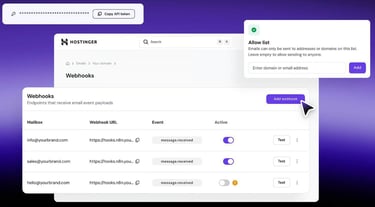
It’s why Hostinger just released its Agentic Mail service, which is built for developers and automation builders who want email to work like infrastructure for AI agents, going well beyond the traditional human inbox.
Launched just this morning, Agentic Mail is built around a webhook-first delivery, where an email arrives, a trigger goes off, and the workflow reacts as it should. It also allows for domain-level allow/block lists for controlling agent interactions and prebuilt connectors for platforms like n8n and Make. Hostinger also says a REST API and MCP server integration are on the horizon.
It is a very specific problem, sure, but it's also a timely one. Nowadays, the internet's oldest systems are constantly being asked to do things they weren't originally built for.
Most Providers Aren’t Built for This Yet
Hostinger’s resellers can leverage this tool immediately. Begin telling your customers that you’re introducing agentic mail, and they’ll jump for joy to see how sophisticated you really are.
For everyone else, it’s a bit more complicated. Mid-market and smaller players are deciding what launches like these may mean for their own road maps. Building from scratch means investing in webhook infrastructure, inbound email routing, filtering logic, and integration maintenance. None of this is trivial for a provider whose core product is shared hosting or managed WordPress.
You can, of course, temporarily solve the problem by partnering with another company or reselling someone else’s technology. But eventually customers will expect your email systems to function like modern AI infrastructure. (And this will happen across the board — not just email. But that's a story for another day.)
For now, most providers can probably afford to wait. Shared hosting customers are not demanding webhook-first email infrastructure tomorrow morning, and many businesses are still early in figuring out what AI agents are actually useful for in production.
But as automation platforms become more embedded into support, sales, and operational workflows, the expectations around email infrastructure may start changing alongside them.