


Key Takeaways
- A new report by CloudLinux and Imunify360 found that nearly half of the surveyed web hosts are losing customers to major website builders like Wix and Shopify.
- But smaller hosting providers still have an opportunity to join the race if they incorporate the most in-demand features, including bundled packages.
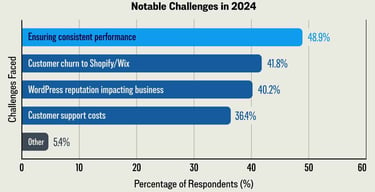
More than 4 in 10 web hosting providers say they have lost customers to big-name platforms like Wix and Shopify, signalling a fundamental market shift toward end-to-end-simplicity.
Many hosting providers say they also struggle with WordPress reputation issues (40.2%), ensuring consistent performance (48.9%), and customer support costs (36.4%), according to the CloudLinux and Imunify360 report.
While these are separately cited issues, they do share a common thread: Smaller hosts are struggling to match what industry giants seem to deliver effortlessly. It’s a sign that the market is riding the rise of all-in-one SaaS platforms.
“Startups and small businesses today are asking for far more than just traditional web hosting,” said Alex Avramenko, Head of Commerce Growth at GoDaddy. “They want all-in-one solutions that are built to support how modern consumers shop,” Avramenko said.
“Nowadays the options feel endless, but small business owners don’t have the time to invest learning multiple different platforms for each aspect of running their business,” he said.
Customers who turn to traditional hosting often juggle multiple vendors for hosting, themes, and plugins, which requires technical knowledge that most small business owners lack.
Platforms like GoDaddy’s eliminate this complexity with drag-and-drop builders and integrated tools.
But the report suggests small or indie web hosts are far from defeated.
There are clear paths forward for those willing to adapt — and some opportunities in areas that most competitors are currently overlooking.
The New Baseline for Hosting
With nearly all major platforms now offering some form of AI-generated content and design tools, AI website building is an expected baseline feature.
It’s reminiscent of how unlimited bandwidth and free SSL certificates used to be competitive advantages, but now they’re standard in almost every plan under the sun.
In fact, the report found that AI content and website generation ranked second (59.4%) among hosting trends.
Looking ahead, 90.2% of hosts say they believe AI will be a bigger force in the coming years, while 21% of marketers expect generative AI to be the most significant disruption.
Specifically, AI-driven customer support (64.5%) is highly regarded as the top use case for hosting AI and could help keep support costs down and experience up.

It seems like a no-brainer, but it’s important to note since high customer support costs (36.4%) and rising performance demands (91.2%) are among the most mounting concerns for smaller web hosts.
Consider this example: Hostinger’s AI assistant resolves 5,500 customer inquiries via live chat support each day, with an average response time of 20 seconds.
Since its beta-testing phase, the average percentage of fully answered queries has more than doubled.
Still, the majority of those surveyed say AI is only somewhat effective at customer service, meaning that proper LLM training and detailed knowledge bases are necessary.
Another point of contention is security.
Today, security delivered as an entire product rather than a feature checkbox is also a major trend, with 81.4% of web hosts saying they have added new measures in the past year.
Unlike traditional rule-based security systems that only react to known threats, AI can learn to identify anomalous behavior patterns, predict potential attack entry points, and respond to threats in real time.
Opportunities Are Hiding in Plain Sight
Interestingly, the report also highlighted some major blind spots that may be opportunities for those indie hosts keeping a close eye.
Only 29.7% of web hosts say they’re exploring predictive analytics in their platforms, even though these tools have proven to be invaluable.
Predictive analytics can anticipate server capacity needs, identify potential security threats, and predict which customers are likely to churn based on usage patterns.
And just 3.8% are prioritizing compliance.

Industries like healthcare (HIPAA), finance (SOX, PCI DSS), and government contracting adhere to strict compliance standards that many smaller hosts aren’t equipped to handle.
Still, there’s always a market opportunity.
While the major providers do cater to enterprises of all sizes for compliance needs, smaller hosts have advantages in local markets where personal relationships and regional expertise matter.
This goes beyond big banks and healthcare systems: Think regional credit unions, healthcare practices, school districts, or cannabis businesses, all of which have state-by-state compliance guidelines.
The platforms dominating today didn’t get there by accident; they solved real pain points. If indie hosts want to compete, these findings point out a few good places to start.