


Key Takeaways
Around 376 billion emails are sent and received every day, but a miniscule fraction actually come from humans.
Hostinger just released a new email data analysis and found that 87% of global email traffic is automated — as in, the sender comes from automated systems like notifications, alerts, receipts, and promotions.
“Automation and AI tools are making it much easier to generate and send emails programmatically,” said Edgaras Lukoševičius, an engineering manager at Hostinger. “[It’s] becoming essential for organizing messages, summarizing conversations, and automating routine tasks.”
It’s a lot like the evolution of physical mail, isn’t it? Email went from being a purposeful, main form of communication to a mailbox where users are forced to sort through notifications, marketing promos, and the occasional personal message.
Email May Have a Purification Problem
Instead of passing messages along in the traditional sense, inbox platforms now spend much of their time deciding which messages should be delivered at all.
It’s why many platforms (well outside of email, too) are emphasizing stronger authentication, sender reputation scoring, and AI-driven filtering.

Think about how much you rely on email — it’s where you save your concert tickets, your “reset my password” requests, your receipts from shopping online. It’s what’s used for nearly any login portal, from your bank account to your work chat.
“When most traffic is automated, the real challenge is distinguishing legitimate systems from abuse while still delivering important notifications reliably,” Lukoševičius explained.
But email security is not as simple as clicking a button. Unlike most platforms, email was designed to be open. Anyone can send a message, anyone can receive a message. Now bad actors are impersonating otherwise trusted senders.
And it all started when we entered the era of mass-automated emails:
- By 2002, spam already accounted for 40% of all email traffic — up from 6% just four years prior
- Then by 2010, that turned into 85%
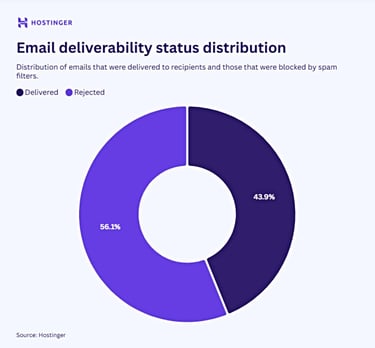
- Hostinger found that in 2026, less than 44% of emails actually reach the inbox; the rest is flagged or blocked as suspicious, malicious, or spam
At the same time, actual, legit companies are also sending out automated emails. And they’re not all unwanted — they’re normal things we all need, from password resets to bill payments.

Security researchers have emphasized for quite some time that the only way to combat the actual bad stuff is with better filtering and security.
It’s up to those providers who offer email to make sure that filtering, sender reputation, and authentication are all configured correctly, otherwise messages (both system and personal) may never reach users.
Lukoševičius warned: “As that volume grows, email systems will increasingly need to act as intelligent filters, using automation and AI to prioritize important messages, reduce noise, and help people respond faster.”