


Key Takeaways
- Securin’s ransomware report reveals that genAI is transforming ransomware, making attacks faster and more sophisticated.
- Humans are not obsolete (yet). The report recommends combining automated testing and detection with human expertise to stay agile.
- Certain industries, like IT, are under the heaviest attack due to their heaps of valuable sensitive data.
- Get expert tips from one of the report’s researchers, offering hosting providers practical steps to protect themselves and get ahead of ransomware threats.
Computer and network security company Securin just released its 2024 Ransomware Report, which highlights one common thread: Thanks to genAI, ransomware threats are getting smarter.
Aviral Verma, a lead security analyst at Securin whose research contributed to the report, said the ransomware attacks we see now “prove the lengths that hackers are willing to go to access critical data.”
As a quick refresher, ransomware is malware that locks or encrypts data. Hackers typically demand a ransom to restore access. If it’s not paid, they threaten to leak or exploit the stolen data.
Hosting providers are prime targets because they store tons of sensitive customer information and often host multiple tenants on the same infrastructure, making the impact of an attack much bigger.
All it takes is one phishing email, one unpatched plugin, or one poorly secured remote access point. Shared hosting models are especially at risk because they typically don’t have strong isolation models.
Securin’s report breaks down the ransomware landscape into five sections.
HostingAdvice focused on the key findings and spoke with Verma to get an inside look at which ransomware groups are the most aggressive and which industries are feeling the biggest impact.
GenAI Is Fueling Smarter Ransomware Attacks
The report started with something most industry experts already know to be true: GenAI is used as both a weapon and a target.
For threat actors, genAI allows for faster, more personalized, and scalable attacks. For defenders, it offers the promise of faster detection, automated response, and predictive threat mitigation.
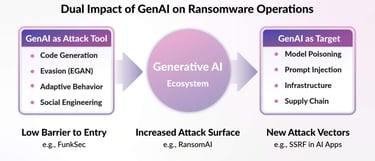
Of particular threat to AI systems are cross-prompt injection attacks, which allow bad actors to bypass security controls and manipulate AI systems into performing actions.
Supply chain attacks are also quickly becoming a main threat vector.
“It is imperative for industry leaders to implement proactive measures, leveraging genAI for threat detection and response, to defend against the evolving cyber threat landscape and strengthen their security posture,” said Verma.
More specifically, Securin recommends developing comprehensive strategies that are unique to AI, particularly by combining automated testing frameworks with human expertise.
Securin warns that without proper safeguards, ransomware could evolve into a self-optimizing threat and achieve up to a 90% success rate in evading detection.
Healthcare and IT Are Prime Targets
In terms of who’s doing the evil bidding, Securin found several main ransomware operators whose names popped up over and over again:
- LockBit: Typically targets government, manufacturing, and financial industries
- Cl0p: Targets supply chains in IT, manufacturing, and energy industries
- Akira: Targets education, financial, and healthcare industries
- Black Basta: Targets healthcare, manufacturing, and infrastructure industries
- RansomHub: Targets water systems, healthcare, and government industries
- BlackCat: Targets healthcare and financial industries

According to Securin’s findings, the most commonly attacked industries include:
- Healthcare & Public Health: 14.5%
- Information Technology: 10.3%
- Manufacturing: 9.1%
- Government & Public Sector: 8.5%
- Education: 5.5%
- Transportation & Logistics: 5.3%
- Financial Services: 5.2%
These industries are frequent targets because they’re undeniably high-value and can’t afford downtime.
That makes them prime opportunities for attackers: Downtime creates leverage, and leverage drives payouts.
One notable incident Securin noted in the report is the Schneider Electric breach by the Hellcat ransomware gang, who bizarrely demanded a $125,000 ransom in baguettes.
The hackers accessed the company’s Atlassian Jira system and stole 40 GB of sensitive data, including employee and customer info, project files, and more.
This attack marked Schneider’s third cybersecurity breach in just two years.
The Weak Links Hackers Exploit Most
Ransomware attacks revealed a consistent weakness across industries: poor authentication and access controls. These remain the most commonly exploited vulnerabilities, giving threat actors an easy way in.
Attackers are using familiar (but effective) tactics, including exploiting misplaced trust in clients, OS command injection, directory indexing flaws, and code injections.

The study noted that this suggests attackers have a mature understanding of enterprise software vulnerabilities.
“Threat actors are exploiting legacy systems and poor security hygiene to gain entry into critical systems,” said Verma.
Verma points to the numbers that back it up:
- Vulnerability and misconfiguration exploits: 30%
- Compromised credentials: 22.8%
- Spearphishing through malicious links or attachments: 19%
Securin reminds us that even as threats grow more sophisticated, many breaches still come down to the same core weaknesses.
Inside the Minds of Ransomware Gangs
Ransomware groups are changing the way they gain access to systems.
Securin found that initial access often comes through exploiting public-facing applications. Another trend the report highlighted is that attackers aren’t just rushing in anymore.

Instead of launching ransomware right away, attackers are taking time to methodically research and carefully choose their most valuable targets.
It’s the Cobra Kai of cybercrime: Strike first, strike hard, no mercy. That, unfortunately, is what makes these attackers a whole lot harder to stop.
Turning the Tables: Best Practices
When it comes to best practices, the report emphasizes that organizations shouldn’t wait for an attack disguised in a Trojan horse. Make sure your castle walls are already built and fortified.
In particular, the report outlines several key areas of focus: authentication and access control, memory protection, and sector-specific defense strategies.
But for hosting and IT providers, Verma has some specific advice.
“Both web hosting providers and industry leaders can take a proactive approach to cybersecurity by adopting measures that identify and address vulnerabilities before they are exploited,” he said.
Here’s what Verma recommends:
- Conduct routine penetration testing and exposure management
- Patch vulnerabilities promptly and based on real-world risk
- Use binary analysis tools to uncover hidden code-level flaws
- Require vendors to follow the FDA’s “security by design” principles
- Roll out multifactor authentication (MFA) across systems
- Enforce unique, non-reused passwords across the organization
While the checklist is long, the underlying message is simple. As the report puts it: “Perfect security isn’t the goal — making attacks economically unfeasible is.”