


Key Takeaways
When cPanel and Plesk raised their prices as expected at the beginning of the year, a lot of providers and developers began exploring other options.
A refresher: cPanel’s Premier license now sits at $60 per month for the first 100 accounts, then it’s $0.30 for each additional. Plesk followed with a 26% increase to its VPS licensing tiers earlier this year.
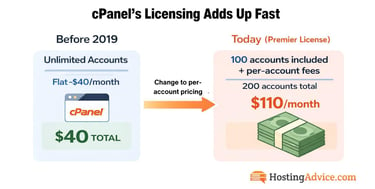
But ask anyone and they’ll tell you the bigger issue isn’t the latest hike, but the pricing model itself. What used to be a flat, predictable cost now grows with every new customer.
And since absolutely nobody’s turning away customers, that leaves providers with two options: 1) pass the cost along to customers through raising prices or 2) absorb it to stay competitive on price.
In an industry where price usually makes the decision, neither one feels particularly great.
What Are People Actually Doing About It?
Across Reddit threads in r/webhosting, r/selfhosted, and r/sysadmin, developers and hosting operators have been swapping tips and tricks on alternatives for a long time now.
HestiaCP comes up probably the most often, with one user saying they eventually moved everything over to Hestia solely because it’s the best free equivalent to cPanel. There are caveats of course: Quite a few say it’s not as intuitive to use and the system depth just doesn’t compare.
CloudPanel is popular with those who are more interested in sheer performance over ease-of-use and familiarity. Users describe it as a fast and lightweight, with quick templates for WordPress and Node without an overabundance of features. But you’ve got to know how to work a control panel.

DirectAdmin is the most common “paid but cheaper” answer for providers who want to keep their hosting model without starting over. Still…the public sentiment is mixed: One user said they’ve used DirectAdmin and found it to work “fine,” but kept going back to cPanel.
CyberPanel and aaPanel seem to appeal to users who don’t mind a learning curve that comes with a zero-dollar cost. A sysadmin thread commenter called CyberPanel a “great free alternative” for that audience and admitted to being “really surprised” by how capable it was.
And then there’s the contingent that has stopped using control panels entirely, opting for more complicated (but customizable) setups that involve containers manual configuration. One user said: “At some point, you realize you don’t actually need a control panel.”
That may be true for hosts running a few projects. But for those managing hundreds of customers, it usually just means they’re trading licensing costs for much more hands-on setup and upkeep.
Should You Stay or Should You Go?
Aside from the obvious tradeoffs you have to compare between control panels, simply migrating is its own undertaking. Moving potentially hundreds of accounts means weeks of work, retraining staff, and a real risk of customer churn.
It’s part of why most providers aren’t just leaving cPanel or Plesk. As said, many are taking the hit — either by restructuring plans or eating the increase to keep customers isolated. IONOS, for example, raised its VPS prices but also openly blamed cPanel/Plesk licensing increases, telling customers: “We can only offset these costs to a limited extent and are therefore forced to pass the price increase on to you.”
Some providers are choosing to hold pricing steady, at least for now. Porkbun has been vocal about keeping pricing consistent and avoiding the kind of renewal spikes that may be common elsewhere. Others, like Namecheap, are taking a slower approach to adjust to those price hikes by changing renewal costs, bundling costs into existing plans, and spacing out price increases over time.
There is no right or wrong answer right now, which means it ultimately comes down to how much you’re willing to sacrifice for cost.