


Key Takeaways
- After nearly a decade of development, Hytale — the sandbox game that's been compared to Minecraft and Roblox — finally launched last month.
- Shockbyte says the surge in private server demand usually becomes obvious months before launch day.
- And when players arrive, they tend to fall into two camps: casual gamers who want a quick server, and power users already thinking about mods and configurations.
When Hytale, the sandbox adventure game that spent nearly a decade in development, finally launched last month, thousands of players flocked to create and join servers.
But game server hosts like Shockbyte already knew what was coming.
Behind every major multiplayer launch is the invisible race to reserving a server. This is exactly where launches tend to test how well a server host did its planning and provisioning.
So, we spoke with Shockbyte’s IT director, Liam Charles, to understand what actually happens behind the scenes when long-awaited sandbox games like Hytale launch.
And, for those who are interested, Charles had one major tip: “A truly launch-ready host combines scalable infrastructure, geographic optimization, automated provisioning, strong DDoS protection, and a support team prepared for volume.”
The Trailer Starts the Clock
Typically, the earliest signs of how popular a game will be often appears months (sometimes years…) before a game is released. For Hytale, it was both.
The game has been in development since 2015 and was teased publicly by the end of 2018, when the announcement trailer managed to rack up tens of millions of views almost overnight.
“When you see creators investing time into future gameplay, mod concepts, and server ideas months or years in advance, that’s a strong signal,” Charles told HostingAdvice.
For years, Reddit dissected how Hytale’s server ecosystem would work; Discord servers organized channels dedicated to map-making and modding tools; YouTube creators were quick to analyze the trailer, right down to the millisecond.

And anyone who ran a Minecraft server in the 2010s already knows how this goes: When a new game like this launches, the instinct isn’t to play… It’s to reserve a server.
And yet, even with months of warning, launch week is still where things get unpredictable.
“Everyone wants a server at once. Hosts need to have infrastructure ready to go, and deployment systems ready to scale instantly,” Charles said.
Because man plans and God laughs, launch week never goes exactly as planned.
“No matter how much you plan, launch week reveals edge cases,” Charles added. “Close monitoring during the first 48 to 72 hours is critical because real-world behavior often differs from beta expectations.”
Everyone Wants Their Own Server
Both Minecraft and Roblox — and now Hytale — are helpful indicators of the kinds of players that are launching these kinds of games.
“More modern games are launching with official dedicated server support,” Charles told us. “Players expect the option to host privately, whether for modding freedom, tighter communities, or simply playing with friends without public-server chaos.”
And we have the younger players to thank for this.
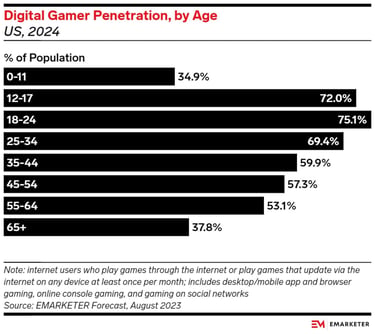
About 75% of Gen Zers ages 18-24 play online games at least once per month. That’s the highest rate among any other age group, including Gen Alpha and millennials.
It actually helps explain one of the biggest traffic surges the industry has seen: when Palworld launched in early 2024. Shockbyte said that the initial wave created such intense infrastructure pressure that almost nobody was fully prepared.
“It wasn’t just about having hardware,” Charles noted. “It was about having the right hardware available in the right regions, pre-configured and optimized.”
While exact demographic data for Hytale isn’t public, we do know the game’s roots. And that tells pretty much everything hosts like Shockbyte needed to know.
It was developed by the same team behind the Hypixel Minecraft server network — one of the largest multiplayer communities ever created — and was widely marketed as a next-generation sandbox experience similar to Minecraft and Roblox.
On these kinds of games, some players may choose to run complex modded environments, installing plugins and optimizing performance. Others simply want a one-click setup to build a world with their besties.
And that, Charles said, creates an interesting challenge: Game hosts now have to serve both power users and plug-and-play users. In any game launch, both groups are going to show up. But they’re both expecting the same thing: a seamless experience.
“A truly launch-ready host combines scalable infrastructure, geographic optimization, automated provisioning, strong DDoS protection, and a support team prepared for volume,” Charles said. “When all of those pieces align, the launch experience feels seamless — and that’s what players remember.”