


- Infomaniak’s new underground data center in Switzerland is 100% renewable »
- The facility converts electricity into heat and feeds into Geneva’s heating network »
- Infomaniak publicly shares its technical plans so others can follow, with founder Boris Siegenthaler urging others toward greener data centers »
Deep beneath the ground in the city of Geneva, Switzerland, is the world’s first renewable energy data center that recovers 100% of the electricity it uses. The surrounding residents don’t see it, feel it, or hear it — but 6,000 of those residents will get heat for the next 20 years because of it.
Infomaniak, Switzerland’s largest web hosting provider (also known as “the ethical cloud”), is making headlines with the launch of its fully renewable data center. Not only does it renew all of the energy it consumes, but it can heat thousands of households every year at no extra cost or installation.
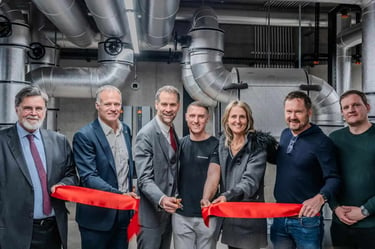
Founder and chief strategy officer, Boris Siegenthaler, said this successful construction is proof that others can follow in its footsteps. Its technical plans are publicly available, which allows anyone anywhere to replicate the technical blueprint. Infomaniak already has plans for two more data centers.
“The future of data centers must incorporate environmental sustainability, not just short-term profitability. With our new facility, we are proving that 100% energy recovery is not only possible but also scalable,” said Siegenthaler.
Since 2 PM on November 11, 2024, Infomaniak’s new data center has been feeding its energy usage back into the Geneva heating network. Currently operating at 25% capacity, the center is set to gradually ramp up its output to full capacity by 2028, which will serve as a sustainable resource for at least the next 20 years.
How the Data Center Works
The facility’s system works in two parts: The heat pumps take energy from the water, which cools the servers without using traditional air conditioning. The gas in the pumps is then compressed to transfer the energy into the heating network (Geneva). It also automatically adjusts the temperature depending on the season.
“In the real world, data centers convert electricity into heat. With the exponential growth of the cloud, this energy is currently being released into the atmosphere and wasted,” Siegenthaler said in the official press release.

Having witnessed it firsthand, Siegenthaler calls on the rest of the industry to adopt this approach.
“There is an urgent need to upgrade this way of doing things, to connect these infrastructures to heating networks and adapt building standards,” he said.
The facility is located on an underground site of the participatory and eco-responsible cooperative, La Bistoquette, which aims to create sustainable and community-oriented living spaces.
You can watch an in-depth video here.
More Power, More Green
As artificial intelligence and machine learning technologies become more advanced, the need for scaling is apparent. This has led to the rise of more data centers: In 2021, there were approximately 700 hyperscale data centers; by the end of 2023, there were 992.
But with this new construction comes a catch: Data centers consume a staggering amount of electricity — about 2% of the world’s total — and emit roughly the same amount of CO2 as the airline industry.

Owen Rogers, chief technology officer at the .eco domain registry, warns that sustainability cannot be overlooked in the race for expansion.
“The massive computational demands of generative AI are driving global data centre growth. In the rush to bring new data centres online, sustainability is taking a backseat to speed,” said Rogers. “That’s why it’s now more important than ever for us to choose internet service and web hosting providers that run on renewable electricity and prioritize energy efficiency.”
It’s a problem the industry has been faced with for years, and although it looks like many companies are participating in initiatives to become more sustainable (power usage automation, cooling optimization), Infomaniak just proved the industry is nowhere near where it could be.
Take a look at the U.S. Project Stargate, a $500 billion venture dedicated to investing in America’s AI infrastructure. While its data centers likely plan to leverage renewable energy sources, its first location in Texas will rely on a newly constructed power plant of natural gas turbines.
Natural gas is not a renewable resource. Building a plant also has immediate impacts on the environment. Emissions of greenhouse gases and pollutants can degrade air quality for local residents, while habitat disruption, water usage, wastewater discharge, and noise/light pollution affect ecosystems and biodiversity.
The U.S. has positioned itself as a leader in AI technologies, but many argue that it is prioritizing rapid growth over safety and sustainability.

The EU and its neighboring countries have led the way with green energy projects, with several climate-neutral, 100% renewable energy data centers, such as EcoDataCenter in Sweden, Green Mountain DC in Norway, Verne Global in Finland, and Kao Data in the UK.
The Climate Change Performance Index — a scoring system designed to display international climate politics — shows these countries ranking much higher in sustainability, with Sweden at #10, Norway at #12, the UK at #20, Finland at #26, and the U.S. at #57.
Siegenthaler said that it’s in the hands of large global players to build data centers that prioritize energy reuse and integrate into local ecosystems instead of disrupting them.
“If the industry fails to take this direction, we risk an unsustainable digital expansion that accelerates climate change instead of mitigating it,” he said. “The time to act is now, and Infomaniak’s data center is a blueprint for what is possible.”