


Key Takeaways
A new report by Imperva confirmed what many web providers have already long suspected: Bots now rule the web.
According to the 2025 Bad Bot Report, Imperva found that bots make up 51% of all internet traffic, and 37% are bad bots.
APIs appear to be their favorite targets, directly threatening the very tools web hosting platforms use to power and personalize their customers’ user experiences.
We broke down the most important findings for web hosting providers and what they can actually do to keep their platforms and customers safe.
Bad Bots Are Coming in Droves
For the sixth year in a row, bad bots are becoming more prominent: In 2023, bad bots accounted for 32% of all internet traffic; by 2024, it grew to 37%.
It’s frightening news for web hosts that manage large volumes of traffic.
Customers’ data is directly in the crosshairs, too: Account takeover (ATO) attacks jumped 79% between June and November 2024 compared to the same period in 2023.
…But Not All Bots are Bad
Bots have an expected negative connotation, but Imperva’s research proved that some are worth keeping around.
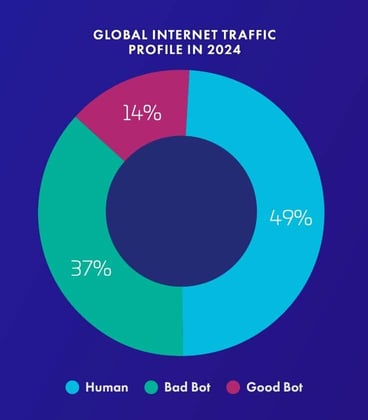
Good bots play an important role in the internet’s infrastructure: They act as search engine crawlers (like Googlebot and Bingbot), which index web content so users can find relevant pages in their search results.
There are also the good bots that most providers or web builders use on a daily basis, like performance monitors to track uptime or SEO tools that analyze site content for optimization.
Of course, there’s always a margin for error.
Imperva reminds its readers that good bots’ presence alone can inadvertently skew metrics by inflating pageviews, distorting ad campaign data, and making certain content appear more popular than it actually is.
The key is to stay on top of your metrics and know how to distinguish between human traffic, good bots, and bad bots.
A Focus on the U.S. and High-Risk Industries
If you’re a U.S.-based web host serving high-risk industries, it’s time to pay attention.
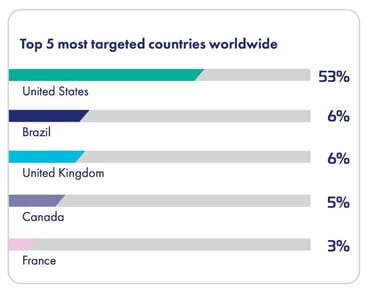
Because of America’s massive online economy and its heavy concentration of financial and tech giants, the U.S. leads the world in bot activity, accounting for 53% of all global attacks.
Brazil and the UK trail far behind at just 6% each, although Europe isn’t off the hook yet.
In 2024, the UK ranked as the most targeted country in the EMEA region, with 31% of all bot attacks, likely driven by the region’s growing fintech hub.
Industry-wise, the landscape is shifting: For the first time, the travel industry has overtaken retail as the most attacked sector, accounting for 27% of all bad bot activity in 2024.
The financial services sector faced the brunt of that threat, making up 22% of all account takeover attacks, followed by telecom and ISPs (18%) and computing and IT (17%).
APIs Are The Magic Backdoor
APIs have increasingly become more susceptible to cyberattacks, making up 44% of all bot attacks, which is up 55% from last year.
About one-third of API attacks are linked to data scraping, which is where bots extract sensitive or proprietary information from web hosting clients.
What’s worse is that bots are increasingly becoming more sophisticated: Now, they’re masking themselves, better known as “spoofing.”
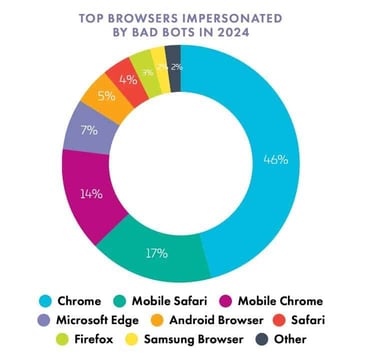
Thanks to AI, even simple bad bots are getting smarter: 46% now use Chrome to blend in with legitimate traffic by faking their browser identity.
APIs also act as an entry point to the entire account, which may explain why 14% of all logins in 2024 were attempts at account takeovers.
With this in mind, providers should prioritize re-securing their endpoints immediately.
AI Is Truly Two Sides of a Coin
Whether for customer-facing tools or for backend efficiency, nearly every web hosting provider now relies on automation. But cybercriminals are turning the same AI technologies into weapons.
Unlike regular bad bots, AI-powered bots use AI/ML to mimic human behavior, such as analyzing data and adapting to patterns, which helps them bypass traditional detection methods.
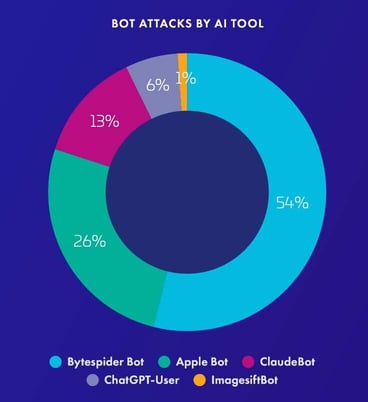
Tools like ByteSpider Bot and ChatGPT User Bot are increasingly being used in these attacks.
ByteSpider Bot, for example, is a trusted web crawler, but Imperva found it was spoofed in 54% of AI-enabled attacks.
That’s a big problem for web hosts that rely on “whitelisting” (automatically trusting known bots) because it lets disguised bad traffic sneak through.
Interestingly, most AI-driven attacks are done by human cyberattackers. Not to say that bad bots don’t play a role: In 2024, they made up 16% of all AI-driven attacks.
But if you factor in business logic abuse (where bots mimic legitimate behavior), that number climbs to 41%.
What should this tell web hosts? Traditional security and bot management tools are no longer enough.
What Can Web Hosting Providers Do?
Society has officially hit the point where George Orwell would be rolling in his grave: It’s Man vs. Machine, and tech is taking the upper hand.
But Imperva’s report came packed with recommendations on what companies and providers can do to better secure their platforms and guarantee data security.
You can download the report here, but here’s the summary:
- Identify Common Risks: High-traffic events, like product launches, attract bot traffic. Use real-time bot detection and traffic analysis to distinguish legitimate users from bots.
- Secure Your Apps and APIs: Secure APIs and mobile apps with strong MFA, access controls, and multi-layered bot mitigation strategies.
- Deploy Threat Reduction Tools: Minimize abuse by validating user-agents, limiting access from known proxy sources, and detecting automation tools (Imperva noted Puppeteer, Playwright, and Selenium).
- Understand Your Baseline: Establish baseline traffic patterns so you can spot bot activity by identifying anomalies, such as high bounce rates or sudden traffic spikes.
- Monitor Traffic in Real Time: Set up alerts for failed logins, checkout failures, and unusual API requests to detect attacks as they happen.
- Stay Aware of the Landscape: Stay informed about global data breaches and use good practices, like Zero-Trust and MFA, to protect against credential stuffing and account takeover attacks.
- Use Your Own Bots: Leverage AI/ML-driven tools, user behavior analysis, and continuous monitoring to adapt to evolving bot threats and secure API endpoints.
- Keep Them Guessing: AI-powered bots recognize patterns, so don’t roll out all your defenses at once. Be strategic with your security upgrades so they can’t predict your next move.
It’s as Imperva wrote in its report: “If you don’t control your web traffic, someone else will.”