


TL; DR: Can your code keep up with today’s evolving cyberthreats? Meet Cycode, the platform that’s redefining secure development pipelines. With Field CTO Jimmy Xu leading the charge, Cycode cuts through the noise, fixes vulnerabilities fast, and keeps your software supply chain safe.
Forty-five percent of all organizations will have experienced a three-fold increase in attacks on their software supply chains by 2025.
That’s what Gartner, one of the world’s leading tech research companies, says anyway. And I don’t know about you, but I’m inclined to believe them.
That’s because I’ve read enough about how cyberattackers evolve as fast as our tech and security standards are updated (while some may argue that cyberattackers are actually getting more sophisticated).
No matter how safe you think you are, cyberthreats are very real, whether it’s through backdoors, poor code, or other vulnerabilities.
One of the most common weaknesses lies in the code itself. It’s like a Jenga tower — one misstep, and everything crumbles. But with complex applications, catching every weak point throughout the Software Development Life Cycle (SDLC) is almost impossible.
With the rise of citizen developers — those are people who don’t have experience writing code but are able to thanks to tools like Microsoft Copilot — and a shift to rapid code deployment, securing every link in the supply chain has never been more crucial.

But with all these codes jumping from development to deployment faster than ever before comes risk. Lots of it.
That’s where Cycode comes in. As a complete ASPM, Cycode secures the entire software supply chain. There is no part of the pipeline that goes unseen, and the best part is that it doesn’t slow you down either.
“Cycode’s mission, simply put, is to help organizations deliver safe code faster,” said Jimmy Xu, Field CTO.
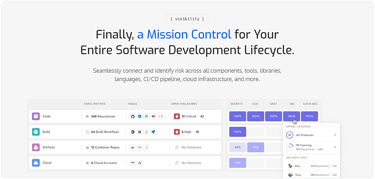
Cycode has the ability to secure your entire development process. It’s easy, too: Think of it as your mission control dashboard, overseeing every stage of whatever you’re building.
Securing the Software Supply Chain
Ever heard of the phrase “too many cooks in the kitchen”?
Software development can feel the same way. Throw in a mixture of contributors, tools, and stages, and it’s tough to keep track of everything.
That’s why Cycode centers around three main aspects of Application Security Posture Management (ASPM), also known as the security of your software lifecycle.
The reality is the software supply chain is full of weak points where attackers can inject malicious code. So Cycode’s ASPM platform is designed to identify these weak points and secure the entire process from end to end.

“Think about how code is assembled now: You’re pulling components from different supply chains that may or may not be sanctioned, pushing it through CI/CD pipelines, and delivering it to the cloud,” said Jimmy. “That whole assembly line has weak points where attackers can take advantage, injecting malicious code that runs without anyone knowing until it’s too late.”
We’ll go over CI/CD pipelines later, but just for reference, it refers to Continuous Integration (CI)/Continuous Delivery (CD).
I want to go over some use cases next. I don’t know about you, but using real-life examples always helps me better understand a product’s purpose. Here are some everyday use cases for which Cycode’s clients employ its ASPM platform:
- Secrets Detection
- CI/CD Security
- Source Code Leakage
- Container Scanning
- Software Composition Analysis (SCA)
- Static Application Security (SAST)
- Infrastructure-as-Code (IaC) Security
- Cycode AI
(Did you catch Cycode AI? In this Digital Era, it’s no surprise that Cycode is using AI to enhance its features. So if you’re like me and enjoy seeing AI in action, don’t worry. We’ll dive into that later, too.)
These features are what make Cycode’s ASPM platform so powerful — though Jimmy admits that many people aren’t familiar with what ASPM actually is.
He explained that Cycode’s platform has come a long way over its decade-long journey, starting out as a way to cut through the overwhelming noise developers often face.
Before it became the full-fledged platform it is today, Jimmy said there were three major phases in the development of its ASPM solution (these terms might sound a bit techy at first, but don’t worry; we’ll break them down):
- Application Security Orchestration Correlation (ASOC): The first wave focused on integrating data from third-party scanners to reduce duplicate findings. It’s sort of like using multiple AI checkers to get an average score on which sentences look suspiciously non-human.
- Software Composition Analysis (SCA): The second wave centered around providing clearer results and consolidating security tools, particularly those that used several third-party tools. The goal was to remove irrelevant information, such as redundant log entries or outdated code comments.
- Software Supply Chain Security: Finally, we arrive at the modern Cycode. This phase highlights software supply chain security by targeting vulnerabilities that lurk within the CI/CD pipeline.
I think understanding Cycode’s evolution is important because it really showcases how much they’ve studied cyberattackers’ trends and pivoted to meet the market’s needs.
And what they found is there are countless ways cyberattackers can slip through the CI/CD pipeline — whether it’s through misconfigurations, poor access controls, or injecting malicious commands.
So, that raises an important question: What exactly do CI/CD systems do for the software development process, and how can we better protect them?
Why CI/CD Systems Matter
OK, so what is CI/CD?
- Continuous Integration: Since devs frequently merge their code changes into a central repository, automated tests are run to make sure the new code integrates well into the existing codebase. It’s basically double-checking that everything is still working after changes are made.
- Continuous Delivery: After the code is integrated and all is good, it’s automatically prepared for release. (This may be a process devs use for bug fixes or patches, for example.) Additional testing is performed at this stage too before deployment.
- Continuous Deployment: And, finally, deployment. Here, the new code gets published to the production environments, delivering new features and fixes to users as quickly as possible.
So as you can see, CI/CD systems are like repair shops or factories, moving code from development to deployment.
But they also serve as choke points, where code flows through a single pipeline…meaning they may be potential points of failure.
And that’s where observability tools and security solutions are critical to maintaining visibility across the SDLC.
Cycode’s platform offers complete ASPM coverage to better secure your dev pipeline:
- Pipeline Security: Ah, the pipeline. Love it or hate it, it helps us keep track of all our stuff. But security isn’t something built into most pipelines, so Cycode’s Pipeline Security identifies and protects against any vulnerabilities — such as exposure or unauthorized access — across your entire software supply chain.
- Application Security Testing (AST): AST is what it sounds like: It’s there to test the security of your apps. Cycode lets you get full-fledged scanning, detection, and coverage across your applications, whether you’re using open source, static code, or cloud.
- Posture Management: When we talk about posture in this context, I don’t mean how you’re sitting right now. (But here’s a reminder to sit up straight anyway!) Cycode uses posture management to connect any and all of your third-party security tools into a single dashboard for easy management.
“As code moves through various stages — especially during testing — you need to have visibility into where issues arise. So when problems are identified, it’s important to trace them back to their source,” said Jimmy.
This means knowing which developer contributed to the code, which branch it came from, and which pipeline it followed.
Run through those three steps listed above, and you get a clear picture of your entire supply chain pipeline, from start to finish, all in one dashboard.
Reducing the Noise
Did you know 93 billion lines of code are written each year?
The issue is that, even for 27 million software devs, that’s a lot to sift through when you’re looking for possible vulnerabilities.
“I always say security should be treated like a quality issue; it’s not something separate,” Jimmy added. “But when devs already have hundreds of things on their plate and then you throw in security issues, they don’t have the time to do that, too.”
And honestly, who could blame them? They’re probably tired from the constant noise — that is, irrelevant issues slowing them down.

With big plans to help reduce the noise already in motion, Cycode is rolling out AI-driven features, such as automated code fixes and malicious code detection.
The goal is to go faster. To Cycode, faster means building something that can take in all that noise, make sense of it, and let developers focus on what they need to.
“We’re the engine that does the hard work and delivers what’s needed,” Jimmy said. “We assist you by automating as much as possible, customizing workflows, and integrating critical tools into your development environment.”
Here’s how Cycode AI makes it all happen:
- Faster Response: Cycode AI cuts through the digital noise and only brings the most critical vulnerabilities to the attention of developers.
- AI for Security: From automated code fixes to spotting subtle (but potentially malicious) changes, Cycode AI takes care of the heavy work.
- Supply Chain Protection: Cycode AI monitors for supply chain risks so you don’t have to.
- Natural Language Queries: Forget complicated syntax. Instead, just ask a simple question like, “Show me the vulnerable containers,” and get instant answers.
With Cycode, developers can do what they do best: build amazing software — faster, more securely, and with way fewer headaches. Trust me, you don’t want to worry about letting the bad guys get in. Book a demo with Cycode today.