


Key Takeaways
For the past couple of days, mega-coffee chain Dunkin’ has been teasing a promo code that promised the first 1 million rewards members in the U.S. a free coffee on May 19.
At almost exactly 9:30 a.m., Dunkin’ released the code — COFFEEISFREE — for customers to enter into the app’s Offers & Rewards section or discount code field when checking out. Alas, it wasn’t long until users began flooding Reddit and social media with complaints about the app erroring out and refusing to apply the coupon.
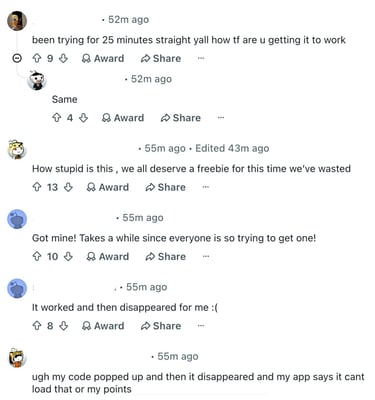
This is a classic problem that should have been foreseen — on April 19, Dunkin’ ran a nearly identical promo on its app, and many users saw technical difficulties on that day, too.
When a sudden spike in requests comes in, it’ll absolutely overwhelm the backend infrastructure. The first 1 million active members to enter the code would instantly unlock a free beverage, and because of that very strict cap, speed meant literally everything. So for all the Dunkin’ app could understand, this was a mass DDoS attack, not a Free Coffee Day.
Why the App Folded Under Its Own Promotion
Promo code redemptions are notoriously write-heavy because everyone is trying to hit that “Apply” button at once, and every successful claim has to clear the database. It’s very different from read-heavy activity — like browsing the Dunkin’ menu (which nobody really experienced buffering in).
Some reported that ditching the app for Dunkin’s website worked as a workaround, but not everyone had the same success; others found backup codes circulating, like PRODUNKTIVITY; and many just sat on a loading page for several minutes.
OneUptime says that coupon validation needs to “be fast (under 10ms) and atomic (no double redemption),” while ByteByte Go explains the mechanics of how to create race conditions that won’t stall the system. Still, DownDetector shows that Dunkin’ saw a mass spike between 9:15 a.m. and 9:45 a.m.
Dunkin' Free Coffee Day App Traffic
Source: DownDetector
- Baseline Reports
- # of Errors Reported
The fact that Dunkin’s website appeared to handle the code redemptions more reliably than the app is actually very interesting: Mobile apps frequently route through different API layers with specific rate limits and configurations. If the website were better provisioned, this would explain a lot. (Issue is, most people are using their Dunkin’ app to place the order, so the website was almost pointless for some.)
The promotion itself is generous and for the users who got through, it worked as advertised. For those who didn’t, this will undoubtedly be a lasting impression — and a very busy day for Dunkin’s support team.