


Key Takeaways
Google Cloud is leading the pack in its number of cloud vulnerabilities, with 38% of hosted assets having at least one security flaw, according to Hackread.
This is higher than Google’s largest competitors, Microsoft Azure (27%), and nearly 2.5 times worse than AWS (15%).
While it looks like an opportunity for smaller hosts to point fingers, the report also found similar or higher vulnerability rates among smaller cloud providers (38.15%) and traditional hosting companies (32.93%).
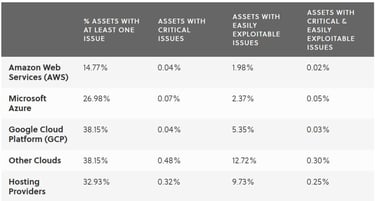
And most hyperscaler flaws weren’t considered critical: Less than 0.1% of assets across AWS, Azure, and Google Cloud were found to be both high-risk and easily exploitable.
Still, other cloud providers weren’t far behind: Oracle and Digital Ocean had similar vulnerabilities as Google Cloud, with GoDaddy and DreamHost coming in at 33% of assets affected.
Where David Wins
Security is a challenge for all cloud players, big and small. Yet, some smaller hosts would argue that they have the ability to be more agile in their response to vulnerabilities.
It’s a classic David versus Goliath scenario: While Goliath is bigger and more powerful, he’s far less nimble than David, who, being a fraction of the size, can move faster.
(It’s also why elephants are afraid of mice, humans of spiders, and so on.)
Hyperscalers have to patch an entire global infrastructure; smaller hosts are able to patch faster and communicate more personally.
It’s an agility advantage that matters, especially since many SMBs and developers feel overwhelmed by cloud complexity.
In fact, only 30% of surveyed organizations knew exactly where their cloud budget was going. The disparity between confusion and context is why smaller hosts excel in the human element.

SiteGround, for example, resolves support tickets in under 10 minutes and responds to live chat in less than 60 seconds. Hostinger’s chat also has a response time of 60 seconds.
But hyperscalers like AWS, Azure, and Google Cloud all require expensive enterprise plans. Google Cloud charges enterprises up to $150k a year for premium support.
Hyperscalers have trouble with things like patch fixes or security checks because of the massive scale across global infrastructure.
The data proves that smaller web hosts maintain significant advantages in customer support response times, personalized security management, and building genuine customer relationships.
While hyperscalers are better with raw computing power and scale at the enterprise level, their support models can leave a sector of customers underserved.
And that’s exactly where smaller providers can shine.
What Smaller Hosts Can Do
There’s a common misconception that smaller hosting companies need to compete on scale, but they don’t. Instead, they can win on speed, trust, and customer care.
One of the most effective strategies is to turn strong customer relationships into security-driven trust. Here’s how smaller hosts can capitalize on this advantage:
- Offer onboarding security audits for new clients
- Send alerts when installs (plugins, APIs, etc.) are outdated or compromised
- Bundle monthly summaries of bug fixes/patching/scan reports
- Add patching updates directly into control panels or managed dashboards
- Communicate fixes — for example: “We fixed the XYZ vulnerability this morning. Here’s your scan report and what we did.”
This kind of personalized communication is virtually impossible for hyperscalers, where support is often buried behind dashboards or generic notifications.
Even if scale weren’t the issue, personalized service often doesn’t exist in the hyperscaler ecosystem — and if it does, it’s locked behind expensive managed service tiers.
For SMBs who want a partner instead of a faceless vendor, that level of care is hard to ignore.