


Key Takeaways
- New entrepreneurs and SMBs are demanding simple, low-cost platforms that bundle modern tools like AI, payments, and marketing in one place.
- Agencies have noted that many clients assume SEO is built in — and yet, most host-provided marketing tools still fall short of those expectations.
- Large platforms are responding by embedding AI and commerce directly into their stacks to keep pace with the things their clients struggle with most: rising costs and competition.
The elephant in the hosting room has been loud and clear as of late: Providing a platform that guarantees speed and uptime is last year’s news, and today’s is all about helping those sites get seen and, in turn, succeed.
Online stores now make up a huge bulk of many hosting providers’ clientele, with estimates suggesting there are nearly 30 million eCommerce stores as of 2025, which is up from around 19 million six years ago.
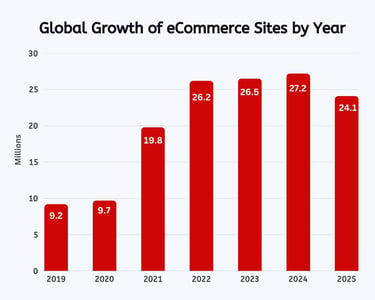
And as Gen Z enters the workforce and more side hustles turn into businesses, the expectation is that this number will only continue to grow.
“The definition of a hosting platform has shifted,” Oren Inditzky, VP and GM of Online Stores at Wix, told HostingAdvice. “It’s no longer just about giving businesses a place to build a website; it’s about giving them a place to manage and grow their business.”
A Demand for All-in-One Growth Platforms
Hostinger has been watching this eCommerce trend closely, said Auksė Žirgulė, Hostinger’s Head of Website Builder. Its data shows more people want to launch an online business as quickly and inexpensively as possible.
“Business beginners want to launch and test their ideas online quickly, easily, and at a low cost,” said Žirgulė. “Hosting is just the foundation — something they expect to work seamlessly. What they really value is having all the tools they need in one place.”
It’s the “all-in-one” concept that Hostinger has leaned into.
Hostinger is one of the few hosting platforms with a turnkey, ready-to-build website builder that has a low learning curve for beginners and SMB owners. It recently also expanded its builder to include AI website generation, integrated payments, sales analytics, and even print-on-demand.

“That means more than just a working website. They want AI to help them create a professional website in minutes,” Žirgulė said. “But they also need full eCommerce functionality — integrated payments, delivery options, sales analytics, and marketing integrations that help them grow.”
It’s something Inditzky agrees with: In his discussion with HostingAdvice, he pointed out that customer acquisition costs have spiked more than 200% since 2013. SMBs just can’t afford to waste time or money while they juggle between various disconnected tools.
“The hosting market continues to grow, but the real differentiation comes from enabling users to go from idea to revenue,” Žirgulė warned. “Providers who only focus on servers and uptime risk falling behind those who empower users with ready-to-use business tools.”
SEO and Marketing = New Basics
Even independent providers are feeling it. Steve Vick, founder of Alaska’s Web 907, told HostingAdvice that the trend is showing up in his own hosting and design work.
“Most of our clients don’t know what SEO is — yet they expect their new website will just start ranking,” he said. “They want a site that gets found, gets used, and brings in customers.”
It’s why his agency now includes a baseline SEO package with every site, though he’s admittedly still skeptical about how other hosting providers are approaching it.

“Most of the tools hosting companies offer today are clunky, underpowered, and poorly supported,” Vick told HostingAdvice. “I’ve had clients buy into these packages and abandon them almost immediately because they’re too confusing or ineffective.”
His advice for other hosts is to keep it simple but strong. The goal isn’t to replace professional platforms like SEMrush or Ahrefs, but just to give small businesses something they can actually use without a huge upfront cost or learning curve.
Embedding AI and Commerce Into the Stack
Wix, too, has seen this at the SaaS/platform level.
“In a world where acquisition is costly, social is central, and GenAI makes professional work accessible at the click of a button, SMBs can finally compete with the sophistication of much larger brands,” Inditzky said.
Of course, that’s why Wix has doubled down on AI and commerce. The platform has long promoted itself as an easy website builder with built-in tools like SEO, having recently added AI-powered marketing agents, automated campaign briefs, and loyalty programs directly into its online stores.

“[Merchants] want a single, unified platform where commerce, marketing, and operations work seamlessly together,” Inditzky added. But the real pressure is coming from the market itself.
Customer acquisition costs have exploded, social commerce has become the new storefront, and AI is lowering the barrier for professional-quality work. That combination, he argued, demands a new definition of hosting.
“My advice is to think beyond basic site creation and focus on the full merchant lifecycle … Platforms that embed these commerce-native capabilities at their core evolve from being utilities to being true growth partners for merchants,” Inditzky advised. “Without that shift, it will be hard to stay relevant in a market where merchants expect their platform to scale with them.”