

Key Takeaways
Google is officially sharing some of its secret ingredients: The company has officially announced Cloud WAN, a global networking service that extends its private fiber infrastructure to enterprises.
Shared at the Cloud Next ’25 event, Cloud WAN is a “fully managed, reliable, and secure enterprise backbone to transform enterprise WAN architectures.”
Google claims performance improvements of up to 40% compared to the public internet and a 40% reduction in total cost of ownership compared to managing a WAN in-house.
This network comprises 202 points of presence, 2 million miles of fiber, 33 subsea cables, and more than 3,000 CDN locations, all backed by a 99.99% reliability SLA.
Early adopters and partners of Cloud WAN include BT (formerly British Telecom) and Lumen Technologies.
Watch the keynote and the announcement below:

Dave Ward, CTO and Product Officer at Lumen, said combining Lumen’s “deep fiber footprint and secure networking” with Google takes AI workloads and environments to the next level.
“We’re giving enterprises the ability to move data faster, more securely, and with the flexibility required to support advanced AI workloads and distributed cloud environments,” said Ward.
Originally developed to meet Google’s internal demands (particularly the surge in AI workloads), the network’s bandwidth expanded sevenfold between 2020 and 2025.
Google’s strategy is clear. By opening its private global network to enterprises, it’s positioning itself not just as a cloud provider but also as a global network backbone as we advance into the AI age.
It’s an unsurprising move for a hyperscaler, of course: Google has a history of providing solutions that the people want.
Muninder Sambi of Network and Security at Google Cloud described it as “going from automation to autonomous.”
“We will have AI agents that run the network with no manual intervention,” added Sambi.
Because if there’s one thing IT leaders and service providers understand, it’s the increasing pressure to modernize networks in ways that match the pace of today’s compute demands.
A Simpler Network for a Complex Cloud World
Enterprise networking has seen steady disruption over the past two decades.
For example, Multiprotocol Label Switching (MPLS) was once the standard for reliable private connectivity before it gave way to SD-WAN solutions as organizations sought more flexibility and lower costs.
That, in turn, evolved into the use of colocation-based cloud on-ramps — direct connections to cloud services designed to bypass the limitations of the public internet.
But today’s needs keep evolving.
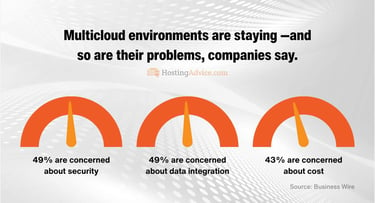
About 90% of companies now operate in multicloud environments. And yet, the top reported multicloud challenges today include managing security (49%), data integration (49%), and cost (43%) across cloud borders.
That shift has implications not just for enterprises but for hosting providers and IT service vendors whose clients are increasingly looking for “invisible” infrastructure that “just works.”
The real question is whether providers will see Cloud WAN as an opportunity to simplify complexity…or as yet another example of a hyperscaler taking control over broad networking decisions.
If it’s the former, Cloud WAN may not remove all the challenges of managing multicloud environments. But it could shift what providers prioritize in their infrastructure partners.
If it’s the latter, embrace it: Offering your clients a solution that Google relies on is a major selling point.