


Key Takeaways
Data4, a French company that finances and designs data centers, has been developing a system that uses waste heat from data center cooling to grow microalgae.

Described as a “circular energy economy and heat reuse between a data center and its local community,” the system will address two main issues, said Linda Lescuyer, Data4’s Head of Innovation.
“This augmented biomass project meets two of the major challenges of our time: food security and the energy transition,” Lescuyer explained.
“[W]e have the opportunity to draw on one of the most prestigious scientific communities in the world, with a common objective of a circular energy economy.”
By recycling CO2 into algae biomass, these high-demand data centers can do more than just power the next generation of AI. They can also do good that’s tangible.
The project launched with help from the Fondation de l’Université Paris-Saclay, whose internal initiative, ABIOMAS, focuses on researching sustainable ways to use organic materials.
Inside the Average Data Center
So, why microalgae? It’s a good question that has a good answer.
Not only do microalgae have an absorption capacity 20 times greater than trees, but Data4 plans to use them for biofuel, animal feed, and dietary supplements.
Algae have been a topic of sustainable conversation for a while now. In this new era of AI, the timing almost couldn’t be better.
Fifty-six percent of the electricity used by data centers in the U.S. comes from nonrenewable sources – things that directly release emissions into the atmosphere.

Emissions from these facilities were linked to approximately 1,100 to 2,500 premature deaths in the U.S. from 2019 to 2023. Other communities have also reported symptoms, including migraines, hypertension, and tinnitus.
Not surprisingly, the environmental and infrastructural impacts of data centers have led to community pushback.
Since 2023, approximately $64 billion in data center projects have been delayed or blocked due to concerns over rising utility bills, water usage, noise pollution, and the loss of green spaces.
Though the concept of “saving the planet” is a phrase that can sometimes feel politicized, the larger impact won’t stay out of sight, out of mind for very long.
It’s Circular by Design
Pivoting data centers toward sustainability has always been possible, though it has traditionally been through renewable energy, reducing carbon footprints, or reusing/recycling hardware.
But Data4’s research and efforts prove we can go much further.
This is about creating a full-circle, symbiotic relationship between society and the technology it’s working so hard to keep up with.
Here’s how the system works:
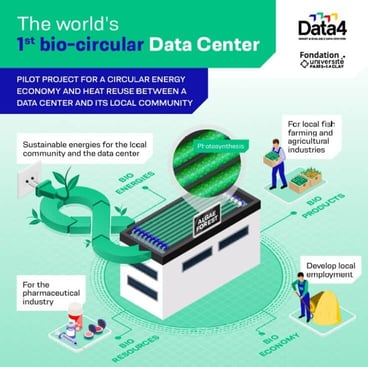
- Data centers generate a significant amount of excess heat. The system captures and repurposes what’s left over.
- The recovered heat is used to sustain unicellular algae growth.
- The algae capture CO2 from the environment, which helps reduce emissions. Data4 predicts usage in agriculture, food production, and the pharmaceutical industries.
It’s also an opportunity to drive local job creation, noted Lescuyer.
“Thanks to the biocircular data center module, we have the opportunity to create a new ecological and economic resource for the region, and therefore jobs, that can develop with the data centers,” said Lescuyer.
Data4 plans to grow the project by adding algae modules to its data center walls and roofs with the goal of producing 20 kilograms of algae and capturing 36 kilograms of CO2 per day.