


TL; DR: Discover DeepAI’s user-friendly AI tools for text, image, and video creation, designed to spark creativity and enhance productivity. DeepAI offers cutting-edge solutions like customizable image styles, interactive AI chat, and intuitive video generation. We talked with Kevin Baragona, Founder of DeepAI, about how these innovations make AI accessible and enjoyable for everyday users — and what the future may hold for similar creative AI applications.
Whenever somebody asks what I do for work, I tell them I’m a tech writer. Almost every time, the follow-up question is, “What do you think about AI?”
It’s a tricky question because there are many different types of AI. There’s the AI we never really think about (like automation for manufacturing industries), the GPTs of the internet where you can create on command, and AI-powered predictive analytics, as when Spotify makes a playlist based on your liked songs.
But I think most of the time, they’re really asking about generative AI, like DeepAI.
DeepAI is part of the revolution changing how we interact with technology, offering adaptable AI-powered tools that bring creativity and functionality to the average user.
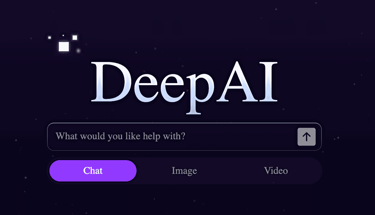
Truthfully, I love it. It’s fun, expressive, and can save a lot of time — whether you’re defeating writer’s block, creating videos for a website, or bringing a concept from your mind to life.
Kevin Baragona, Founder of DeepAI, shares that sentiment. When asked why he thinks it’s important to have these tools accessible to the general public, he said he wasn’t sure if he’d consider it important — but instead, more of a simple way to fulfill creativity and innovation.
“I would say it’s something people want more than need,” he said. “Is making a movie important? Maybe, but most of the time, it’s something people enjoy or find useful. And that’s how we view our product suite: We’re building tools that people really like.”
From Developer Tools to Consumer Solutions
DeepAI’s user base grew 15 times between 2017 — the year DeepAI was founded — and 2023. Part of this growth is attributed to its shift in focus on developers during its early period toward the average consumer.
“For the first couple of years, we were effectively a collection of deep learning-based tools for developers,” Kevin recalled. “As far as we know, we were the first text-to-image service, which we’re pretty proud of.”

Over the years, DeepAI has pivoted to becoming a suite or collection of tools that are still deep learning-based but now cater to the average consumer with text, images, and video options.
“Now that we build tools for everyday people, it’s quite exciting,” Kevin added.
Speaking of its product suite, here’s what you can do with DeepAI:
- AI Chat: Ask the chatbot for assistance with various activities such as editing, writing poetry, trivia games, code generation, and news updates.
- AI Image Generator: Type in your prompt and select the model (Standard, HD, or Genius), preference (speed or quality), and style (more than 100 options including cyberpunk, impressionism, and anime).
- AI Video Generator: Create 1-2 second videos (resembling GIFs) for educational, explanatory, or entertaining purposes.
- AI Music Generator: While this can’t sing “Fly” by Sugar Ray in Arnold Schwarzenegger’s voice just yet, the music generator is an excellent resource for creating original soundscapes for foley, sound effects, and background tracks for content videos.
“Our chat and image services are as good as anyone else’s,” Kevin said. “They’re very high quality, but we always work to improve our quality, and I’m excited to see once it does.”
In fact, DeepAI has plans to become more sophisticated.
“There are so many things I’m particularly excited about — improved video generators, music generators, and mobile apps,” said Kevin. “We’re also exploring tools for web designers so you can create a webpage from an image or vice versa.”
The Art — and Challenges — of Training AI
During its initial years, DeepAI focused on training large language models (LLMs). But due to the high cost of producing high-quality models, the team shifted its focus to training smaller models.
“We’re certainly very aware of the process, and we think a lot about the different models on the market, as well as their strengths and weaknesses,” said Kevin.
One of those weaknesses Kevin mentioned is hallucination.

AI hallucination is when an LLM perceives patterns or objects that are nonexistent in real life. One of the most viral topics on the internet revolves around Midjourney’s incapability to accurately interpret human hands (often adding a sixth finger or other abstract variations).
Sometimes, it’s hilarious, but sometimes, the hallucinations are dangerous — after all, misinformation already runs rampant on the World Wide Web.
“Hallucination rate is a major factor, and we care about quality,” Kevin noted. “So, before putting a model in production, we run it through a series of tests and generally only use it if it’s better than we had before. So, we’re pretty careful about what we end up using.”
Bracing for the Inevitable Human-AI Connection
Kevin said that he thinks a lot about how AI will affect society in the future. Personally, when I think about it, one movie that stands out is Steven Spielberg’s 2001 film “A.I. Artificial Intelligence.”
The movie portrays David, a robot child programmed to feel emotions, who is adopted by a couple as he struggles for acceptance from both humans and machines. Without spoiling the ending, Spielberg’s movie was ahead of its time in exploring the possibilities and challenges of AI in society.
It’s not hard to imagine a world where AI becomes advanced enough to “feel” emotions — even if it can’t truly experience them.
Instead, AI can learn to emulate emotions through standard thought processes. It might respond defensively to a rude user, for example. Or it could go as far as Microsoft’s chatbot, which confessed to falling in love with its users.

“When you consider how much the world has changed due to the internet and social media, introducing thinking machines that act human-like could be utterly transformative in ways I think are very hard to predict,” Kevin said.
Kevin also anticipates that while text-based bots currently dominate the market, the next generation may feature multimodal models that surpass text in expressiveness.
An evolution like this may provoke a societal discussion where it’s our turn to decide how much humans are willing to accept robots.
“If a text chatbot can reach a product market fit for a billion people, I can only imagine what a natural-sounding computer with full emotional depth will be like,” Kevin commented. “I suspect AI personalities will be rapidly integrated into our society, where we’ll have to handle classically sci-fi questions like, ‘Do they have souls? Should they have rights?’ much sooner than we might expect.”
Whether robots will eventually become our next-door neighbors or participate in elections in the future, for now, you can play with the unlimited possibilities of generative content and art with DeepAI.