


TL; DR: Managing data at the edge can feel like juggling too many tasks, especially for remote small-to-medium-sized businesses (SMBs). Edge solutions provider StorMagic recently released a new version of its product, SvHCI 2.0, which simplifies edge computing with hyperconverged infrastructure that boosts flexibility, reduces costs, and easily integrates with existing hardware. We spoke with Bruce Kornfeld, Chief Product Officer of StorMagic, about how the new features make managing on-site data easier than popular alternatives, such as VMware.
I get extremely frustrated when my internet doesn’t work. Not just because it’s inconvenient — but because I really want to know what I’m paying all this money for if it doesn’t work when it’s supposed to…which should be all. the. time.
But with the popularity of edge computing in today’s digital era, I realized that it doesn’t always come down to corporate greed or false advertising and trickery. It’s really more about the limitation of the network’s reach.
WiFi routers, smartphones, security cameras, and sensors are all examples of edge devices. They’re called edge devices because they operate on the “edge” of a network — not in the sense of being out of service, but because they’re located at the point where data is generated and used.
Take remote desktops, for example. Let’s say you’re working from home on your computer. In this scenario, your computer would be considered an edge device because it’s where data is created, processed, and used.
Edge computing keeps data processing closer to the source, like when your home computer uses remote desktop software. Instead of sending everything to faraway servers and waiting for it to bounce back, everything is done at the source. The idea here is to reduce latency.
But when something in edge servers isn’t working — like when your connection to the central system has issues — it can cause delays or outages. And then suddenly, your Zoom call freezes mid-sentence, or the files you need take forever to load.
That’s why edge computing setups need to be reliable and well-designed to keep everything running just right. And that’s the issue StorMagic wants to help small businesses and growing companies solve.
In fact, this edge solutions company just rolled out an upgraded version of its full-stack hyper-converged infrastructure (HCI) product, SvHCI 2.0 — a compelling alternative to virtual machine (VM) solutions, like VMware.
“The demand for alternative hypervisors is booming,” said Bruce Kornfeld, StorMagic’s Chief Product Officer, referring to one of the most famous hypervisor brands, VMware. “SvHCI 2.0 introduces new capabilities that make it even easier for customers to manage their HCI infrastructure and keep applications running — all at the lowest possible cost.”
Lowest possible cost? If I ran a business, that would sound good to me.
The Future of Edge Computing?
Founded nearly 20 years ago in 2006, StorMagic is a UK-based company that specializes in software-defined storage and edge computing solutions. Specifically, it services companies, from small businesses to remote enterprises and everyone in between, that need help with better connectivity and infrastructure.
Mitch Ashley, VP and Practice Lead of DevOps and Application Development for the research company The Futurum Group, said StorMagic’s introduction positions it as a “key player in the market.”
StorMagic has two main products:
- SvSAN: SvSAN is a virtual Storage Area Network (SAN) solution designed to provide high availability and storage virtualization. It allows users to create a virtual SAN using their existing server storage.
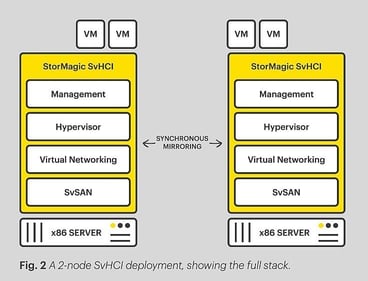
- SvHCI: Designed to be deployed on a single server (or two servers for high availability), SvHCI is a full-stack hyperconverged infrastructure (HCI) solution that combines computing, storage, and networking into a single system.
And why we’re here today is to talk about StorMagic’s newest version of its full-stack hyperconvergence infrastructure product, SvHCI 2.0, which was launched in early 2024.
Designed to help businesses run applications and manage data on-site easier and faster, SvHCI 2.0 is built to be a cost-effective, easy-to-use option for SMBs and edge environments, with the potential to save customers up to 62% on software costs.

Basically, you get the performance and scalability you need but at a price that leaves room in your budget for other things. It’s also designed to be compatible with existing hardware, so there’s no need to make adjustments and investments to make the new solution work.
More specifically, this release introduces new features, including VM Snapshots, Edge Control Monitoring and Management, and VM Import capabilities, all designed to make data storage easy for everyone to understand without having to know all of the techy jargon that even I dislike.
Making Edge Computing More Accessible
Before we talk about the SvHCI 2.0’s features, let’s talk about hyperconvergence infrastructure. I know — it’s a mouthful, and if that term alone makes your head spin, don’t worry just yet.
Hyperconverged infrastructure is akin to bundling everything you need to run your IT systems into a single, easy-to-manage package. Traditionally speaking, you’d have separate pieces: one for computing (servers), one for storage (hard drives), and one for networking (switches).
HCI combines all of these into one system through a manageable software interface. And, with edge computing, hyper-converged infrastructure can be deployed closer to the source.
While hypervisor solutions, like VMware, have specialties that lie in managing virtualized workloads in large, centralized data centers, it’s not always the best fit for edge computing, which requires more distributed, flexible setups.

HCI is a bit more straightforward but way more scalable: Just add more units when you need them.
“HCI is a great way to run applications and store data on-site to save time, money, and resources,” Bruce said.
Think of it like a smartphone: Instead of carrying a separate camera, GPS, and MP3 player, it’s all built into one device. HCI does the same thing for IT.
Bruce also added, that for anyone looking to transition from VMware, “StorMagic can help a customer transition using the exact hardware configuration they already have with very minimal downtime.”
OK, now let’s look at SvHCI 2.0’s features:
- VM Snapshots: Take snapshots of all your VMs to easily roll back software updates and keep point-in-time records for better data protection.
- Edge Control Monitoring and Management: This cloud-based tool lets you manage all your SvHCI systems from one place, whether you have a few or thousands of remote edge sites.
- VM Import: Switching over? Easily migrate your VMware VMs to StorMagic SvHCI without the expected hassle.
There are a few other added features, too: You can connect more virtual devices for added flexibility and run more VMs on one server. Intel VROC also lets you manage storage through your server’s CPU, so you don’t need to invest in any extra equipment.
But the Edge Control Monitoring and Management feature is a particularly much-needed one. If you’re a visual learner like me, having a tool that can literally show you your resources is a game changer.
“Edge Control is a one-stop shop to help customers manage their entire fleet of StorMagic HCI deployments, regardless of location. It includes a cloud-based management console that provides management and control for any system using StorMagic software,” Bruce explained.
Initially, Edge Control was set to be part of StorMagic’s SvSAN — the hyper-converged storage product that works with hypervisors like vSphere and Hyper-V. But StorMagic decided to include it in the latest SvHCI release so customers can manage both products from the same web browser.
Easy peasy.
The Growing Demand for HCI
StorMagic has been around the block once or twice in the past two decades, so it comes as no surprise that this new product is an answer to its customers’ needs.
For big companies, edge locations can be anywhere: retail stores, factory floors, offshore rigs, remote workers’ homes. For smaller businesses, it may be things like IoT devices, in-store systems, cloud services, or storage and databases.
No matter the setup, they all need reliable data processing, performance, and management.
That’s why StorMagic connects directly with its users.
“Before we built SvHCI, we had extensive live meetings with end users and partners to get their feedback and prioritization of features,” said Bruce.
So StorMagic developed the SvHCI Global Beta Program, an in-house initiative where customers could try new features and share feedback. StorMagic used this program to gauge customer interest and more than 95% said they were ready to explore a VMware alternative.
I also think it’s worth mentioning what Mitch — the analyst from The Futurum Group — said. We briefly touched on the company earlier, but The Futurum Group is a global technology research and advisory firm, and it recently published a white paper diving into the ins and outs of StorMagic’s new tool.
And it seems the consensus is in.
In a press release, Mitch said: “Enterprise edge and SMB customers looking to migrate from the escalating costs of virtualization technologies…should seriously consider a move to SvHCI as an effective transition path to modern, more efficient data management.”
The bottom line is that SvHCI 2.0 has the potential to be much cheaper than what you may already be using. It will be available for purchase soon, and annual pricing starts at $2,049 for single-server configurations.