


Key Takeaways
- .eco recently announced it’s offering carbon footprint tracking for .eco TLDs, possibly setting a new precedent for climate accountability in the web sector.
- With the growing energy demands of genAI, web hosting providers face pressure to adopt more efficient practices.
- .eco carbon footprints are measured by the DNS traffic each domain gets per month. Reports are also GHG Protocol-compliant.
For the first time in the web infrastructure world, the .eco TLD now lets users track their domains’ carbon footprints.
The move is part of .eco’s mission to increase climate accountability across the internet.
Owen Rogers, .eco’s CTO, has warned that the massive computational demands of genAI are the culprits of newfound mass energy usage.
While tracking carbon footprints for domains may seem like small potatoes, it’s still one that could influence others.
By quantifying emissions at the domain level, .eco has unequivocally set a new bar that other infrastructure providers can follow.
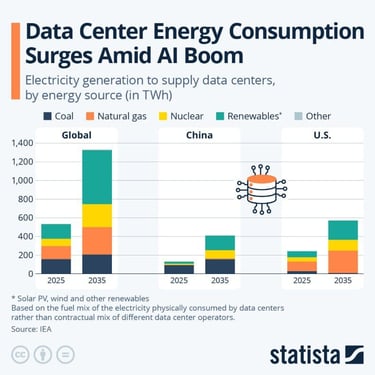
The issue is that hyperscale data centers consume massive amounts of electricity and water. And, with new data centers constantly springing up, the strain is only compounded.
As .eco’s CTO, Rogers has been vocal about the growing energy demands of digital infrastructure, especially in the age of AI.
He stressed there’s an urgent need for sustainable choices in how we power the web: “In the rush to bring new data centres online, sustainability is taking a backseat to speed.”
“That’s why it’s now more important than ever for us to choose internet service and web hosting providers that run on renewable electricity and prioritize energy efficiency,” said Rogers.
Using Sustainability as a Value Proposition
The web hosting landscape is competitive. There are hundreds of thousands of web hosts on the internet — and yet only a few names dominate the entire market.
So while some providers continue competing with one another on price and basic features, they may be missing an opportunity to stand out.
Some forward-thinking companies, including hyperscalers like AWS and Google, already recognize that sustainability is both an ethical imperative and a business value proposition.
Something as simple as partnering with registries that prioritize environmental initiatives, such as .eco domains, is a press-worthy feature.
So pay attention, hosts: Now may be the best time to get ahead of what could become the next big race.
How .eco Carbon Footprints Are Calculated
On average, retrieving and delivering a single search or website visit can transfer around 1 GB of data and consume about 0.06 kWh of electricity.
That’s enough to:
- Power a 60-watt lightbulb for an hour
- Keep a 6-watt LED light on for 10 hours
- Fully charge a smartphone 2 to 3 times
It may not seem like much, but try multiplying that by billions of users browsing the internet daily.
With this in mind, the registry calculates the carbon footprint of each .eco domain based on its share of DNS traffic.
If you have a .eco domain, check your carbon footprint here.
This data tracking also follows the GHG Protocol standards for carbon reporting. Specifically, .eco recommends organizations count it under Scope 3 for indirect emissions.