


TL; DR: “Have you tried unplugging it and plugging it back in?” The days when this was the solution to a technological problem are gone because now you have TestGrid.io. TestGrid is an all-in-one solution for testing just about anything for your software or app, including cross-browser or codeless automation. We talked with Junaid Ahmed, CMO of TestGrid, about how far TestGrid has come since its inception in 2015, thanks to its strong focus on developers’ needs.
I distinctly remember when NASA’s Mars Climate Orbiter got lost in space in 1998. It cost $125 million to build — a pretty penny for NASA, which was already on a budget as it was funding the International Space Station at the time.
By 1999, NASA had lost all contact with the robot, and it became clear that it was either destroyed in the Martian atmosphere or had escaped the vicinity altogether. I remember asking whether aliens had gotten to it, but when I got some clarification, I was severely underwhelmed.
Apparently, there was a software error that caused the orbiter to get lost in space. More specifically, there was a mismatch between metric and imperial units that likely caused the robot to sail too far from the intended trajectory.

Though it would have been more exciting if aliens had caused the Orbiter to disappear, this story is just one example of what happens when you don’t test your software before launch. Since then, we’ve seen plenty of cyberattacks, breaches, and malfunctions because of poorly tested software.
You may not be building the next Orbiter, but if you’re putting out software of any kind, you need to make sure it’s been thoroughly tested with things like functionality, user interface, and end-to-end testing. These types of tests are the kinds of solutions that TestGrid.io offers.
Trusted by hundreds of startups and Fortune 500 companies, TestGrid’s CMO, Junaid Ahmed, credits this versatility and success to its customers. He said it best: “Our solutions are built entirely on customer feedback — and that’s why our platform is what it is today.”
From Scriptless Beginnings
TestGrid was founded in 2015. Since then, it’s completed more than 20 million tests for its customers.
But before it became what it is today, TestGrid was developed as a scriptless, or codeless, testing platform, which typically uses graphical user interfaces (GUIs), like drag-and-drop functionalities, to create automated test scripts.
“This kind of platform is something QA testers use when developing websites or mobile applications to test what they’re building,” Junaid explained.
By 2022, TestGrid transformed into an all-in-one testing infrastructure provider. Today, it integrates several testing features into one platform.
Here’s a full glance at the tests you can perform with TestGrid:
- Codeless automation
- Mobile app automation
- Real device testing
- Cross-browser testing
- Performance testing
- Cypress testing
- IoT testing
- Visual testing
Pricing ranges from $0/month to $30/month with custom prices for enterprises.
“The market wasn’t untapped, but we unified this market by creating all those features in-house and bundling them into the platform,” Junaid said. “Now, you don’t need to go to different platforms for different types of testing. TestGrid offers all the testing features you need in one ecosystem.”
Cross-platform testing is super easy and accessible, too. Junaid said all you have to do is sign up and do it on the TestGrid site. Cross-platform testing is necessary because people may be using different browsers, operating systems (OSes), and locations; you can verify compatibility and performance, whether it’s Windows versus Mac or Chrome versus Edge.
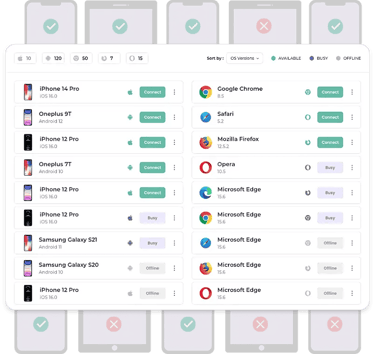
“Let’s say your QA tester needs to check how the website looks in Edge but only has access to Safari,” said Junaid. “They can sign up on the TestGrid platform, create a free account, fire up a machine with an Edge browser, and test how the website looks as if it were on their own device. It’s a real machine loading the real website.”
I don’t know if anyone else sometimes thinks about the days before cross-web fonts. Now, we have web-based fonts, so they’re visible no matter the device you’re using, like Roboto or Open Sans. But in the aughts, a font on a website would appear differently depending on the device.
Junaid shared that since this pivot, TestGrid has seen about 10 times the revenue compared to when it was a scriptless platform. He again attributed this to the value of customer feedback, adding, “We interact with our customers daily and weekly, taking their suggestions seriously and building the product around their needs.”
Simplifying Testing with TestOS 2.0
Getting tests done on your software is like putting gas in your car before going on a long road trip: If you want to avoid inevitably breaking down later, make sure your software is in good shape first.
“If you’re a QA tester with a website or an app, how do you ensure it works consistently for someone accessing it from India on a Mac versus someone in Australia on a Windows device?” Junaid noted. “What do you do to ensure your website provides a perfect digital experience to your users?”
This is where a platform like TestGrid comes in.
TestGrid recently released TestOS 2.0. TestOS 2.0 is a codeless way to test mobile apps and websites for visual compatibility or performance bugs on any device, resolution, OS, or browser at once.
Depending on the plan, this is what you get with it:
- Automated visual testing: AI-powered visual validation for flawless UI and UX
- Record and play: Record your browser or app actions and let TestOS generate robust automated scripts
- TG tunnel: Debug unreleased apps and websites securely from your local machine
- Performance testing: Simulate global locations, new UI, and detailed reports for pinpoint analysis
- MDM support: Enhanced data security with individual device PINs (Enterprise feature)
- Image injection: Test image capturing, QR code, barcode scanning remotely on real devices
- Biometric authentication: Validate fingerprint and face recognition securely on real devices
- Integration with Jira and Slack: Streamline workflows. Submit defects directly from TestGrid to Jira, Slack, and other popular CI/CD tools
The biggest plus is the support it offers for larger organizations with a multicountry presence (think global companies like Amazon, Facebook, or AT&T). This support is helpful when making sure content is correctly displayed and connectivity is working across different geographical locations.

“They need to test their data reception in different locations worldwide. They procure devices from TestGrid, host them on their optimizers, and use our software to test their network and internet receptors,” Junaid said. “This helps them understand the performance before launching anything in a specific area or region.”
But it is not just devs for cable companies who use TestGrid; Junaid shared that typically, two main types of people use the platform: manual and automation testers.
Manual users perform testing without coding, and automatic testers use tools and frameworks, such as Selenium, Appium, and Cypress, to write and run scripts.
But Junaid said there’s a third category that is emerging — codeless automation testers, which is for both the manual and automation testers, where “whatever they record is turned into code or test steps that can be reused to ensure there are no bugs.”
Whatever your way of testing, TestGrid is versatile enough to meet those requirements.
Meet CoTester, Your New Best (Test Case) Friend
TestGrid’s newest product, CoTester, is the world’s first AI agent for software testing.
The company didn’t just create this out of thin air, though; Junaid explained that after months of surveying its customer base, there was one main consensus: Writing test cases takes a lot of time.
“The idea behind creating Code Tester is to ensure everything is done on one platform, augmented by AI. With CotTester, we created a chatbot where you can use plain language,” Junaid explained.
Unlike general-purpose chatbots, CoTester is created explicitly for testers and developers. The large language model (LLM) capabilities behind CoTester lets it pull from an entire database of information, including software fundamentals.

I write about AI pretty much every day, and anyone can employ it; it’s just nice to see it done with such a niche purpose.
Here’s what you can do:
- Perform tasks: Create test cases, run tests on devices and browsers, find and assign bugs, take notes, and set tasks and reminders
- Generate test cases: Pre-trained on advanced software testing principles streamlines the process, as it learns from each test, bug, and performance issue, replicating them to make sure they’re fixed before deployment
- Integrates: Integrates easily with project management tools such as Slack, JIRA, Asana, MS Teams, and more, as well as testing frameworks including Selenium, Appium, and Cypress
Next, Junaid shared that TestGrid is working on adding Salesforce application testing capabilities, driven by customer feedback.
“Our goal is to automate testing for Salesforce websites and applications, and this feature should be out soon,” Junaid shared. “Tests should run better and faster without latency, and we’re resolving any bugs along the way.”
Personally, I’m excited about a future with fewer technological errors… and hopefully, the days of having to restart your computer and hoping it fixes the problem will be behind us.