


Key Takeaways
- Cloudflare built Kitesurf in about 12 weeks as an agent-only browser that runs entirely on Workers, with no window, no tabs, and no human users.
- Kitesurf uses 3 to 7 times less CPU and memory than Chromium, and infrastructure bills are priced on exactly those two resources.
- Existing Puppeteer, Playwright, and MCP automations can switch to Kitesurf without code changes, and the beta is free through Browser Run.
The question no one had ever considered until agents started doing the browsing was: Why does software need to scroll at 60 frames per second?
The reason is because it must satisfy human users who require tabs, extensions, themes and perfect rendering of every pixel. But an agent retrieving product documentation does no scrolling, no theming, and has no appreciation for your CSS transitions.
It’s why on August 7, Cloudflare released Kitesurf, a browser that eliminates all of the above. It’s fully agent-only with no window, no tabs, and no involvement of human users. Instead, it operates entirely on Cloudflare Workers with complete isolation of each page within a separate V8 execution context.
Built in 12 Weeks, Rendered in WebAssembly
To do this, Cloudflare adapted Obscura, an open-source, Rust-based, headless browser engine, for use on Workers. This required approximately 12 weeks of effort, according to TechRepublic, and produced a browser that incorporates a modular rendering engine based on Blitz, on the Firefox-Stylo implementation of CSS and on the Boa implementation of ECMAScript, all compiled to WebAssembly.
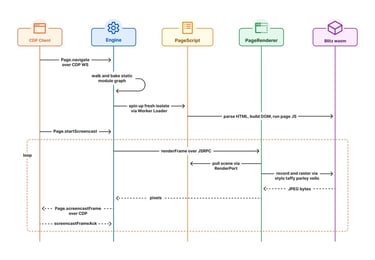
It’s a system that’s as much fun as it is technically exciting. The browser already satisfies more than 215,000 Web Platform Tests, the standard conformance requirements for web browsers, and adds several hundred additional tests each week. It provides correct rendering of Wikipedia, the web site for Hacker News, the TodoMVC benchmark application, the Cloudflare blog, and much of the Cloudflare dashboard.
The Numbers That Matter Are on the Invoice
Cloudflare also removed much of the rendering and visual functionality a human-first browser needs, instead optimizing the browser to extract webpage content efficiently for AI agents. Every time an AI agent browses the web, Cloudflare assumes the webpage could be trying to trick or manipulate the AI.
As a result, the consumption of computing resources is much less than for a commercial browser based on Chromium: For a test corpus of 14 web pages, CPU utilization for production of screenshots was 3.1 times lower and for production of HTML output 3.8 times lower than for Chromium. Memory requirements for screenshots and for HTML output were 4.7 and 7 times lower, respectively, according to benchmarks performed by Cloudflare.
Kitesurf's resource savings vs. Chromium
Chromium may finish individual tasks faster, but Kitesurf uses significantly less CPU and memory. For providers running large numbers of AI agents, that efficiency could matter more than raw browser speed because the same hardware can support more simultaneous sessions.
Costs are based on CPU and memory, and 3- to 7-fold lower resource consumption provides a substantial increase in the number of simultaneous sessions.
Kitesurf may be slower than Chromium, but it uses far fewer resources, allowing providers to run more AI agents simultaneously without paying for a separate, resource-heavy browser instance for each one.
Your Puppeteer Scripts Don’t Have to Know
Kitesurf implements the Chrome DevTools Protocol and thereby permits continued use of Puppeteer, Playwright, and any MCP client that supports CDP without requiring any changes, TechCrunch reported.
Cloudflare says existing implementations of AI agents from Chromium can be migrated to Kitesurf within about one day’s work. The service is available at no charge during the beta period.

Kitesurf will be made available as open-source software once it’s mature enough. This will allow customers to run the software themselves rather than relying on Cloudflare’s infrastructure.
Four Agentic Launches in 10 Days
The Kitesurf launch is the fourth deployment of agent-based web technologies within 10 days, after the release of Wallets and cloudflare.pay on August 4, Cloudflare Agents the same day, Cloudflare OS on August 5, and the AEO Visibility Dashboard on August 6.
This was no accident: Cloudflare is making a claim on the layer of technology that agents use to reach the web and directly challenging the assumption that has governed automation technology since 2017. That assumption was the need of a separate instance of Chromium. Services such as Browserbase and Anchor Browser were built around providing that capability, while tools such as Selenium, Puppeteer, and Playwright continue to rely on Chromium-based automation.
In contrast, Cloudflare is offering technology adjacent to hosting that eliminates the need for Chromium instances altogether. The resulting competition is evident: Will Browserbase, Anchor or Bright Data implement a compatibility layer for Kitesurf, or deploy an alternative agent-optimized browser within 90 days? And will AWS or GCP offer their own primitive for execution of serverless agent-browser technology by year-end?
For independent developers building agent-based automation for clients — a chatbot consuming content from a CMS, an SEO agent monitoring competitor web pages, a technical support bot accessing documentation — the browser has certainly been the most expensive line item.
The Cost Math Lands on Hosts Too
Kitesurf changes the arithmetic mid-course of beta testing, combining cost savings and protection against system compromise. This could be major for providers of agent-managed SaaS where the browser is a major share of operational costs.
There’s an additional but largely invisible message to providers of web hosting providers and website operators. As agents increasingly rely on purpose-built tools to retrieve web content, the way websites structure that content will be more important. Clean HTML and properly implemented schema.org markup gives those agents something useful to work with, which is the purpose behind Cloudflare’s newly released AEO Visibility Dashboard.
It will be worth watching whether the promise of open-source technology is fulfilled before year-end and whether the mode of self-hosted implementation will accompany it. Finally, Cloudflare has delivered a browser that will never be seen. But if expectations are on the right track, it will soon become the browser used by all agents.