

Key Takeaways
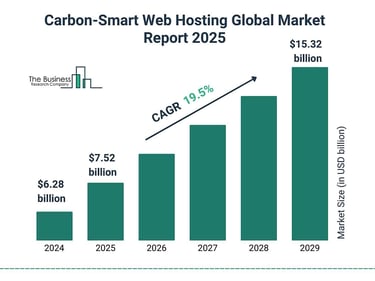
A new report by The Business Research Company predicts that the carbon-smart hosting market — web hosting services that reduce the carbon impact of data centers and servers — will double from $7.52 billion in 2025 to $15.3 billion by 2029.
The major growth is mainly thanks to the heavy computing demands caused by video streaming. Video sites are, naturally, among the most energy-intensive clients that hosts serve.
The IEA estimated that in 2024, data centers consumed about 415 TWh of electricity, which equals to about 1.5% of global electricity demand.
For perspective, those numbers could be far higher if the industry were still running on more “traditional” sustainability methods. But there have been leaps and bounds of improvements in cooling efficiency and workload distribution that have kept energy usage more stable, even as streaming exploded.
But with that explosion — that is, AI-driven energy systems, edge computing, and sophisticated data centers — the report notes that 2025’s investors, consumers, and governments are now demanding measurable progress.
And that’s forcing service providers to respond with new tools and smarter infrastructure.
Where the Growth Is Happening
A decade ago, carbon-smart infrastructure was perceived as an “add-on” — one only required for companies that had to meet specific ESG requirements.
Now, the landscape around green hosting has changed. At the federal level, new mandates and incentives have also inspired investment, which explains the federally and privately funded projects in Quebec, wind farms in Texas, and solar expansions across the Southwest.
Still, this isn’t hitting everyone yet — not even Data Center Alley. Virginia’s data centers still remain heavily dependent on natural gas and nuclear, while renewables make up only about 12% of in-state generation, as of 2023.

As a result, the state’s residents have been taking a proactive role to enforce zoning controls, which decides where data centers can operate and how much strain they put on local grids.
But Virginia is just one example: Similar demands have been happening in Iowa, Arizona, and Ohio.
These instances are what’s forced U.S. hyperscalers and hosts to look for better workarounds, such as PPAs with wind and solar farms to even “carbon scheduling,” which times workloads around cleaner grid hours.
Meanwhile, in APAC — the fastest-growing region for carbon-smart hosting — the idea is more about modernization. It’s simple: The region’s digital infrastructure is scaling so quickly that sustainable choices are automatically built in from the beginning instead of being implemented later.
In fact, the APAC green data center market is projected to grow at a 20% CAGR. Foreign cloud partnerships play the role here, where American hyperscalers like AWS and Google are building in new territories, such as Thailand and Malaysia, with sustainability already built into their plans.