


Key Takeaways
- AI is making web design more accessible, but a new survey suggests that it’s also making web design and building more unpredictable.
- Designers say client expectations are getting harder to manage because AI-instant deployment makes users think web building should be instant.
- With hosts now commoditizing these services, they’re the ones that act as the face for what they didn’t build.
A new survey reveals that most web designers agree that AI is concerning for the future of their industry. And it’s not because AI is going to replace them.
Almost 70% of respondents agreed that managing client expectations has been one of the most difficult parts of the job. A major factor is the rise of AI-generated promises — you know, such as instant websites and automated content solutions.
Low-to-no-code builders have, unfortunately, convinced clients that websites should always be instant, cheap, and effortless. While AI builders lowered the barrier to entry, it also raised the bar for what end users think “good enough” actually is.
Almost all of it comes back to the same issue: Clients don’t really understand what goes into building a website. Because when you break down how designers actually spend their time, it’s a lot less design than you’d expect:
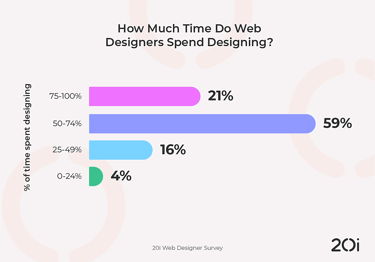
- 59% spend 50-74% of their time designing
- 20.8% spend 75-100%
- 16.6% spend 25-49%
- 3.6% spend under 25%
Clearly, a huge chunk of web designers are spending a meaningful chunk of time not designing. They’re spending other hours doing behind-the-scenes stuff that clients never see, like fixing layout issues, optimizing images, and debugging plugins.
An Instant-Website Hangover
The survey — led by hosting provider 20i — found that designers say clients are mainly focused on how fast and how cheaply a site can be built, which ultimately leaves less room for other important factors.
As in, the things that actually make a site work:

And you know who this falls to? It looks like this is what a lot of people are talking about out loud.
If, for example, a site loads slowly or a page built with an AI tool looks fine on desktop but falls apart on mobile…it’s the hosting provider who’s the face of the platform.
As AI brings more people online — regardless of their skill levels — hosts are the representative of the entire website building experience, from marketing to app building and security and everything in between. Some of these may be things they didn’t even build themselves, like the design templates and elements.
At the same time, while designers can have creative freedom, support is something that needs deep education about the product and platform — at least, enough to make a very in-depth knowledge base that is extremely referential. Designers say the biggest forces shaping the future are:
- increasing use of AI: 76%
- rising cost of tools and software: 46%
A single tool might run $20 to $100 per month, but most teams aren’t using just one. Stack a few together — plus API usage and maintenance — then that “cheap/low-cost” build that brought in customers is costing hundreds or even thousands a month to keep running.
The Burden Literally Nobody Asked For
There is some good news, though. Lloyd Cobb, director at 20i — which ran the survey — said clients haven’t totally abandoned human expertise.
“Our data shows that while competition is intensifying, clients still recognize the value of expertise,” Cobb told us. “AI can generate images, but it can’t yet replicate judgment, creativity or commercial understanding.”
This much is clear: The job outlook is still pretty good for web designers, with nearly 80% agreeing they feel they’re being paid enough for their jobs.

Ironically, the demand for AI is what’s keeping web developers in business. It’s just harder to keep up with the cost and competition that come with it. And that’s leaving room for a different kind of expertise. Cobb points to areas like UX, performance, and measurement. As in, the parts of the job AI still doesn’t handle well.
“The designers who will thrive over the next decade are those who move beyond execution and position themselves as strategic partners,” he said.
Sure, AI is creating more websites, but not necessarily better ones. That’s where designers are holding their job security — perhaps not as builders per se, but as the editorial guards.
In fact, analysts at Gartner have long pointed to the rise of non-technical builders, warning that platforms need stronger guardrails and guidance. And hosts need to, as per usual, get ahead of it.
It may mean setting expectations clearly at onboarding — not scaring off leads, but flagging performance and mobile issues before clients notice them, and offering real fixes. Not just support teams or bots that solely rely on KB articles, but support that actually understands what’s happening across infrastructure, design, and security.