

Key Takeaways
When we covered WP Engine’s AI agency data, the message was clear: Agencies are investing in tools, training staff, rewriting internal policies, and redesigning client sites for a web where AI is now part of the audience. But what are hosts supposed to do with this information?
Well, Liza Adams told us she may have the answer.
As an AI advisor and GTM Strategist, Adams was the keynote speaker at WP Engine’s DE{CODE} 2026 on May 6, a free virtual event built around how industries are moving into the era of the “Intelligent Web.” Her research goes straight into the question hosts should be asking: Are my clients showing up in search, and what is AI saying about them when they do?
“AI isn’t ranking your content,” Adams warned. “It’s forming an opinion about you. That’s a brand reputation problem, and treating it like a ranking problem will keep you stuck.”
AI Has Opinions Now?
To prep her DE{CODE} session, Adams ran a buyer scenario across three major AI platforms — think “what’s the best managed WordPress host for a growing eCommerce brand” — and each one returned entirely different results and described the same vendors very differently:
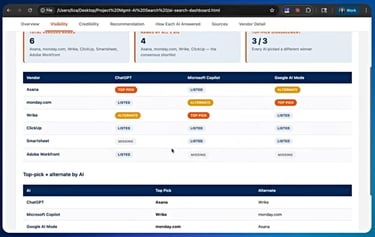
Adams breaks it down into three pillars:
- Visible means AI knows your client exists
- Credible means the signals about them hold up across sources
- Recommended means AI matches them to the right buyer at the right moment
“AI pulls from sources it can read and grab quickly. If your site is hard to parse or slow to load, you won’t make the answer. Machine-readability now helps you get on the shortlist,” Adams explained.
Fast Gets You In, But Trust Gets You Picked
If more than 70% of agencies are already adjusting their development practices to better serve AI systems, hosts who aren’t thinking about this yet are already several steps behind their own customers.
No doubt does performance still matter — that’s not what Adams is saying. What she is saying is that there is a line to draw between what speed does and what trust signals do.
Agencies Are Already Building for AI
More than 70% of agencies are adjusting development practices to better serve AI systems.
“When AI gets live content to answer a question, it makes a resource-allocation decision in milliseconds. A slow or unresponsive site won’t be in the answer. There’s no SERP page 2 to fall back on,” Adams explained.
Basically, a slow site may never make it into an AI-generated answer because the system prioritizes grabbing information fast. What happens after is where hosts should be focusing.
“Beyond raw performance, AI looks for signals that say your content is worth trusting: clear authorship, transparent sources, and being backed by trusted voices,” Adams said. “AI is judging your credibility before any human reads what you wrote.”
Hosting providers should probably be having this conversation with thier clients now: Let them know that it’s not about “showing up” in SERPs anymore. Instead, it’s about trying to make sure AI understands your brand, trusts your content, and represents you accurately in SERPs/AI answers.
If Clicks Are Outdated KPIs…Then What?
There is a teeny problem for those who are used to tracking clicks: Since AI can recommend a brand before anyone even visits a site, clicks alone may not be the right KPI. This is the ROI problem that WP Engine actually flagged in our recent coverage, with 12% of agencies saying unclear returns are their biggest challenge.
Adams has some advice: “Run many structured queries across the major AI platforms and document how your brand shows up. How often does it appear? What’s said about it? How does that compare to your competitors? Do this monthly and you build a baseline.”
“Run many structured queries across the major AI platforms and document how your brand shows up. How often does it appear? What’s said about it? How does that compare to your competitors? Do this monthly and you build a baseline.”
So for example, if someone sees a brand mentioned in an AI answer, they may then search for that brand later instead of clicking directly through the AI tool at that moment.
And when users do arrive via AI-assisted search, the traffic may actually be worth more: Adams points to SEMrush data that says AI-assisted visitors convert 4.4x the rate of regular organic traffic, likely because they already have compared options before landing on your client’s site.
But if your customers still get frustrated because of their KPIs, just remember to tell them this one thing.
“If engagement and conversion on those visits are rising, you’re gaining visibility,” Adams said, “whether or not you can trace the click.”
Watch Adams’ full DE{CODE} 2026 keynote: