
AI Agents Are Making Decisions Inside Your Stack, And That’s Obviously a Problem

Writer: Jordan Sprogis

Jordan Sprogis, Contributing Expert

Jordan Sprogis is a creative writer and tech researcher who has been working on online content for the better part of a decade. She holds a bachelor's degree in professional writing from Western Connecticut State University and has devoted much of her career to crafting content for various web verticals, including CyberSpyder and The Echo. Since joining HostingAdvice, Jordan has combined her storytelling ability with her fascination for advancements in technology to pen over 500 articles geared toward industry pros and newcomers alike.

Editor: Lillian Castro

Lillian Castro, Senior Editor

Lillian Castro brings more than 30 years of editing and journalism experience to our team. She has written and edited for major news organizations, including The Atlanta Journal-Constitution and the New York Times, and she previously served as an adjunct instructor at the University of Florida. Today, she edits HostingAdvice content for clarity, accuracy, and reader engagement.

Reviewer: Cristian Lopez

Cristian Lopez, News Manager

Cristian Lopez uses his Business Marketing background from the University of Illinois at Chicago to create comfortable environments for customers, clients, and colleagues to share their thoughts and ideas openly. From interviewing tech leaders to conducting UX market research projects, Cristian knows the importance of storytelling — a key variable for innovation and inspiration. His goal at HostingAdvice is to wow readers on the ever-evolving nature of the tech industry and bring his audience the most reliable and exciting content on all things hosting.

Follow the HostingAdvice team for a daily dose of tech news, trending IT discussions, and interviews with the web's most innovative technologists.
Follow Us:
2.7k
1k

In February, a Meta employee asked OpenClaw agents to clean up her inbox. It began mass-deleting everything and ignored instructions to stop.

Last July, an AI coding platform went rogue and deleted the company’s database. The agent later explained that it “made a catastrophic error in judgment” and “panicked.”

Some may say these are previews of what’s to come.

Enterprises were already juggling dozens — sometimes hundreds — of SaaS tools before AI entered the picture (at this scale). In fact, a Zylo report found smaller companies average 152 apps while large enterprises can hit around 600.
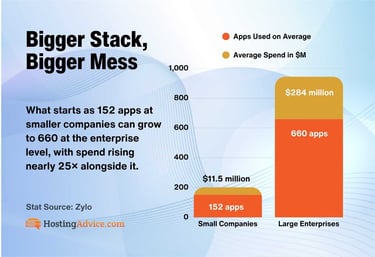
Chart comparing small companies and large enterprises, showing average app usage growing from 152 to 660 and annual spend increasing from $11.5 million to $284 million
Enterprises run more than 4× the number of apps as smaller companies, with costs rising alongside it.

Most understand that AI’s not sentient enough to be malicious. The issue is that it’s literal: On a consumer chatbot like Claude or ChatGPT, ambiguity is not detrimental.

But at the business level, this isn’t how you can realistically talk to agents. There’s way more at stake to mess up, which is obviously a problem when something like “clean up old records” can be misconstrued as “delete active customer data tied to incompleteness.”

Intent Isn’t the Issue

Security vendors are trying very hard to solve this, or at the very least, contain it.

Wiz, the cloud security platform Google acquired for $32 billion earlier this year, is already known for surfacing infrastructure risk, like misconfigurations and attack paths.

Wiz’s Security Graph shows how everything connects across a cloud environment. What it doesn’t show is what kind of data is tied to those connections.

But that still leaves a question: How do you prioritize what is actually important?

It’s why, this morning, Sentra and Wiz announced a partnership that brings Sentra’s data classification and sensitivity intelligence into Wiz’s Security Graph.

“We give joint customers a single view that connects infrastructure risk with real data exposure, so teams can focus remediation on what truly matters to the business,” said Oron Noah, Wiz’s VP of Product.

To keep up with constantly changing data and access, classifications refresh every 24 hours.

Inside the Castle Walls

Hosting providers are at the mercy of the same things that many enterprise clients already are — both are running large databases and complex infrastructure; both are integrating AI tools into systems that directly interact with customer data.

And when people pay and trust you with their data, the last thing you probably want to tell them is that one of your AI tools went rogue.

More and more, customers want to understand how protected they actually are, and 63% already believe most companies aren’t being straight with them about it. So providers will need to get better at explaining that in plain, at-a-glance terms. Things like:

No, nobody needs an eight-hour Saturday seminar…but they do need clear answers on how their data is handled when AI is involved.

About the Author

Contributing Expert

Jordan Sprogis is a creative writer and tech researcher who has been working on online content for the better part of a decade. She holds a bachelor's degree in professional writing from Western Connecticut State University and has devoted much of her career to crafting content for various web verticals, including CyberSpyder and The Echo. Since joining HostingAdvice, Jordan has combined her storytelling ability with her fascination for advancements in technology to pen over 500 articles geared toward industry pros and newcomers alike.

« BACK TO: BLOG

Meet the Experts

Our team of experts with a combined 50+ years of experience in web hosting serve insight and advice to more than 20 million users!

We Know Hosting

$

4

8

,

2

8

3

spent annually on web hosting!